You get a short text that just says IMY, and you pause. Is it friendly, romantic, or just a casual check-in?
This guide answers that in plain words.
You will learn what IMY means, how tone and relationship change it, how to use it without sounding awkward, how to reply to it, and which similar codes not to mix it up with.
Quick Answer
IMY = I Miss You
IMY is warm, personal, and casual. It is not a formal phrase, and it is not the same as saying “I love you.”
IMY Meaning Table
| Meaning | Where you see it | How to spot it |
|---|---|---|
| I Miss You | Texts, DMs, captions, comments | Sent to a close friend, partner, or family member |
| I Miss You Too (IMYT / IMY2) | Replies to IMY | Comes second, as a return message |
| I Miss You So Much (IMYSM) | Emotional texts and long-distance chats | Stronger wording, often with a sad or heart emoji |
| I Miss You More (IMYM) | Playful back-and-forth chats | A light reply that tops the first IMY |
| I Miss You Already (IMYA) | Right after parting | Sent minutes after saying goodbye |
| I Love You (ILY) | Romantic and close family chats | A different code, about love, not absence |
| In My Yard / In My Year | Very rare, local or playful uses | Only if home, place, or a year is already the topic |
| Imagine Me and You | Playful, romantic imagining | Only if a shared plan or daydream is the topic |
How To Tell What Kind of IMY It Is
IMY almost always means “I miss you.” The question is rarely what it means, but what kind of missing it is. That comes from three clues: who sent it, what you were just talking about, and what came with it.
If a best friend sends it after an old photo, it is friendship missing. If a partner sends it at the end of a long day, it is romantic missing. If a parent sends it while you are travelling, it is family missing. The letters do not change. The relationship does.
Emoji and timing help, but they do not replace the relationship. A heart emoji makes IMY warmer. A laughing emoji makes it lighter. A sad face makes it more emotional. “IMY already” right after goodbye is different from “IMY” after three quiet months, even though both are genuine.
If you are not sure whether it is romantic, do not decide from IMY alone. Look at the last few messages: were they flirty, friendly, or practical? That history is a better guide than the abbreviation.
On Instagram, a handle swap and a missing message can look alike at first glance, so check whether the person wants a username or is saying they miss you. The first is a SN meaning in text question, the second is IMY.
IMY as I Miss You
IMY is the short form of “I miss you,” used when someone is thinking about you and wishes you were closer, or wishes you were back in their daily life. It grew with SMS texting in the late 1990s and early 2000s, when short messages saved time and space, and it stayed popular after character limits disappeared because it felt lighter than the full phrase.
That lightness is the point. “I miss you” can feel heavy to type, especially early in a friendship or after a short time apart, while IMY says the same thing with less weight and lets a person be honest without making the message feel dramatic. It works best in one-to-one chats, where the other person already knows you: “Haven’t seen you in forever, IMY,” “Long day, IMY,” and “Good luck today, IMY” are all natural uses. IMY does not need a long explanation after it, but it does need a real connection behind it. Sent to a close person, it feels warm. Sent to someone you barely know, it can feel too close, too fast.
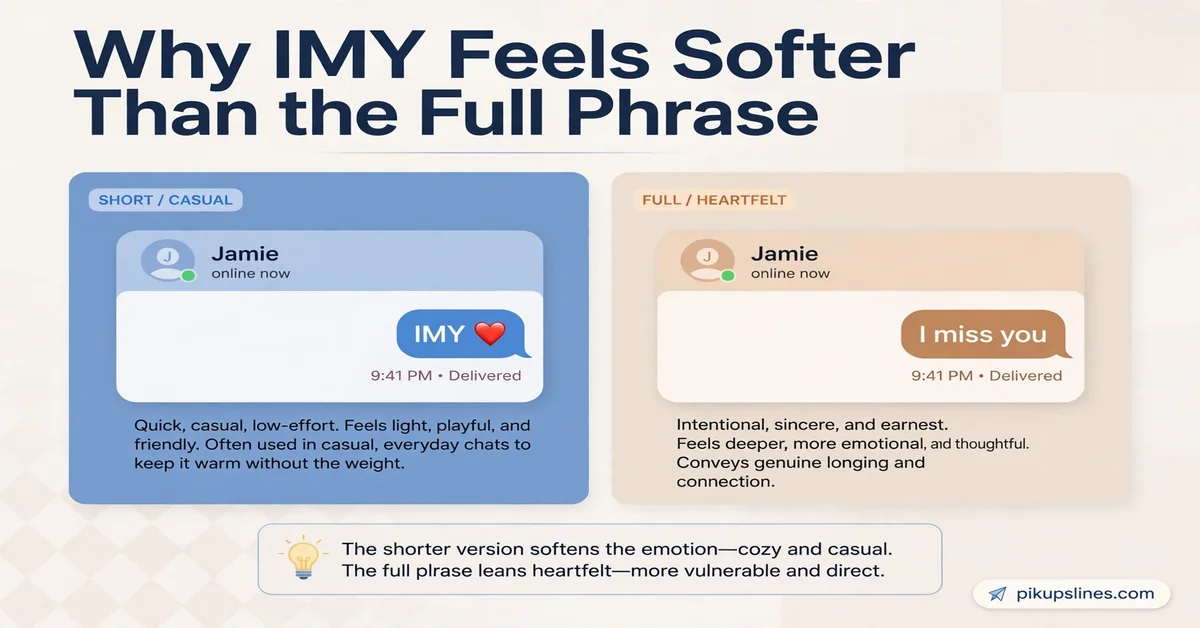
Why IMY Feels Softer Than the Full Phrase
Competitors often say IMY is just faster, but speed is only half the story. The other half is softness. Saying “I miss you” out loud carries real weight, and that weight can make the sender feel exposed, especially if they are not sure how the other person feels. IMY removes that pressure: it says the same thing, but it gives the other person room to answer casually instead of matching the intensity.
That softening also explains why IMY pairs so well with emoji, photos, and memories. “IMY” plus a beach photo from last summer feels nostalgic and warm, not heavy. “IMY” plus a crying-laughing emoji feels friendly, not needy. The abbreviation invites the other person to fill in the feeling from the context, which makes the message flexible.
Timing changes the weight again. IMY after a fun memory feels nostalgic, after a hard week feels supportive, and after a silence feels like a warm check-in. The same three letters can be playful, caring, or emotional, depending on when they arrive and who sends them. That is why IMY has survived since the texting era: it adapts to the moment instead of forcing one.
IMY, IMYSM, IMYT, and ILY — Do Not Mix Them Up
These codes look alike, but they carry different levels of feeling.
IMY means “I miss you.” It is warm and medium in strength. It fits friends, family, and partners.
IMYT and IMY2 mean “I miss you too.” They are replies, not openers. If someone sends IMY, IMYT is the natural answer.
IMYSM means “I miss you so much.” It is stronger than IMY, and it fits emotional moments, long-distance relationships, and times when the missing is the whole point of the message.
IMYM means “I miss you more.” It is playful, a light competition after an IMY. It works between close people who tease each other.
IMU is a more casual spelling of “I miss u.” It sounds lighter and more playful than IMY, and it fits quick, informal chats.
ILY means “I love you.” That is a different feeling, not a stronger version of IMY. You can miss someone without loving them, and you can love someone without missing them right now.
A simple rule helps: IMY is about absence, ILY is about love, and the longer IMY versions are about how strong or playful the missing is.
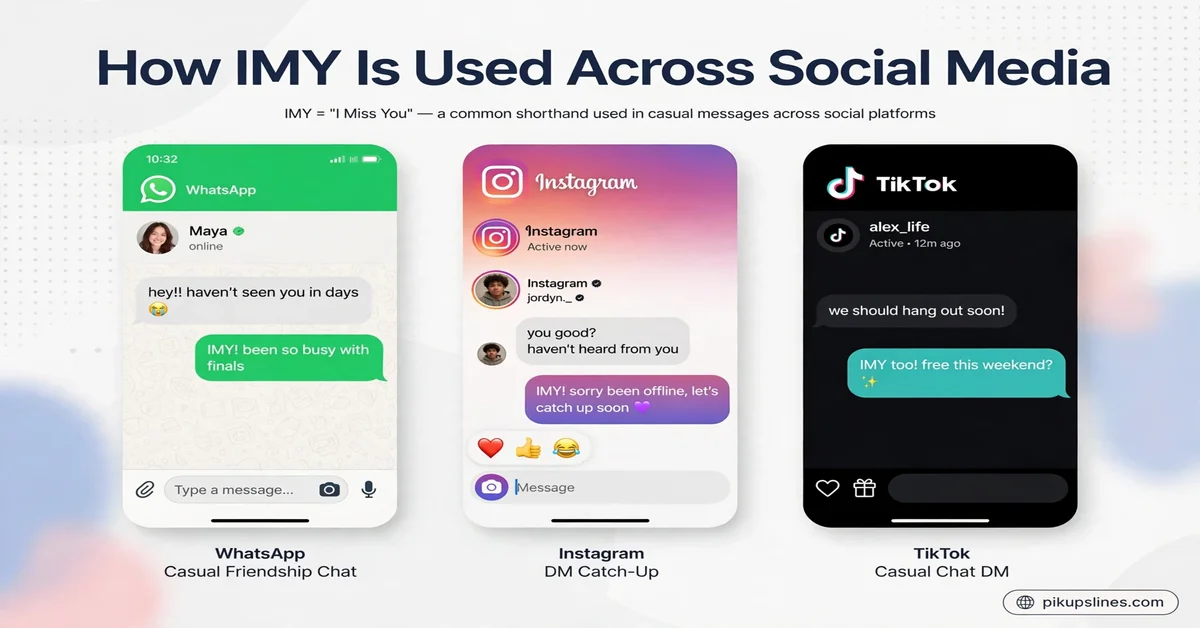
How IMY Is Used Across Social Media
IMY does not change its meaning from app to app, but where it appears changes what it signals.
On WhatsApp and in private texts, IMY is most often a direct, personal message to a friend, partner, or family member. In a group chat, it usually tags one person inside a shared memory: “We need a reunion, IMY all.” On Instagram and Facebook, IMY shows up under throwback photos, in captions like “IMY, beach days,” and as a comment on a friend’s post. On TikTok, “IMY” in a comment is usually a quick reaction to a video about friendship, school days, or a place the viewer misses.
In all of these places, IMY works when the audience is already close. A public IMY to a stranger feels out of place, because missing someone is personal. The app changes the packaging, but the feeling stays the same: someone is on your mind.
Other Meanings You Should Not Assume
In everyday texting, IMY almost always means “I miss you.” The other expansions below are real in some corners of the internet, but they are rare, and assuming one of them in a normal chat will usually be wrong.
“In My Yard” and “In My Year” appear in some playful or local uses, for a home or a year already being discussed. “Imagine Me and You” shows up in romantic or daydreamy contexts, usually when a shared plan is already the topic. None of these appear without strong context pointing to them.
If you mean one of these rare meanings, spell it out in full the first time. Do not make a friend guess. And if someone sends you IMY with no context, the safe reading is “I miss you” until the conversation shows otherwise.
Common Mistakes and Confusions
The biggest mistake is assuming IMY is only romantic. Friends, siblings, parents, and old classmates use it with each other all the time, and treating every IMY as a confession creates awkwardness where none existed.
The second mistake is assuming IMY means the sender wants a big reply. It does not. A heart emoji, a short “miss you too,” or a shared memory is usually enough. A long emotional essay in return can feel like too much for a light message.
The third mistake is sending IMY too early, to someone you barely know, or in a work chat, where it can feel unprofessional or too personal. Keep it for people you actually miss.
Finally, do not confuse a missing message with a warning message. If you are about to share a heavy TW meaning in text note, that is a different conversation from a warm IMY, so keep the two apart.
When Not To Use IMY
Do not use IMY in a formal email, a work report, or a message to a teacher or a client. It is personal and casual, and in those settings it can look unprofessional.
Do not use IMY with someone you barely know, or right after meeting them, unless the conversation is already warm and friendly. Missing someone you just met is confusing.
Do not use IMY as a way to pressure someone into replying. If a person has gone quiet, one warm IMY is fine, but repeating it to get attention turns a kind message into a demand.
Do not use IMY to replace a real apology or a real conversation. If you hurt someone, “IMY” alone does not fix it, and it can feel like you are skipping the hard part.
In short, use IMY with close people, when you genuinely miss them, and when the tone fits. If the situation is formal, new, or tense, write the full sentence or say it in person instead.
How To Reply To IMY
Your reply depends on how you feel, and on the relationship, not on a fixed script.
If you miss them too, the simplest reply is “IMY too” or “IMYT.” Adding a plan makes it warmer: “IMY too, let’s meet this weekend,” or “Miss you too! Call tonight?”
If you want to keep it light, a heart emoji or “Aww, same here” is enough. You do not need to match the exact wording. If the IMY feels unexpected, a gentle question works: “Miss me already? What’s up?” Match their warmth, and you will rarely go wrong.
IMY Examples in Real Chats
Short examples show how IMY actually sounds in a chat. The words stay the same, but the feeling changes with the person. The same idea applies to other short codes, like GNG meaning in text and BR meaning in text.
With a Friend
Ana: IMY! We have not talked in weeks.
Ben: Same here. Coffee on Saturday?
Ana: Yes! I will bring the old photos.
With a Partner
Sara: IMY. Today felt so long without you.
Ali: IMYT. Call me when you get home?
Sara: Always. You make every day better.
With Family
Mom: IMY, beta. Come home this weekend.
Zain: IMYT, Mom. I will try my best.
Mom: Good. I will cook your favorite food.
Long-Distance
Leo: IMY so much. This city feels empty without you.
Mia: IMYSM. Two more weeks, then I am home.
Leo: Counting the days. Stay safe.
IMY From a Guy or a Girl
From a Girl
When a girl sends IMY, it usually means she is thinking of you and wants to talk. With a friend, it is warm and friendly. With a crush, it can be a soft way to show interest. The relationship and the timing tell you which one it is.
From a Guy
When a guy sends IMY, it usually means the same thing: he misses you and wants to reconnect. Guys often use short forms to keep feelings light. With a partner, it is romantic. With a friend, it is just honest.
What the Emoji Next to IMY Means
The emoji next to IMY changes the feeling of the message. The letters stay the same, but the emoji tells you how strong the missing is.
- IMY ❤️: Warm and loving. The most common one.
- IMY 😭: Missing you a lot. The feeling is strong.
- IMY 🥹: Touched and a little emotional. Soft and sweet.
- IMY 😘: Affectionate and playful. Usually romantic.
- IMY 💀: Joking. It means “I miss you” in a funny way.
- IMY (no emoji): Casual and calm. A simple check-in.
IMYT and IMYM: The Replies That Answer IMY
IMYT means “I miss you too.” It is the natural reply when someone sends IMY and you feel the same. It works in every kind of chat, from friends to partners to family.
IMYM means “I miss you more.” It is playful, a light competition after an IMY. Use it when the mood is fun. Do not use IMYT or IMYM to start a chat, because they only make sense as answers.
When IMY Gets Complicated
An IMY from an ex can be confusing. It may mean they miss you, or it may mean they are lonely. Do not read too much into one message. If you are not sure, a short and kind reply is enough.
An IMY with no reply back can hurt. The other person may be busy, or they may not feel the same. One message is fine, but do not keep sending IMY to get attention. That turns a kind message into pressure.
IMY can also be a guilt trip when it comes with blame, like “IMY, but you never call.” That is not a warm message. It is a complaint. A real IMY asks for closeness, not for guilt.
Is IMY Still Popular in 2026?
Yes, IMY is still common in 2026. It shows up on TikTok, Snapchat, Instagram, and WhatsApp every day. Short forms stay popular because they feel lighter than the full phrase.
On TikTok, IMY often appears in comments on videos about friendship, school days, or old places. On Snapchat, it is a quick message between close friends. The letters are old, but the feeling is not.
Frequently Asked Questions About IMY Meaning in Text
What does IMY mean in a text message?
IMY means “I miss you” in a text message. It is a casual shorthand used to say you are thinking about someone and wish they were closer or back in your daily life. It works between friends, family, and partners.
What is the difference between IMY and IMYSM?
IMY means “I miss you,” a warm and straightforward expression. IMYSM means “I miss you so much,” which is stronger and more emotional. Use IMYSM for deeper feelings and long-distance moments, and IMY for everyday missing.
Can you use IMY with friends or is it only romantic?
IMY works between friends, family, and romantic partners. It is not only romantic. You can text a best friend “IMY” after a fun trip, or a parent while travelling, and it will read as warm friendship or family affection.
How do you reply to IMY?
The most natural reply is IMYT, meaning “I miss you too,” or simply “Miss you too!” You can also add a plan, like “IMY too, let’s meet this weekend,” or keep it light with a heart emoji.
Is IMY only used romantically?
No. It is used between friends, family, and partners alike. Context and tone decide whether it is romantic, friendly, or family warmth. Do not assume romance from IMY alone.
What is the difference between IMY and IMY2?
IMY means “I miss you,” while IMY2 means “I miss you too.” IMY2 is usually a reply to an IMY, not an opener, and it fits casual chats where a number feels natural.
Is it okay to send IMY first?
Yes. There is nothing wrong with saying you miss someone first. Waiting for the other person to go first only delays a kind message. If you genuinely miss a close friend, family member, or partner, send it.
Is IMY flirty?
It can be, depending on the relationship. With friends, it is friendly. With partners, it is romantic. With someone you barely know, it can feel too forward. The relationship, not the letters, decides the tone.
Does lowercase imy mean something different from IMY?
No. Lowercase imy means the same thing as IMY. Capital letters add a little emphasis, and lowercase feels more casual, but the meaning stays “I miss you.”
Is IMY still used in 2026?
Yes. It is still common on TikTok, Snapchat, Instagram, and WhatsApp. Short forms like IMY stay popular because they feel lighter than the full phrase.
Can IMY be used after a breakup?
It can, but be careful. An IMY from an ex can reopen old feelings. Send it only if you are sure the other person will welcome it, and keep it kind.
Conclusion
IMY has one main meaning in text: “I miss you.” It is warm, casual, and personal, and it fits friends, family, and partners. The longer versions add strength or playfulness, and ILY is a different feeling entirely.
The relationship around it tells you what kind of missing it is. A friend, a partner, and a parent can all send the same three letters and mean something different, and that is normal. Distance tests every relationship, and small messages like IMY are one of the simplest ways to keep long-distance friendships warm.
Check who sent it, check what you were talking about, and reply in a way that matches how you actually feel. A short, honest answer is always better than silence or overthinking. Now you know exactly what IMY means, and you will never have to pause at it again.