You open a post and the first line says TW: grief, and you stop. Is that a warning, a name, or something else?
This guide answers that in plain words.
You will learn what TW means most often, how to spot it in seconds, how to write it well, where it changes by platform, and which other meanings to check before you guess.
Quick Answer
TW = Trigger Warning
TW = Taiwan, only in country, code, or news contexts
TW = Twitter, only as older shorthand for the platform now called X
The first meaning is the default online. The other two only fit when the topic, the place, or the platform already points to them.
TW Meaning Table
| Meaning | Where you see it | How to spot it |
|---|---|---|
| Trigger Warning | Social media, forums, group chats, captions | TW, a colon, and a sensitive topic at the very start |
| Taiwan | News, sports, geography, .tw web addresses | A country, team, or code context, not a warning |
| Twitter (now X) | Older chats and posts about the platform | A sentence about something seen or posted there |
| Total War | Gaming, strategy game communities | A game title or strategy talk follows it |
| This Week | Work chats, schedules, newsletters | A plan, deadline, or recap, with no sensitive topic |
| Tailwind | Cycling, running, aviation, weather talk | Wind, speed, or a route is the topic |
| Twilight | Fandom and fan fiction spaces | Books, films, or fan stories are the topic |
| Topic Warning | Some online posts, less standard | Used like Trigger Warning, but looser and less clear |
How To Tell Which Meaning Is Right in Seconds
Look at what comes right after TW, and where TW sits in the post.
If TW is at the start, followed by a colon and a sensitive topic, it is Trigger Warning. “TW: violence” is a warning, not a name. “TW: grief” is a warning, not a place.
If TW sits in a sentence about a country, a team, or a web address, it is Taiwan. “TW wins the match” and “a .tw site” have nothing to do with a warning.
If TW sits in a sentence about a viral post or a platform, it may be the older Twitter shorthand. “It is all over TW” is about a platform, not a warning. In 2026, most people say X for that platform, so this use is fading.
Short labels work the same way in other slang guides: a two-letter code only makes sense once you know the conversation around it, as with SN meaning in text.
If you still cannot tell, ask one short question. “TW for what?” is better than guessing, and it shows you are taking the warning seriously.
TW as Trigger Warning
A trigger warning is a short note placed before content that may be upsetting for some readers. It does not say the content is bad, banned, or wrong. It says, in advance, what kind of hard material is coming, so the reader can choose to continue, skip it, or come back later.
The idea grew in early online trauma and mental health communities around 2010 to 2012, then spread through Tumblr in 2012 to 2014, and later to Reddit, Twitter, Instagram, and TikTok. Writers discussing sexual assault, eating disorders, domestic violence, grief, or self-harm began labelling posts so survivors could choose whether to read them. That history matters, because it explains why TW is about choice, not censorship.
TW is not only for people with a mental health condition. Anyone can have a hard reaction to a topic because of their own life experience, and the warning gives that choice without asking the reader to explain why. It does not promise the content will upset everyone, only that the sender believes it could be sensitive for some readers.
How To Write a Good TW
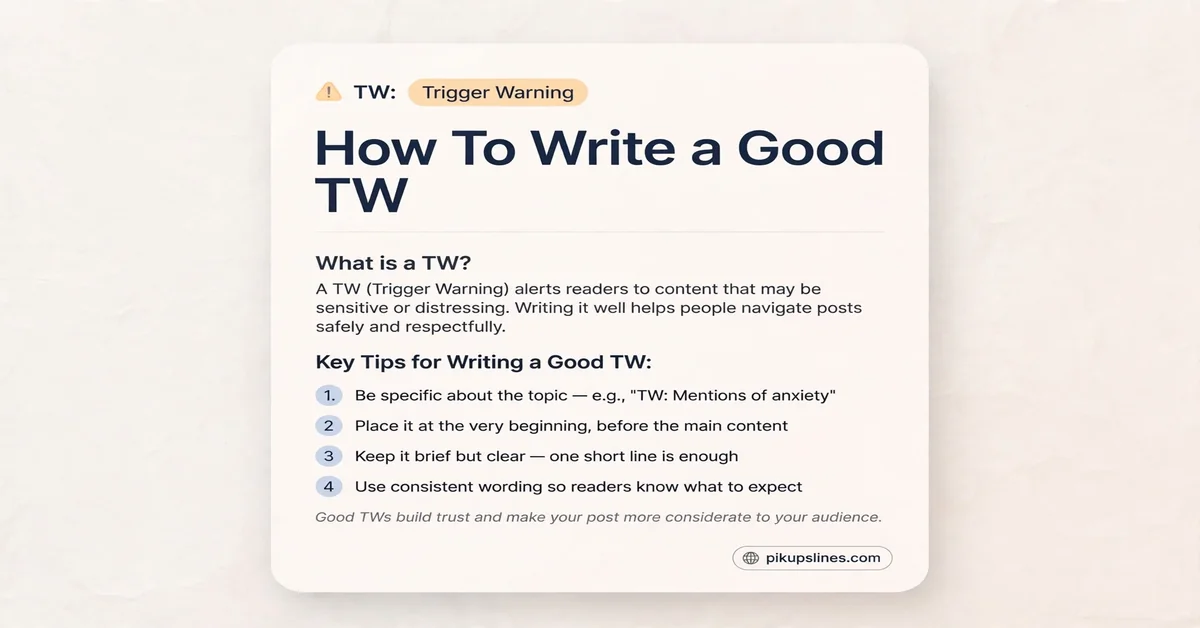
A good TW is short, specific, and first. That order is the whole skill.
First, put TW at the very beginning, before the hard part. A warning at the end, after the reader has already seen the graphic image or read the hard paragraph, has already failed. On TikTok, that means on-screen text in the opening frame. On Instagram, it means the caption before the “more” cut, or the first slide of a carousel. On Reddit, it means the post title or flair.
Second, name the topic after a colon. “TW: grief” helps a reader decide. “TW” alone does not, because it does not say what to avoid. “TW: graphic injury in the second photo” is even better, because it says what, and where.
Third, keep it to what is genuinely likely to distress a vulnerable reader. Violence, abuse, death, grief, sexual assault, self-harm, eating disorders, serious illness, and graphic injuries are common examples. A mildly sad post, an everyday frustration, or a spoiler does not need a TW. Overusing TW on everything makes real warnings easier to ignore, which is the opposite of what a careful writer wants.
Fourth, match the community you are in. Mental health subreddits often treat TW as a rule, fandom spaces build warnings into tags, and Tumblr and Mastodon users often prefer CW. When a community has its own rule, follow that community first.
Fifth, do not hide the topic behind a vague label to be clever. “TW: stuff” and “TW ahead” force the reader to guess, and guessing is what a warning is meant to prevent.
TW vs CW vs CN
TW, CW, and CN look alike, but they are not the same tool.
TW means Trigger Warning. It is the most specific of the three. It points to content that could cause a real emotional or trauma-related reaction, not just discomfort.
CW means Content Warning. It is broader. It can cover spoilers, strong language, graphic images, mature themes, or politics, even when no trauma response is expected. Some communities prefer CW because it feels less clinical than TW, and because it covers more kinds of content a reader might want to skip.
CN means Content Note. It is the most formal of the three. You will see it in academic writing, journalism, newsletters, and professional reports, where “Trigger Warning” can feel too casual. A CN often reads like “Content note: this article discusses grief and loss.”
In practice, the three overlap. If a space says CW, use CW. If a space says TW, use TW.
TW is also different from NSFW, which means Not Safe For Work. NSFW is about whether content is appropriate at work or in public. A distressing story can need a TW without being NSFW, and some NSFW content may not be distressing at all.
How TW Is Used Across Social Media
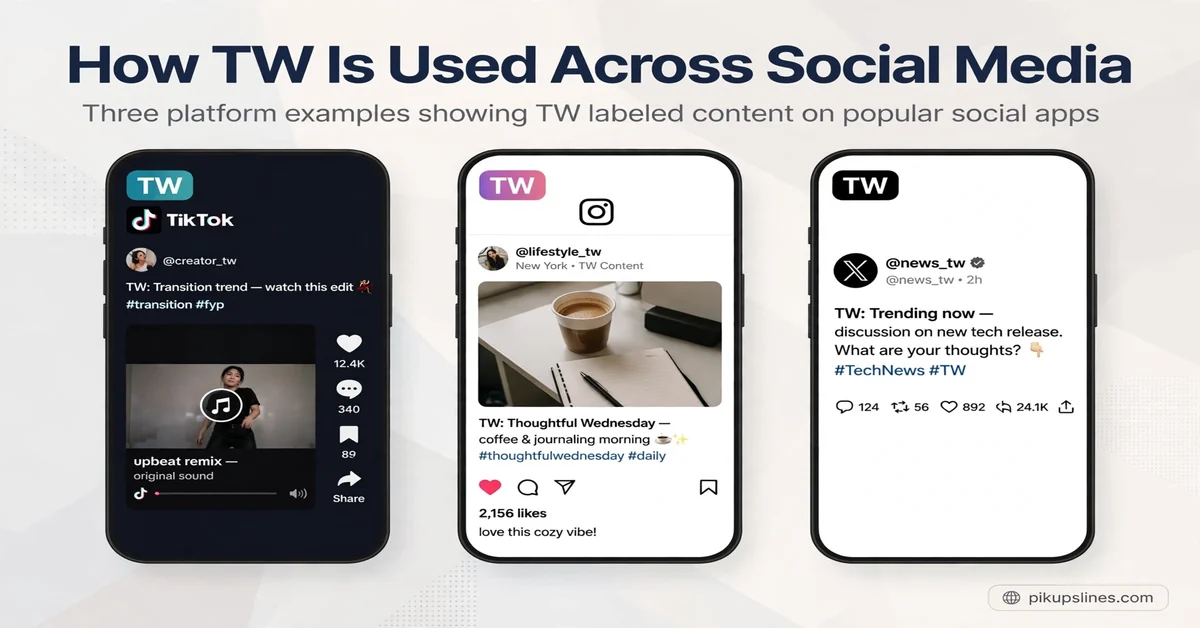
TW does not change its spelling from app to app, but its placement changes, because each app shows content differently.
On TikTok, TW appears in a caption and on screen at the start of a video, and it must be visible in the first second, not buried in a long caption. On Instagram, it appears in captions, Stories, and carousel introductions, often about what the reader is about to see, such as “TW: injury photo on slide 4.” On X, formerly Twitter, it goes at the start of a post or thread, especially for news or personal stories with graphic detail. On Reddit and Tumblr, it is part of community safety, often through tags as well as a line at the top of a post. On WhatsApp and in private messages, it is more personal, often before forwarding a news article, a photo, or a story the sender knows could be hard for that person.
In all of these places, the rule is the same: first, specific, and before the content. The app only changes where “first” is.
Other Meanings You Should Not Assume
Most TW meanings outside Trigger Warning are real, but they are narrow. Do not assume them in a general chat.
Taiwan is the country code TW, in news, sports, and web addresses. A headline about TW in a tournament is about a country, not a warning, and the .tw domain works the same way. Twitter as TW is older shorthand, but since the platform is now called X, this use is less clear, and in a sensitive post it can be badly misread. Total War is a strategy game series, so “Anyone playing TW tonight?” in a gaming Discord is about a game, not a warning. This Week is work shorthand for a schedule, and Tailwind is wind blowing in the same direction as travel, in cycling, running, and aviation. Twilight is a fandom meaning, for the books and films, and it only fits when fandom is already the topic. Topic Warning is sometimes used as a looser version of Trigger Warning, but it is not as standard, and CW is clearer if you want a broader label.
If you mean one of these narrow meanings and the topic is not already clear, spell it out. Do not make the reader choose between a warning and a country, a game, and a schedule.
Common Mistakes and Confusions
The biggest mistake is writing TW too late, too vaguely, or not at all when the content is genuinely hard. A warning after the graphic part, or a warning that names no topic, does not give a real choice.
The second mistake is overusing TW until it means nothing. If every post gets a TW, even mild ones, readers learn to skip the label. The third mistake is using TW as a joke about sensitivity. That teaches readers to ignore the label in serious posts too, even if the joke lands. The fourth mistake is treating TW as censorship. It does not remove content or ban a topic, it adds information before the content, and the reader still chooses. The fifth mistake is confusing TW with a spoiler warning. A spoiler warning protects a reader from learning a plot point early, while a TW protects a reader from unexpected distressing material. Finally, do not assume a TW means the content is graphic in a visual sense. A written discussion of grief, abuse, or self-harm can need a TW even with no image at all.
When Not To Use TW
Do not use TW in a formal email, an academic paper, or a legal document. In those settings, write the full phrase, such as “Please note: the following discusses grief and loss,” or use Content Note, which fits formal writing better.
Do not use TW as Twitter shorthand in a sensitive post. If the post is about a hard topic, readers will read TW as Trigger Warning first, and your platform reference will be lost or misread.
Do not use TW to label content you have not actually checked. A guessed TW can warn about the wrong topic, or miss the topic that matters.
Do not use TW to replace a real safety step. If content shows a graphic injury, a TW helps, but blurring the image, using a spoiler cover, or linking instead of embedding the image may be needed too, depending on the platform.
In short, use TW when a specific, sensitive topic is about to appear and the reader would benefit from choosing first. If the topic is mild, the audience is formal, or the warning would create more confusion than clarity, write it out in full words instead.
How To Reply To a TW
Your reply depends on whether you want to read the content, and whether you need more information.
If you are ready to read it, “Thanks for the TW, I will read it now” is enough. If you are not ready, you can opt out without explaining why: “Thanks for the warning, I will skip this one.” If the TW is vague, ask what it covers. “TW for what?” shows you are taking the warning seriously. If someone forgot a TW, flag it gently: “Hey, this might be worth adding a TW to for folks in the group.” Most people forget, they do not refuse on purpose. If you see a TW used as a joke about a real need, you do not have to laugh along. Saying plainly that the label matters in serious posts keeps it useful for the next person who needs it.
Frequently Asked Question
What does TW stand for in texting?
In texting, TW most commonly stands for Trigger Warning, a heads-up before sensitive or emotionally difficult content. It can also mean Twitter when someone is referencing the platform casually, but that use is older and less clear in 2026.
What does TW mean on social media?
On Instagram, TikTok, X, and Tumblr, TW stands for Trigger Warning. It is placed at the start of posts that contain sensitive topics like mental health, trauma, violence, or grief, so readers can choose before they engage.
Is TW the same as CW?
They are very similar, but not exactly the same. TW specifically signals content that could emotionally trigger people with trauma or mental health sensitivities, while CW is a broader label for any content some people might prefer to avoid.
What does TW mean in sports and weather?
In sports, cycling, running, and aviation contexts, TW stands for Tailwind, a wind blowing in the same direction as your movement, which helps you go faster. It is a separate meaning, and it only fits when wind or speed is already the topic.
Is TW only used for serious topics?
Mostly yes, but you will also see TW used humorously for non-serious content, like a long rant about a coffee order. That use is self-aware humour, and it does not change the serious meaning in a real warning.
What does TW mean on TikTok?
On TikTok, TW usually means Trigger Warning. Creators place it in captions or on-screen text before videos discussing or showing potentially distressing material, so viewers can decide before watching.
What does TW mean on Snapchat?
On Snapchat, TW commonly warns viewers about sensitive material in an upcoming Snap or Story. For example, “TW: blood in next snap” lets viewers avoid advancing if they prefer.
Are TW and NSFW the same thing?
No. TW warns about potentially distressing material, while NSFW means Not Safe For Work and usually labels material that may be inappropriate to view in professional or public settings. Some content can fit both labels, for different reasons.
Conclusion
TW has one main meaning in respectful online engagement: Trigger Warning, a short, specific note placed before sensitive content so readers can choose first.
The topic after the colon tells you what the warning covers. A warning at the start, with a clear topic, is useful. A vague warning, a late warning, or a warning used as a joke is not.
Check the position, check the topic, and check the community, and you will not need to guess what TW means in the post in front of you.