You see “wassup gng” in a group chat, and you pause. Is that a greeting to friends, a plan to go somewhere, or a goodnight?
This guide answers that in plain words.
You will learn the two main meanings of GNG, a one-second grammar test to tell them apart, how it changes by platform, and which other meanings not to assume.
Quick Answer
GNG = Gang, as in a friend group or crew
GNG = Going, as in moving somewhere
Which one fits depends on grammar, not on guessing. If GNG addresses someone, it is gang. If GNG sits where “going” would sit, it is going.
GNG Meaning Table
| Meaning | Where you see it | How to spot it |
|---|---|---|
| Gang | Group chats, TikTok, Instagram, Discord | Used to address friends, or to name the group |
| Going | Texts, WhatsApp, plans | Used as a verb, before a place or an activity |
| Good Night Gang | Group chats at night | A sign-off, often with a sleep or heart emoji |
| Good Night Gamers | Gaming chats at the end of a session | A sign-off when players are logging off |
| Good N’ Gorgeous | Instagram comments, selfies | A compliment, often with heart or fire emoji |
| Good Game | Gaming lobbies, after a match | Said to teammates or opponents at the end |
| Grind Now, Glow-Up Later | Motivational captions | Only if work, goals, or hustle is already the topic |
How To Tell Which Meaning Is Right in Seconds
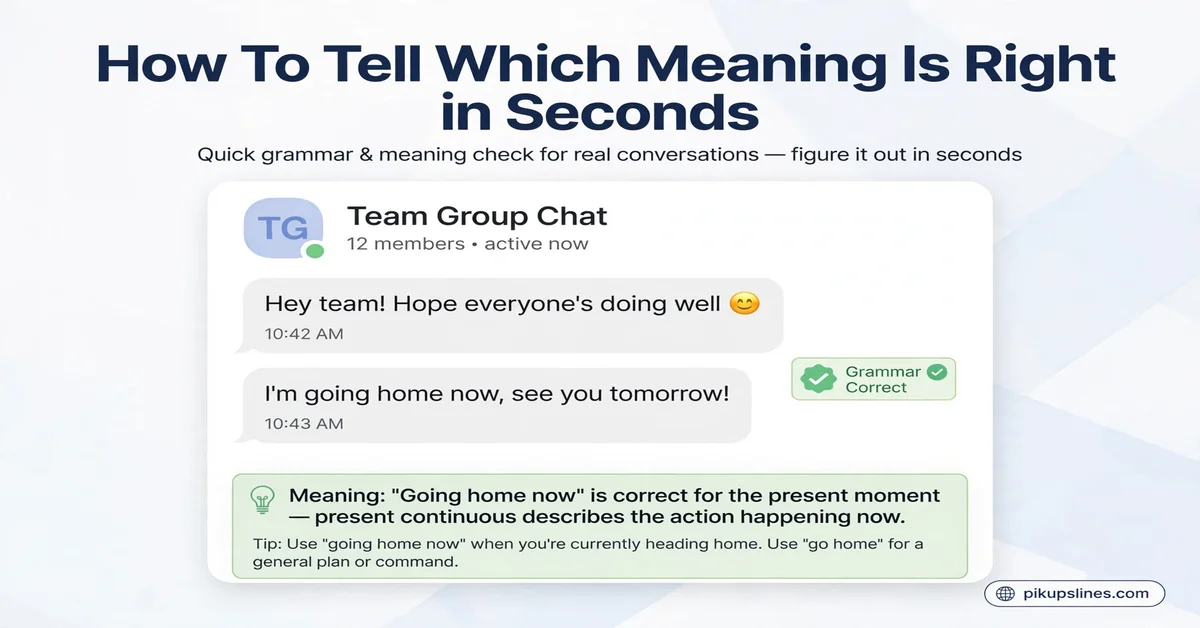
Use the grammar test, not a list of guesses. Replace GNG with “gang” and with “going,” and see which one makes a normal sentence.
“What’s up, gng?” becomes “What’s up, gang?” That works. “What’s up, going?” does not. So the first is gang.
“I’m gng home” becomes “I’m going home.” That works. “I’m gang home” does not. So the second is going.
“Where you gng tonight?” becomes “Where are you going tonight?” That works, so it is going. “Thanks, gng” becomes “Thanks, gang,” as in thanks, friend, so it is gang.
Position helps too. At the start or end of a message, as a greeting or a thank-you, GNG is usually gang. In the middle, before a place or an activity, it is usually going. At night, as a sign-off, check for sleep emoji or a “see you tomorrow” after it, which points to Good Night Gang.
A group greeting is not a missing message, unlike IMY meaning in text, and it is not a request for a handle, unlike a SN meaning in text question. If the message is about people, it is gang. If it is about movement, it is going.
If both replacements sound odd, ask. “Gng as in gang, or going?” is a normal question, and it is faster than replying to the wrong meaning.
GNG as Gang
When GNG means gang, it does not mean a criminal gang. In online slang, gang means a friend group, a crew, a squad, or people you trust and feel close to. It is a shortened spelling of “gang,” made by dropping the vowel, the same way many texting words are squeezed down for speed.
It works as an address and as a name for the group. “Wassup gng” addresses the group. “Me and the gng are going out tonight” names the group. “You good, gng?” can even address one friend, the way “bro” or “fam” can address one person, even though those words can also name a group.
That flexibility is why GNG feels warm. Calling someone gng says they belong to your circle, casually, like “my people” rather than “my friends” in a school report.
It also explains why creators use it with followers. A TikTok creator who writes “What’s good, gng?” to thousands of followers is borrowing that close-group feeling, even though the audience is not a small friend group. The tone is personal, even if the scale is not.
GNG as gang is most common on TikTok, Instagram, Snapchat, Discord, and in group chats, especially among younger users. Older readers may not recognise it, which is why it can look like a code to outsiders, even though it is just a friendly address to insiders.
GNG as Going
When GNG means going, it is not slang for a group at all. It is a fast spelling of the verb “going,” used when someone is in a hurry or writing casually.
“I’m gng to the store” means “I’m going to the store.” “Where you gng?” means “Where are you going?” “Gng to sleep” means “Going to sleep.” In each case, GNG sits exactly where “going” would sit, before a place, an activity, or a state.
Competitors disagree most here. Some call gang the main meaning, others call going the main meaning. Both are common, in different sentence jobs, so the grammar test above is more reliable than a single “most common” claim.
Going as GNG is most common in fast private texts and WhatsApp plans, where speed matters more than style. “Who’s gng Saturday?” is a plan question, not a group greeting, even though it appears in a group chat. The verb job gives it away.
Do not confuse GNG as going with GTG, which means “got to go.” GTG is about leaving soon. GNG as going is about movement itself, and it can describe a plan for later, not only an immediate exit.
GNG as Good Night Gang
At night, GNG can be a sign-off, short for Good Night Gang. “Alright, gng, see you tomorrow” and “GNG” with a sleep emoji are common ways to close a group chat for the night. In gaming, the same sign-off can mean Good Night Gamers, when players are logging off after a session.
This meaning only fits as a closing. If GNG appears in the middle of a daytime plan, it is not a goodnight. If it appears at the end, with a sleep emoji, a heart, or a “see you tomorrow,” a goodnight reading is reasonable.
Some guides also list Good N’ Gorgeous, a compliment used under selfies, often with heart or fire emoji. “You’re gng” under a photo is praise, not a group address and not a plan. It only fits when a photo or a look is already the topic, and it is much less common than gang or going.
Grind Now, Glow-Up Later appears in motivational captions, where GNG is used as a hustle motto. Again, it only fits when goals, work, or a glow-up is already the topic. Do not assume it in a normal chat.
How GNG Is Used Across Social Media
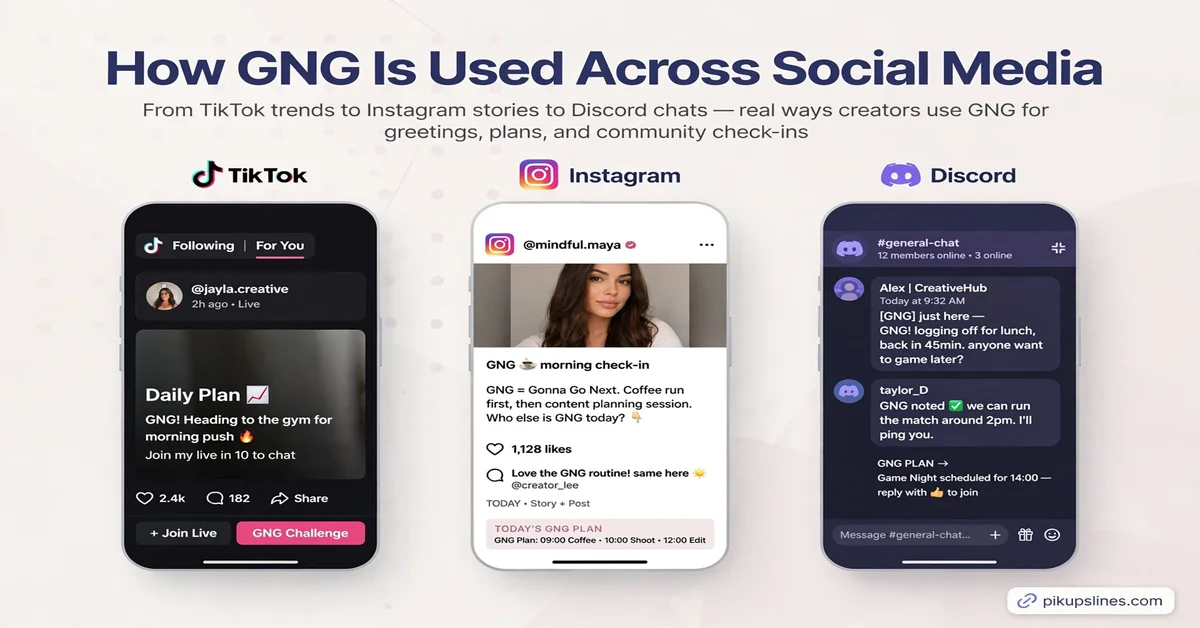
On TikTok, GNG is most often gang, used to address followers, commenters, or a creator’s community. “What’s good, gng?” and “Real gng” are greetings and agreement, not plans. A TikTok comment that says “I’m gng” under a video is different, because there GNG is a verb, often a joke about leaving or reacting.
On Instagram, GNG appears in DMs, story replies, and comments, usually as gang, and sometimes as a compliment under a selfie. The photo or the chat history tells you which one it is.
On Snapchat, GNG is usually a private, casual address between friends, such as “Pull up later gng,” or a fast plan, such as “gng home now.” Because Snapchat chats are short, the grammar test matters even more there.
On Discord and in gaming chats, GNG is usually gang, for teammates, and sometimes a sign-off. “Nice play gng” is praise to a teammate. “Good game gng” is a friendly close after a match. A gaming GNG is rarely about a criminal gang, and it is rarely formal.
On WhatsApp, GNG is often going, in real plans. “Who’s gng Saturday?” and “I’m gng to the shop” are movement questions, not greetings, even though they appear in a friend group chat. That is why reading the sentence job, not just the app, is the reliable test.
GNG vs Bro, Fam, and Crew
GNG as gang sits in the same family as bro, fam, crew, squad, and homie, but the words are not exact synonyms.
Bro and homie usually address one person, even in a group chat. Fam suggests family-like closeness, while crew and squad name a team or group, often with a shared activity. GNG can do both jobs: address one friend like bro, and name a group like crew.
That dual job is a strength and a risk. It makes GNG flexible, but it also means a reader who expects only one job can misread it. “Thanks, gng” to one person is like “thanks, bro.” “The gng is outside” is like “the crew is outside.” The sentence, not a dictionary, tells you which job it is doing.
In formal writing, none of these words fit. “Thank you, gng” in a job application or a business email sounds careless, even if the feeling behind it is warm. In those settings, use the full, plain wording instead.
Common Mistakes and Confusions
The biggest mistake is assuming GNG always means gang, even when it sits as a verb. “I’m gng home” is not a group greeting. It is a movement plan, and replying as if it were a greeting misses the plan.
The second mistake is the opposite: assuming GNG always means going, even when it addresses someone. “Wassup gng” is not a movement question. It is a greeting, and replying with a location misses the greeting.
The third mistake is assuming GNG means a criminal gang. In almost all online chats, it means friends, a crew, or a community. The criminal meaning comes from the full word “gang” in news contexts, not from slang in a friend chat.
The fourth mistake is overusing GNG in every sentence. “Hey gng, thanks gng, see you later gng” sounds forced, even between close friends. One GNG per message, where it fits naturally, sounds more genuine than three.
The fifth mistake is using GNG with people who do not know the slang, and then assuming they understood. Older relatives, teachers, and new work contacts may read it as a typo, a code, or a gang reference. With those audiences, write “gang” in full, or use “friends” instead, and save GNG for chats where it is already understood.
Finally, a group greeting is not a warning. If a group chat turns to a heavy topic, a friendly “wassup gng” does not prepare readers for what follows. See TW meaning in text for how to label sensitive content first, before the main message.
When Not To Use GNG
Do not use GNG in a job application, a business email, a professional meeting, or an academic paper. In those settings, it can look careless, confusing, or too familiar, even if you meant it warmly.
Do not use GNG with strangers in a formal setting, or with someone who has told you they do not like slang. A greeting should make the other person feel included, not tested on internet vocabulary.
Do not use GNG to address a group when you actually mean one specific person and the message could be misread by the whole group. If a message is private, send it privately, rather than letting a group address do private work.
Do not use GNG as going in a message where clarity matters, such as a work schedule or a travel plan with times and places. “Gng to the airport at 6” in a casual chat is fine. In a formal travel note, “Going to the airport at 6” is clearer and safer.
In short, use GNG with close friends, in casual chats, where the sentence job is clear. If the audience is formal, new, or mixed, write it out in full words instead.
How To Reply To GNG
Your reply depends on which GNG you just got.
If GNG is a greeting, reply with a greeting. “Wassup gng” can be answered with “All good, gng, you?” or simply “Hey, what’s up?” You do not need to use GNG back if it is not natural for you, but matching the tone helps the chat feel friendly.
If GNG is going, reply to the plan, not the greeting. “I’m gng home” can be answered with “Safe trip” or “See you tomorrow.” “Where you gng?” can be answered with a place, not with a greeting.
If GNG is a goodnight sign-off, reply with a short close. “Good night gng” or “See you tomorrow” is enough. You do not need to start a new topic after a sign-off.
If you are not sure, ask the grammar question. “Gng as in gang, or going?” is a normal, quick check, and it is better than replying to a plan as if it were a greeting, or to a greeting as if it were a plan.
Frequently Asked Question
Is GNG a good thing?
Yes. In most cases, GNG is a friendly term used to refer to a friend, buddy, or trusted person. It is usually positive, not offensive, when used between friends.
What does GNG mean on TikTok?
On TikTok, GNG usually means gang, another way of saying friend, bro, or homie. It appears in comments, captions, replies, and direct messages to address a community or a friend group.
What does “What’s up GNG?” mean?
It means “What’s up, friend?” or “How are you doing?” It is a casual greeting to a friend or a group, not a question about movement.
Is GNG the same as bro?
Not exactly, but they are very similar. Both are casual terms used between friends. GNG can also name a whole group, while bro usually addresses one person.
Can girls use GNG?
Yes. GNG is not limited to any gender and can be used by anyone in casual conversations.
Is GNG flirty?
GNG is not inherently flirty. When it means gang, it is generally a casual, friendly way to address someone. Any flirty tone comes from the relationship and the emoji around it, not from GNG itself.
Is GNG formal or informal?
GNG is highly informal internet slang. It fits texts, group chats, TikTok comments, DMs, and casual online conversations, but it would be out of place in a professional email or a formal letter.
What does GNG mean in a group chat?
In a group chat, GNG most often means gang, and it can address everyone in the conversation, as in “GNG, are we still meeting at 8?” If the message says “I’m gng out,” however, the meaning is more likely going, and the rest of the sentence gives the clue.
Conclusion
GNG has two main meanings in friendships and social connections: gang, for a friend group or crew, and going, for movement to a place or an activity.
The grammar test tells you which one fits. If GNG addresses someone, it is gang. If GNG sits where going would sit, it is going.
Check the sentence job, check the time of day for a goodnight sign-off, and you will not need to guess what GNG means in the message in front of you.