Have you ever received a message containing just two letters, “FQ,” and wondered what the sender was trying to say? Texting abbreviations can make conversations quicker, but unfamiliar ones can leave you guessing. FQ is one such abbreviation because its meaning can change depending on the situation.
In casual digital communication, FQ may stand for “Fair Question” or “Frequent Question.” In some communities, it can have other meanings, too. Unlike popular abbreviations such as LOL and IDK, FQ does not have one universally recognized definition.
Understanding the surrounding conversation is the best way to interpret it. This guide explores the possible meanings of FQ, how people use it in messages and social media, real-life examples, and the best ways to respond.
What Does FQ Mean in Text?
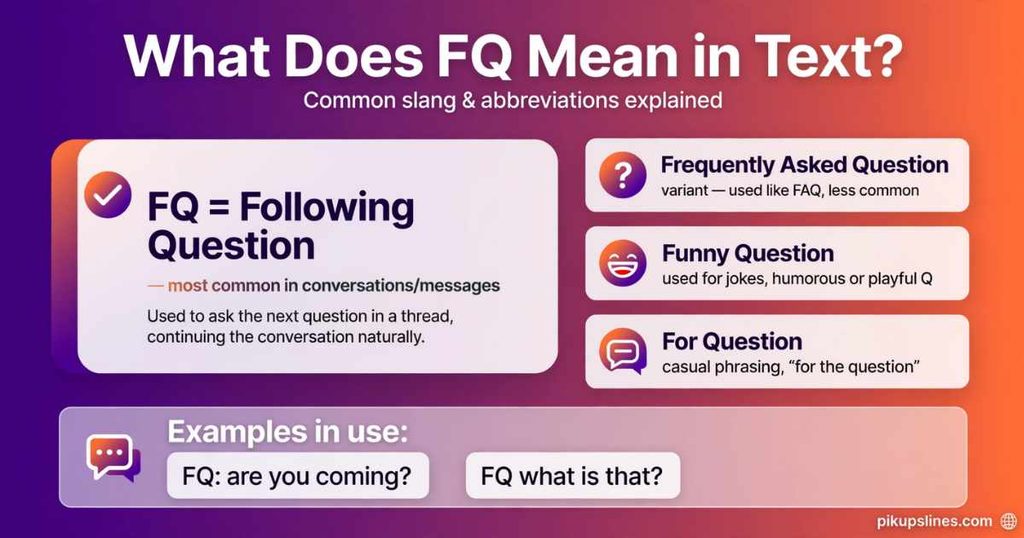
FQ is a short abbreviation that can have several interpretations in texting and online communication. Two possible meanings are “Fair Question” and “Frequent Question.” Which one makes sense depends on how the sender uses it.
When someone uses FQ to mean “Fair Question,” they are acknowledging that another person’s question is reasonable, understandable, or worth asking. It can be a quick way to agree that a question makes sense without typing the complete phrase.
For example:
Person A: Why didn’t you tell us about the meeting earlier?
Person B: FQ. I should have mentioned it yesterday.
Here, FQ can mean “Fair Question.” Person B recognizes that the other person has raised a reasonable point.
In another situation, FQ may refer to a “Frequent Question.” This interpretation is more likely when someone discusses questions that people repeatedly ask.
For example:
Person A: What do new customers ask most often?
Person B: Delivery time is an FQ.
In this case, FQ refers to a question that comes up frequently.
It is important to understand that FQ is not as established or widely recognized as common texting abbreviations such as BRB, OMG, or TBH. Some people may understand it immediately, while others may not recognize it at all.
You may also encounter other interpretations in specialized communities, private conversations, or slang dictionaries. Therefore, do not assume that every person who types FQ means exactly the same thing.
FQ Meaning in Simple Words
In simple terms, FQ can mean “Fair Question” when someone is responding to a reasonable question. It can also mean “Frequent Question” when someone is discussing something that people ask repeatedly.
Think of these two situations:
- Someone asks why you missed an important event. You reply, “FQ,” meaning that it is a fair question.
- Someone asks what customers usually want to know. You reply that delivery costs are an FQ, meaning that people ask about them often.
The difference is easy to understand when you look at the conversation.
Here are a few simple phrases that may help you recognize the intended meaning:
When FQ means Fair Question:
- That’s a reasonable question.
- Good question.
- I understand why you asked.
- That’s a valid point.
- I can see why you want to know.
When FQ means Frequent Question:
- People ask this question often.
- This comes up regularly.
- It’s a common question.
- Many people want to know the answer.
- This is something we get asked repeatedly.
The sender’s wording usually provides enough clues to identify the intended meaning.
What Does FQ Stand For?
FQ consists of two letters, but the words they represent depend on the context.
When used as “Fair Question,” the letters refer to:
- F – Fair
- Q – Question
When used as “Frequent Question,” they refer to:
- F – Frequent
- Q – Question
Both interpretations are understandable, but neither should automatically be treated as the correct meaning in every conversation.
FQ may also be used as personal shorthand. Friends sometimes invent abbreviations that make sense only within their group. Online communities can do the same, developing expressions that are familiar to regular members but confusing to outsiders.
This is why context matters more than the letters themselves.
Why Do People Use FQ in Text Messages?
People use abbreviations to make digital conversations shorter, faster, and more convenient. FQ can serve this purpose when both people understand what it means.
Here are some reasons someone might use it.
To Acknowledge a Reasonable Question
When FQ means “Fair Question,” it can be a quick acknowledgment. Instead of writing a full sentence, someone may use the two-letter abbreviation to show that they understand why another person is asking.
For example:
Friend: Why are you always late on Mondays?
You: FQ. My bus schedule is different at the start of the week.
The response acknowledges the question before explaining the reason.
To Refer to Repeated Questions
When FQ means “Frequent Question,” it can describe something that people ask regularly.
For example:
Coworker: Do customers keep asking about refunds?
You: Yes, it’s an FQ this month.
The abbreviation is being used as shorthand for a question that comes up often.
In professional writing, however, spelling out “frequently asked question” or “common question” is usually clearer.
To Keep Messages Short
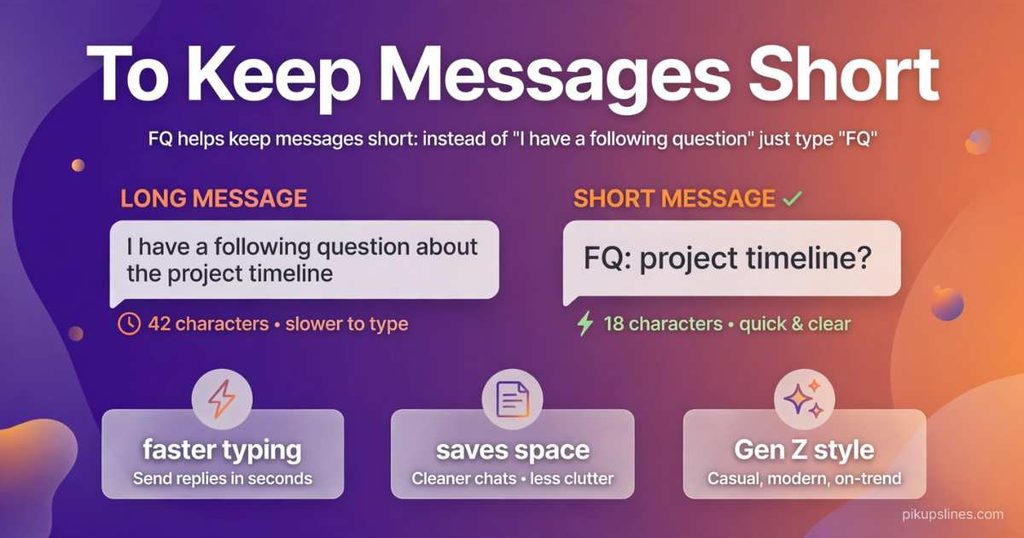
Digital conversations often move quickly. People may use short forms because they do not want to type a complete phrase every time.
For example:
Person A: Why did you choose that design?
Person B: FQ 😂 I just liked the colors.
The abbreviation keeps the exchange brief and casual.
To Match an Informal Conversation
Friends often communicate using a mixture of full sentences, abbreviations, emojis, and playful expressions. FQ may fit naturally into that style if everyone understands it.
However, using an unfamiliar abbreviation with someone who has never seen it can create confusion rather than save time.
To Make a Conversation Feel Relaxed
A short expression can make a conversation feel less formal. Someone may use FQ instead of writing a longer acknowledgment, especially when chatting with friends.
Still, a short message does not automatically sound friendly. Tone depends on the relationship and the surrounding words.
FQ Meaning in Different Contexts
The meaning of FQ becomes easier to understand when you consider the type of conversation in which it appears.
FQ in Casual Text Messages
In a private conversation, FQ may be used to acknowledge a reasonable question.
Example:
Alex: Why didn’t you answer my call last night?
Sam: FQ. My phone was on silent, and I didn’t notice it.
Here, Sam recognizes that Alex has a fair reason to ask.
However, if the sender uses FQ in a different way, the intended meaning may not be obvious. If you are unsure, asking for clarification is perfectly reasonable.
FQ in Social Media Conversations
Social media users often communicate through short comments, replies, and direct messages. Abbreviations can help make these exchanges quicker.
For example:
User A: Why do you always upload videos so late?
User B: FQ 😂 I usually finish editing at night.
In this example, FQ can be read as “Fair Question.”
The same abbreviation might appear in a discussion about frequently repeated questions:
User A: What do people ask about this product?
User B: Shipping time is an FQ.
Here, the meaning is closer to “Frequent Question.”
Because social media audiences can include people with different communication habits, writing out the complete phrase may be more effective when clarity matters.
FQ in Group Chats
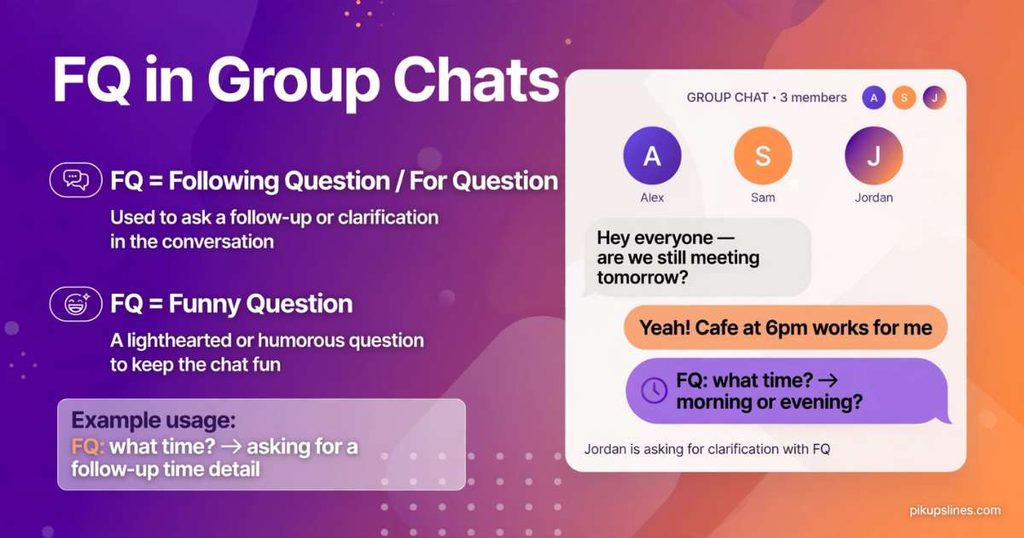
Group chats often include several people discussing plans, sharing opinions, or asking questions. FQ might appear when someone acknowledges a question or refers to a topic that comes up repeatedly.
Example:
Mia: Why are we changing the meeting time again?
Daniel: FQ. The original time doesn’t work for everyone.
The abbreviation acknowledges that Mia’s question is reasonable.
In a group that does not commonly use FQ, however, some members may misunderstand it. A complete phrase is often the safer option.
FQ in Gaming Chats
Gaming communities have their own abbreviations and communication styles. Players often use short expressions to coordinate activities, discuss strategies, or react to other players.
FQ is not a universally established gaming abbreviation, so its meaning should not be assumed.
For example:
Player A: Why didn’t you attack when the enemy was low?
Player B: FQ. I was waiting for the team.
Here, the sender may mean “Fair Question.”
If you encounter FQ during a game and the meaning is unclear, look at the discussion or ask the player what they mean.
FQ in Workplace Chats
In workplace communication, FQ may be used informally to refer to a fair question or a frequently raised question.
For example:
Employee A: Why are customers asking about the new policy?
Employee B: It’s become an FQ since the update.
Here, the intended meaning is likely “Frequent Question.”
Another example:
Manager: Why do you think the deadline needs to change?
Employee: FQ. The current schedule does not include enough testing time.
Here, the employee is acknowledging that the manager’s question is reasonable.
Although these examples illustrate possible uses, FQ is not a standard professional abbreviation. In formal emails, reports, and presentations, use the complete wording.
FQ Meaning on Different Social Media Platforms
FQ does not have a separate, universally accepted meaning on every social media platform. Its interpretation generally depends on the conversation rather than the app.
You may come across it in messages, comments, or community discussions.
FQ Meaning on Snapchat
Snapchat conversations are often informal and personal. Friends use direct messages to share updates, make plans, and ask questions.
If someone sends FQ after you ask something, they may be acknowledging that your question is reasonable.
Example:
Friend: Why did you leave the party so early?
You: FQ 😂 I had to get home before midnight.
The reply recognizes the question and provides an explanation.
If the abbreviation appears without enough context, do not assume it has a specific Snapchat-only meaning.
FQ Meaning on Instagram
Instagram supports direct messages, comments, and story replies. FQ may appear when users respond to questions or discuss topics that people ask about regularly.
Example:
User A: Why don’t you show your editing process?
User B: FQ. Maybe I’ll post a tutorial soon.
Here, FQ can mean “Fair Question.”
It may also be used in discussions about frequently asked questions related to products, accounts, or content.
FQ Meaning on TikTok
TikTok conversations often involve comments about videos, trends, creators, and personal opinions.
Example:
Comment: Why do you always use the same background?
Creator: FQ 😂 It’s the only quiet place in my house.
The creator acknowledges that the comment raises a reasonable question.
Because FQ is not a widely standardized TikTok abbreviation, its meaning should be interpreted from the surrounding message.
FQ Meaning on WhatsApp
WhatsApp is used for personal conversations, family groups, work discussions, and community chats. FQ may appear in any of these settings.
Example:
Cousin: Why aren’t you coming to dinner tonight?
You: FQ. I have an early appointment tomorrow.
Here, FQ means “Fair Question.”
In a group discussing repeated questions, it may instead refer to a frequent question.
FQ Meaning on Facebook Messenger
Facebook Messenger supports private chats and group conversations. Someone may use FQ as a brief acknowledgment when responding to a reasonable question.
Example:
Friend: Why did you stop playing football?
You: FQ. I got too busy with work.
The abbreviation makes the reply shorter while recognizing the other person’s curiosity.
FQ Meaning on Discord
Discord is used by gaming groups, hobby communities, and online discussion servers. Different communities may develop their own shorthand.
If FQ appears in a Discord conversation, read the messages around it before deciding what it means.
Example:
Member A: Why does the server have so many rules?
Member B: FQ. We had problems with spam before.
In this example, FQ can be understood as “Fair Question.”
In another channel, someone might use FQ to refer to a question that new members repeatedly ask.
Other Possible Meanings of FQ
FQ is not limited to “Fair Question” and “Frequent Question.” It can have other meanings in particular communities and situations.
These interpretations are less predictable, so it is important not to assume they apply to ordinary texting.
FQ as Friend Request
Some informal online users use FQ as shorthand for “Friend Request.” This interpretation may appear in conversations about adding people on social media or gaming platforms.
Example:
Person A: I sent you an FQ yesterday.
Person B: Oh, I’ll check it now.
Here, the sender may be referring to a friend request.
However, this is not a universal abbreviation. Many people simply write “FR” or spell out “friend request,” so context is essential.
FQ as an Offensive Expression
Some user-generated slang references list FQ as shorthand for the vulgar phrase “Fuck You.” It may be used as an insult or an expression of anger in certain informal contexts.
For example, someone might use it during an argument to communicate hostility.
Because this interpretation is offensive, it should not be assumed whenever someone types FQ. The surrounding words, the relationship between the people, and the tone of the conversation matter.
If someone sends FQ during a disagreement, look at the full message before deciding whether it is intended as an insult.
FQ as Force Quit
In computing discussions, FQ may be used as shorthand for “Force Quit,” particularly when discussing closing an unresponsive application.
Example:
User A: The program has frozen again.
User B: Try a force quit.
This is a technical use rather than a typical texting meaning. In many computer conversations, the full phrase or the established term “force quit” is clearer.
FQ in Specialized Communities
FQ may also represent organization names, technical terms, community-specific expressions, or other phrases.
For example, an abbreviation used in a gaming group may not mean the same thing in a business discussion. Similarly, a term used in a technical document may have no connection to internet slang.
The safest approach is to interpret FQ based on the topic being discussed rather than treating every possible definition as a texting meaning.
Is FQ Polite or Rude?
FQ is not automatically polite or rude. Its tone depends on what the sender means and how they use it.
When FQ means “Fair Question,” it generally communicates acknowledgment. The sender is recognizing that another person has asked something reasonable.
For example:
Friend: Why didn’t you invite me?
You: FQ. I honestly thought you were busy.
This response can sound thoughtful because it acknowledges the other person’s concern.
When FQ refers to “Frequent Question,” it is usually descriptive rather than emotional.
For example:
Employee: Delivery time is an FQ from customers.
The sender is simply describing a common inquiry.
However, if someone uses FQ as an abbreviation for an offensive phrase, the tone is clearly hostile.
When FQ Sounds Friendly
FQ may sound friendly when:
- It is used to acknowledge a reasonable question.
- The conversation is casual.
- The sender adds an explanation.
- The message includes a friendly emoji.
- Both people understand the abbreviation.
For example:
“FQ 😂 I never thought about it that way.”
This response sounds relaxed and acknowledges the other person’s point.
When FQ Sounds Blunt
FQ may seem abrupt when it appears by itself, particularly if the other person expects a detailed response.
For example:
Friend: Why have you been ignoring my messages?
Reply: FQ.
The reply is too short to explain the situation and may leave the other person confused.
A clearer alternative would be:
“That’s a fair question. I’ve been dealing with a lot lately, and I should have replied sooner.”
When FQ Sounds Offensive
If the sender intends the vulgar interpretation, FQ may be an insult rather than a neutral abbreviation.
The surrounding language can provide clues. If the message contains aggressive comments, personal attacks, or hostile language, consider the possibility that the sender is using it offensively.
If you are unsure, ask what they mean instead of immediately reacting.
How to Respond When Someone Sends FQ
Your response depends on the meaning the sender intends.
If FQ means “Fair Question,” you can acknowledge the comment or continue explaining your answer. If it means “Frequent Question,” you can respond by discussing the topic people ask about regularly.
Here are some natural ways to reply.
Simple and Casual Replies
When someone uses FQ to acknowledge your question, you can respond casually.
Examples:
- “Exactly!”
- “That’s what I was thinking.”
- “Yeah, it makes sense.”
- “I was curious too.”
- “True, good point.”
These replies keep the conversation moving without making it unnecessarily complicated.
Friendly Replies
If you are chatting with a close friend, you can use a relaxed response.
Examples:
- “Haha, glad you agree.”
- “I knew you’d understand.”
- “Right? I was wondering the same thing.”
- “Exactly 😂”
- “That’s what I wanted to know!”
Thoughtful Replies
If the discussion is serious, a more complete response may be appropriate.
Examples:
- “Yes, I think it’s reasonable to ask.”
- “I understand why you brought that up.”
- “That’s something worth discussing.”
- “I appreciate you asking.”
- “Let me explain what happened.”
Replies When FQ Means Frequent Question
If someone uses FQ to refer to a repeated question, you can respond by asking for more information.
Examples:
- “What do people usually ask?”
- “Is there a standard answer?”
- “That makes sense.”
- “We should add it to the FAQ.”
- “Maybe we should explain that more clearly.”
When You Do Not Understand FQ
There is nothing wrong with asking someone to clarify an abbreviation.
You can simply write:
- “What does FQ mean here?”
- “Do you mean fair question?”
- “Are you referring to a frequent question?”
- “I’m not familiar with that abbreviation.”
A quick clarification is better than misunderstanding the entire conversation.
FQ vs. Similar Texting Abbreviations
FQ can be confused with other short expressions, especially when someone is unfamiliar with online shorthand. Understanding the differences can help you interpret messages more accurately.
FQ vs. FAQ
FAQ stands for “Frequently Asked Questions.” It usually refers to a collection of common questions and their answers.
FQ may stand for “Frequent Question” in some contexts, but it is not interchangeable with FAQ in every situation.
Example:
FAQ: The website has an FAQ page about delivery and returns.
FQ: Delivery time is a frequent question from customers.
FAQ is much more widely recognized, particularly on websites and help pages.
FQ vs. FR
FR commonly means “For Real” in texting. People use it to express agreement, seriousness, or disbelief.
FQ and FR have different purposes.
Example:
Person A: This movie is amazing.
Person B: FR!
Here, the sender means “For Real.”
By contrast:
Person A: Why is this movie so popular?
Person B: FQ. The story is really good.
Here, FQ may mean “Fair Question.”
FQ vs. FYI
FYI stands for “For Your Information.” It is used when someone shares information that another person may find useful.
For example:
Friend: FYI, the meeting starts at 10.
FQ does not serve the same purpose. It may acknowledge a question or refer to something people ask regularly.
FQ vs. TBH
TBH means “To Be Honest.” People use it when sharing an honest opinion or statement.
For example:
Friend: Did you enjoy the movie?
You: TBH, not really.
FQ is different because it does not introduce an honest opinion. Its meaning depends on whether the sender intends “Fair Question,” “Frequent Question,” or another interpretation.
FQ vs. IMO
IMO means “In My Opinion.” It is used when someone shares a personal viewpoint.
For example:
Person A: Which phone is better?
Person B: IMO, the second one.
FQ is not a substitute for IMO. The two abbreviations communicate different ideas.If you enjoy learning common texting abbreviations, check out our guide on GL meaning in text to understand what it means and how people use it in online conversations.
FQ vs. IDK
IDK stands for “I Don’t Know.” It is used when someone does not have an answer.
For example:
Friend: Why did the shop close?
You: IDK.
FQ, when used as “Fair Question,” acknowledges that the question is reasonable but does not necessarily answer it.
How to Know What FQ Means in a Conversation
When you see FQ in a message, do not rely on the abbreviation alone. Consider the surrounding conversation.
A few simple checks can help you identify the intended meaning.
Look at the Previous Message
The message immediately before FQ is often the strongest clue.
If someone asks a question and the reply is simply “FQ,” the sender may mean “Fair Question.”
If someone is discussing repeated customer inquiries, “Frequent Question” may make more sense.
Check the Subject
Think about what the conversation is about.
- A personal discussion may point toward “Fair Question.”
- A customer support discussion may point toward “Frequent Question.”
- A social media conversation about adding people may suggest “Friend Request.”
- A computer troubleshooting discussion may involve “Force Quit.”
These are possibilities, not fixed rules. The topic helps narrow down the meaning.
Consider the Sender’s Usual Style
Some people use abbreviations regularly, while others prefer complete sentences.
If the sender often uses short forms, FQ may simply be part of their normal communication style.
You can also consider whether the person usually jokes, writes formally, or uses community-specific slang.
Read the Whole Message
Never interpret an abbreviation by looking at two letters alone.
For example:
“FQ, I was wondering that too.”
This sounds like an acknowledgment of a reasonable question.
“That’s an FQ for new customers.”
This sounds more like a reference to a frequently asked question.
The sentence structure provides useful clues.
Ask for Clarification
If the meaning is still unclear, ask.
A simple question such as “What do you mean by FQ?” can prevent unnecessary confusion.
Is FQ Common in Modern Texting?
FQ is not as widely recognized as many established texting abbreviations. Expressions such as LOL, BRB, IDK, OMG, and FYI are familiar to a large number of internet users.
FQ is less predictable because it can represent different phrases and may be unfamiliar to people outside certain communities.
You may encounter it in informal messages, online discussions, or specialized conversations, but that does not mean everyone will understand it.
Digital language changes constantly. Some abbreviations become popular across many platforms, while others remain limited to particular groups.
FQ is best treated as a context-dependent abbreviation rather than a universal texting expression.
Should You Use FQ in Your Messages?
You can use FQ when the intended meaning is clear to the person receiving your message. However, because it is not universally recognized, using the complete phrase is often the better option.
When It Is Fine to Use FQ
FQ may be suitable when:
- You are chatting with friends who understand it.
- The meaning is obvious from the conversation.
- You are responding casually to a reasonable question.
- You are discussing repeated questions in an informal group.
- You are communicating with people who regularly use the abbreviation.
For example:
Friend: Why do you always order the same food?
You: FQ 😂 It’s my favorite.
If both people understand the expression, the abbreviation can work naturally.Just like other popular chat abbreviations, DTTM can have a specific meaning depending on the conversation, so explore our guide on DTTM meaning in text for a clearer explanation.
When You Should Avoid FQ
Avoid using FQ when:
- You are writing a formal email.
- You are communicating with a client or manager.
- The conversation is serious or sensitive.
- The recipient may not know the abbreviation.
- There is a risk of misunderstanding an offensive interpretation.
Instead of writing only “FQ,” you can say:
- “That’s a fair question.”
- “People ask this question frequently.”
- “That’s something we get asked often.”
- “I understand why you’re asking.”
Complete phrases are generally clearer and more appropriate in professional settings.
Common Mistakes People Make When Understanding FQ
Because FQ has several possible interpretations, people sometimes misunderstand it. Avoiding a few common mistakes can help you read messages more accurately.
Assuming It Always Means Fair Question
Although “Fair Question” is a possible conversational interpretation, it is not a guaranteed definition.
If the conversation is about customer inquiries, “Frequent Question” may fit better.
Treating FQ as a Universal Abbreviation
Not everyone uses FQ, and not everyone interprets it in the same way.
It is better to consider the sender’s communication style rather than assume that every person understands the same slang.
Confusing FQ With FAQ
FAQ is a widely recognized abbreviation for “Frequently Asked Questions.” FQ may have a related meaning in certain contexts, but the two are not automatically interchangeable.If you come across CKFS in a message, read our detailed guide to CKFS meaning in text to learn what this abbreviation means and when people use it.
Assuming It Is Offensive
Some slang references list FQ as a shortened form of a vulgar insult. However, that does not mean every use is offensive.
Look at the tone and subject of the conversation before reaching a conclusion.
Ignoring the Context
The biggest mistake is interpreting FQ without reading the rest of the message.
Two letters can represent different phrases. The sentence, topic, and relationship between the people help reveal the intended meaning.
Frequently Asked Questions About FQ Meaning in Text
What does FQ mean in text?
FQ can mean “Fair Question” or “Frequent Question” in text, depending on the context. It may also have other meanings in specialized or informal communities.
What does FQ stand for in texting?
Possible interpretations include Fair Question and Frequent Question. The sender’s wording and the subject of the conversation help determine which meaning fits.
Does FQ mean Fair Question?
Yes. FQ may be used as shorthand for “Fair Question” when someone wants to acknowledge that another person’s question is reasonable.
Does FQ mean Frequent Question?
Yes. FQ can also stand for “Frequent Question,” especially when discussing something people ask repeatedly.
Is FQ the same as FAQ?
No. FAQ stands for “Frequently Asked Questions” and commonly refers to a collection of questions and answers. FQ may refer to a frequent question, but it is not a universal substitute for FAQ.
What does FQ mean on Snapchat?
FQ does not have a universally accepted Snapchat-specific meaning. In a conversation, it may mean “Fair Question” or another expression depending on the context.
What does FQ mean on Instagram?
On Instagram, FQ may be used in direct messages or comments as shorthand for “Fair Question” or “Frequent Question.” The surrounding message helps identify the intended meaning.
What does FQ mean on TikTok?
FQ may appear in TikTok comments or messages, but it is not a standardized platform-specific abbreviation. Read the conversation to understand what the sender means.
What does FQ mean on WhatsApp?
On WhatsApp, FQ can have different meanings depending on the conversation. It may mean “Fair Question” when acknowledging a question or “Frequent Question” when discussing repeated inquiries.
Can FQ mean something offensive?
Yes. Some informal slang references list FQ as shorthand for a vulgar insult. However, this interpretation should not be assumed without supporting context.
What does FQ mean from a girl?
If a girl sends FQ, she may mean “Fair Question,” “Frequent Question,” or another expression. The abbreviation alone does not reveal her feelings or intentions. Look at what she is responding to.
What does FQ mean from a guy?
When a guy uses FQ, the meaning also depends on the conversation. It may acknowledge a reasonable question or refer to something people ask frequently.
Is FQ a popular texting abbreviation?
FQ is less widely recognized than common expressions such as LOL, IDK, BRB, and FYI. Some people use it, but its meaning is more context-dependent.
How should I respond when someone says FQ?
If the sender means “Fair Question,” you can reply with “Exactly,” “That’s true,” or “I was wondering the same thing.” If you are unsure, ask what they mean.
Is FQ appropriate in professional messages?
It is generally better to avoid FQ in formal communication. Use complete phrases such as “That’s a fair question” or “This is a frequently asked question” to make your meaning clear.
Can FQ have a personal meaning?
Yes. Friends, online groups, and specialized communities sometimes create their own abbreviations. If the usual interpretations do not fit the conversation, FQ may be personal shorthand.
Final Thoughts on FQ Meaning in Text
FQ is a short abbreviation with more than one possible meaning. In casual conversations, it may stand for “Fair Question,” especially when someone acknowledges that another person’s question is reasonable. In discussions about repeated inquiries, it may mean “Frequent Question.”
You may also encounter other interpretations, such as “Friend Request,” “Force Quit,” or an offensive expression, in particular communities and situations. These meanings are not interchangeable, and none should be assumed without considering the context.
Unlike widely recognized abbreviations such as LOL, IDK, and FYI, FQ is not universally understood. Pay attention to the previous message, the topic, and the sender’s usual communication style. If the meaning is still unclear, simply ask for clarification.
The easiest way to understand FQ is to remember that context determines its meaning. Once you look beyond the two letters and consider the full conversation, interpreting the message becomes much easier.