You see KMS in a message, and it stops you. The letters sound serious, but the chat looks like a joke.
This guide explains what KMS means, how to tell a joke from a real warning, how to reply in both cases, and when not to use it.
If you, or someone you know, is in crisis, call or text 988 in the US, or contact a local crisis line, right away.
Quick Answer
KMS = Kill Myself
In most texts, KMS is a dramatic, exaggerated way to say “I am so frustrated, embarrassed, or overwhelmed right now.” It is usually not literal. Sometimes, however, it is serious, and it must never be ignored when the context suggests real distress.
KMS Meaning Table
| Meaning | Where you see it | How to spot it |
|---|---|---|
| Kill Myself (hyperbole) | Texts, Snapchat, Instagram, TikTok, Discord | Attached to a small frustration, with jokes or emojis |
| Kill Myself (serious) | Private messages, late-night chats, social posts | Hopeless tone, repeated use, no joke, withdrawal, or a plan |
| Kilometers | Car listings, travel, fitness, maps | A number nearby, such as “120,000 kms” |
| Key Management Service | IT, software, cloud security | Licenses, servers, or cloud settings are the topic |
| Knowledge Management System | Work, corporate IT, training | Documents, knowledge, or a company system is the topic |
| Killing Me Softly | Music, song titles, playlists | A song or an artist is already the topic |
| Kill Me Now (KMN) | Texts and memes, cousin of KMS | Same dramatic venting, different letters, not the same as KMS |
| KYS (Kill Yourself) | Toxic chats, insults, bullying | Directed AT someone else, not about the sender |
How To Tell a Joke From a Serious Warning
Most guides stop at “it is usually a joke,” but that is not enough, because the same letters can mean two very different things. Five clues, taken together, tell you which one you are reading.
First, look at the trigger. A joke KMS follows a small frustration: a spilled coffee, a failed quiz, a typo sent to the wrong person. A serious KMS follows hopelessness, not a single event: feeling trapped, worthless, or alone, often over days. Second, look at the tone. A joke KMS often comes with laughing emojis, a meme, or a follow-up joke. A serious KMS often comes with flat tone, no joke, a late-night message, or sudden withdrawal. Third, look at repetition. One KMS after an embarrassing moment, from someone otherwise fine, is usually venting. Repeated KMS messages, especially if the person sounds more hopeless over time, deserve a check-in. Fourth, look at what follows. If a joke reply makes the person laugh and move on, it was probably venting. If they say they really feel bad, or do not reply after a serious-sounding message, do not assume it was a joke. Fifth, look at the relationship. KMS between close friends who share dark humour differs from KMS sent to a parent or stranger, where the sender may be testing whether anyone notices. When in doubt, treat it as serious until you have reason to believe otherwise, and ask directly.
Asking directly does not make things worse. Research shared by crisis organisations says asking “Are you okay? Are you thinking about hurting yourself?” does not put the idea in someone’s head. It gives them permission to say the truth, and it gives you a clear answer instead of a guess.
KMS as a Joke: Why Teens and Young Adults Use It
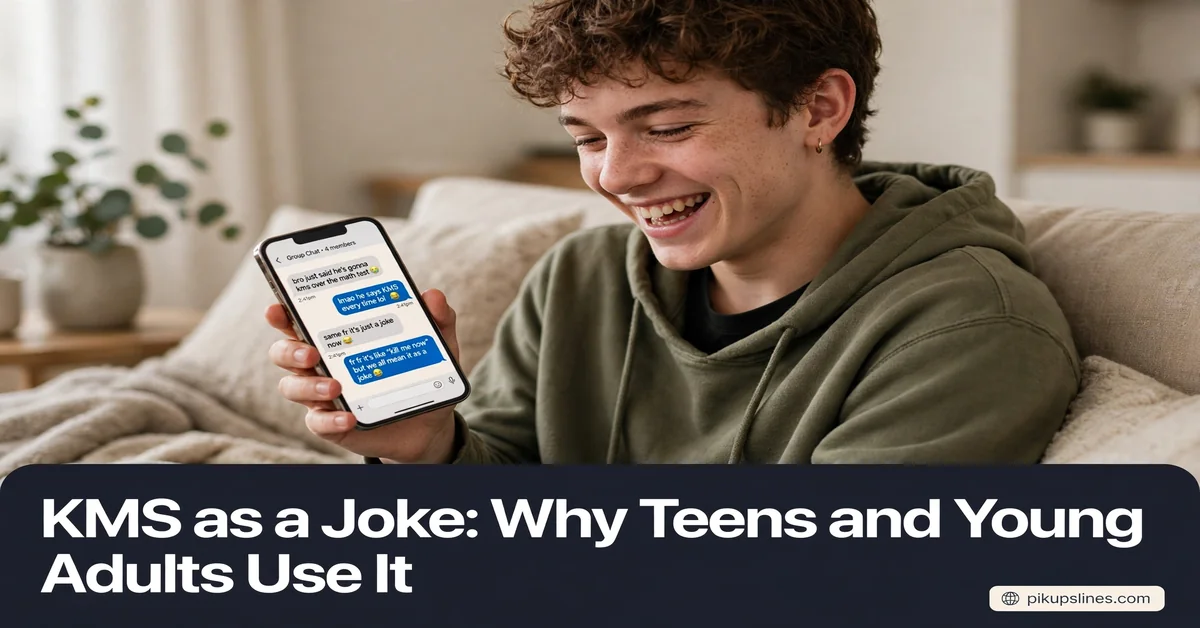
KMS appeared on Urban Dictionary by 2007 and on Twitter by 2009, and spread to Snapchat, Instagram, WhatsApp, and TikTok as shorthand for an over-the-top reaction, like “I’m dead” or “this is killing me.”
In that use, KMS is a tone marker, not a statement of intent. It can sit at the end of a sentence, as in “I’m out of Diet Coke kms,” or stand alone, as in “KMS! I just sent that screenshot to the wrong person.” It can also work as a verb phrase, as in “I’m gonna kms if this meeting runs over again.” The meaning is not “I plan to do this.” It is “This feels unbearable right now, in a funny, exaggerated way.” That exaggeration is the point: saying “I am mildly annoyed” does not match the gut-punch feeling of liking an ex’s old photo by accident. KMS matches the intensity of the feeling, even though the event is small. Emojis often soften it further, and without them, the same message can read as serious, especially to a parent or teacher. That gap, between what the sender meant and what the reader hears, is why KMS causes more confusion than most slang.
When KMS Is Not a Joke
Sometimes KMS is real, and the signs are different from a joke. Take it seriously if the message includes hopelessness, such as “I can’t do this anymore,” “nothing will get better,” or “everyone would be better off without me.” Take it seriously if the person talks about a method, a time, or a plan, even vaguely. Take it seriously if the person is withdrawing, giving things away, saying goodbye in an unusual way, or sounding calm after a long period of distress, which can sometimes mean a decision has been made.
Do not try to diagnose, and do not argue about whether the feeling is “big enough” to count. Your job is to stay, listen, ask directly, and connect the person to help. If you believe someone may act right now, stay with them if you safely can, and contact emergency services, such as 911 in the US or 999 in the UK. If the risk is not immediate, encourage them to contact a crisis line, a trusted adult, a counsellor, or a doctor, and offer to stay with them while they do it. In the US, call or text 988 for the Suicide and Crisis Lifeline, free and confidential, 24 hours a day. In the UK and Ireland, call Samaritans on 116 123, free, 24 hours a day. In other countries, search for your local crisis line. Do not wait for proof before sharing these numbers. This article is a slang guide, not medical advice.
How KMS Is Used Across Social Media
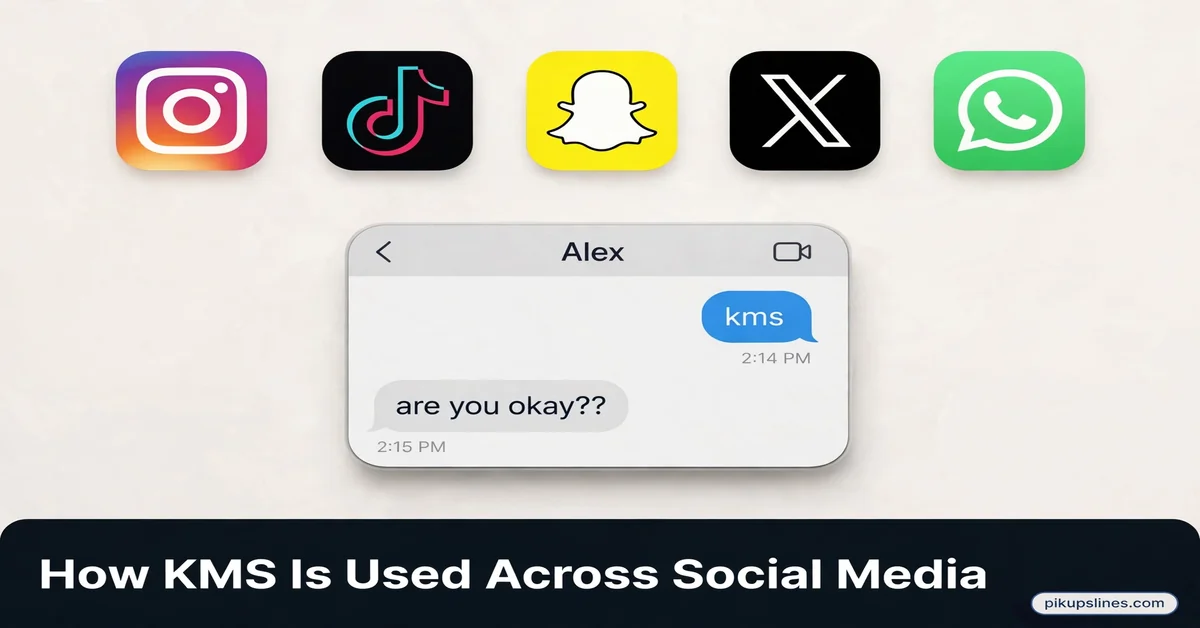
On Snapchat, KMS is common in private chats and Stories, often with disappearing messages, which makes full context harder to see. A Snapchat KMS after a small embarrassment is usually a joke, but a series of serious-sounding Snaps deserves a direct check-in, not just a reaction emoji. On TikTok, it appears in comments and captions as relatable exaggeration, such as “literal kms energy,” and creators sometimes write “K M S” or use coded words such as “unalive” to avoid moderation filters. That coded spelling does not change the meaning, but it can hide a serious message.
On Instagram, a public KMS under a meme is usually a joke, while a private DM KMS, sent late at night with no joke attached, deserves more care. On WhatsApp and in private texts, KMS is most often a real conversation with a close friend, and that is also where a serious KMS is most likely to appear, because people are more honest in private. Across all platforms, the meaning does not change by app. What changes is the audience, the privacy, and the context you can see.
KMS vs KMN, KYS, and FML
KMN means “Kill Me Now,” the same kind of dramatic venting as joke KMS, usually about a current annoyance, such as a boring meeting. KMS carries a heavier literal meaning, so it is more likely to alarm a reader who does not know the slang. KYS means “Kill Yourself,” directed at someone else as an insult or bullying, not the same as KMS, which is about the sender. It should never be used as a joke, and harassment using it deserves a report and a block. FML is also dramatic venting, but it does not reference self-harm directly, so it reads as complaining, while KMS can read as a warning, even as a joke. A simple rule helps: if the code is about the sender and sounds like venting, check the tone; if it is directed at someone else, it is harassment; if it mentions self-harm and the tone is hopeless, treat it as serious.
Other Meanings You Should Not Assume
In a text, KMS almost always means “Kill Myself,” in either its joke or its serious form. The other meanings below are real in narrow settings, but they are not general texting meanings.
Kilometers is the most common non-slang meaning: “120,000 kms” in a car listing, or “10 kms” in a fitness app, is distance, not slang, even though the official abbreviation is usually “km.” Key Management Service fits IT and cloud settings, Knowledge Management System fits corporate work systems, and Killing Me Softly fits music only. If you mean one of these, make the topic clear first, rather than making a friend guess between a distance, a software system, and a serious personal message.
Common Mistakes and Confusions
The biggest mistake is assuming every KMS is a joke, without checking the tone, which can miss a real warning. The opposite mistake is panicking over every joke, which can embarrass the sender and make them less honest next time. The cure for both is the same: ask directly, and listen to the answer. Replying to a serious-sounding KMS with a joke, a meme, or silence is another mistake. If you are not sure, “Hey, are you okay? That sounded serious, do you want to talk?” is better than a laugh, and better than no reply.
Using KMS casually around people who do not share the humour, such as parents, teachers, or managers, can sound alarming, even as a joke. In those settings, “I’m so embarrassed” says the same thing without the alarm. Using KMS repeatedly to test whether someone cares teaches friends to ignore it, which is dangerous if you later send it seriously. Confusing KMS with KYS, which is directed at someone else, or with FML, which is complaining without a self-harm reference, can turn a joke into an insult, or an insult into a missed warning. Finally, do not use KMS as a warning label. If a message that follows is heavy, label it first, in plain words. See TW meaning in text for how to write a clear trigger warning, and see WYO meaning in text for how a casual opener differs from a serious message.
When Not To Use KMS
Do not use KMS in a work email, a school assignment, or a message to a manager, a teacher, or a client, where it can look unprofessional or alarming, even as a joke. Do not use it with people you do not know well, unless you are sure they share the humour. Do not use it when you actually need help, or when you are feeling hopeless: say so in plain words, and contact a crisis line or a professional. Do not use it repeatedly for every small annoyance, which dulls its meaning and makes a serious message harder to spot later.
How To Reply To KMS
Your reply depends on what you think KMS means, and on what you hear in the tone.
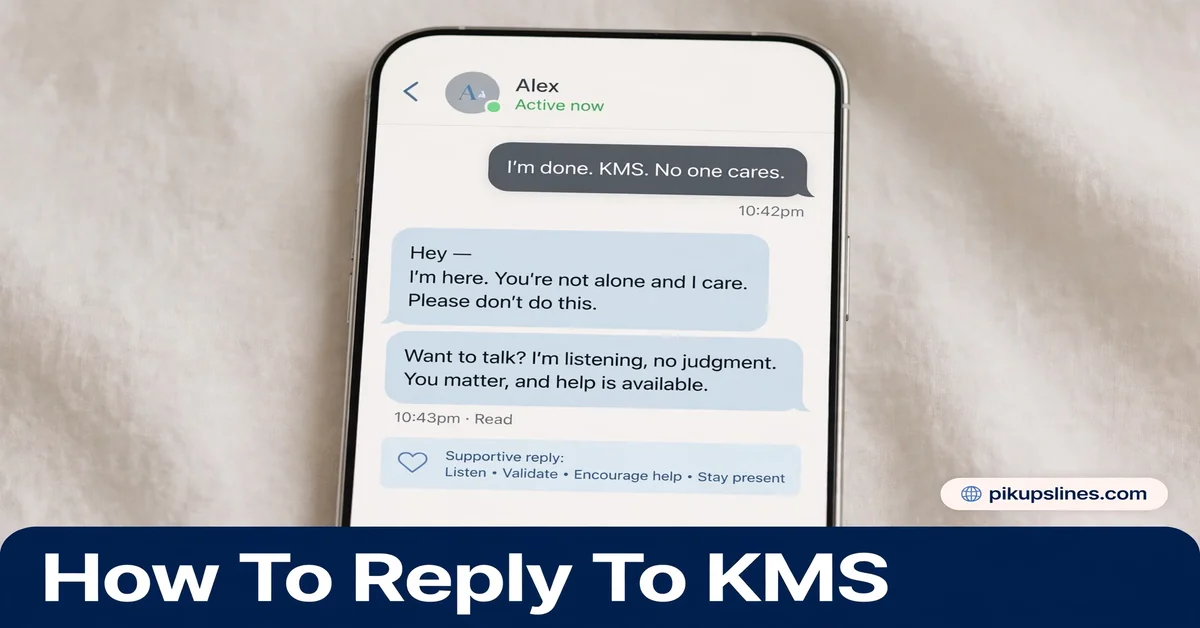
If it is clearly a joke, match the humour lightly: “Oh no, what happened?” If you are not sure, ask directly, and do not joke first: “Hey, are you okay? That sounded serious, do you want to talk about it?” If the person says it was a joke, laugh and move on. If they say they are not okay, stay, listen, and help them contact support. If it sounds serious, stay calm, do not argue, and do not leave suddenly. Ask “Are you thinking about hurting yourself?” Encourage them to contact a crisis line, a trusted adult, or a professional, and offer to stay with them while they do it. If you believe they may act right now, contact emergency services. If you receive KYS as an insult, do not reply in kind: block, report, and talk to a trusted person. If you are a parent or teacher and you see KMS in a child’s messages, do not panic or punish first. Ask what they meant, calmly, and use it as a chance to talk about feelings and when to ask for help.
Frequently Asked Question
What does KMS mean in messages?
KMS means “Kill Myself” in messages, almost always used hyperbolically to express frustration, embarrassment, or exhaustion. It is usually a joke about a small problem, but if the tone sounds serious, it should be taken seriously and checked.
What does KMS mean on TikTok?
On TikTok, KMS means the same as everywhere else: “Kill Myself,” used as overstatement. TikTok’s automated moderation may flag the phrase, so creators sometimes spell it as “K M S” or use coded variants like “unalive.”
What is the 988 number?
988 is the US Suicide and Crisis Lifeline. Call or text 988 from anywhere in the US for free, 24/7 mental-health support. It launched on July 16, 2022, and is free and confidential.
What does KMS mean on WhatsApp?
On WhatsApp, KMS means “Kill Myself,” the same hyperbolic slang use as in other chats. Because WhatsApp is private, a serious-sounding KMS there deserves a direct check-in, not just a reaction emoji.
What does KMS mean in text?
KMS in text means “Kill Myself.” When used in chat, it is usually a casual way to express frustration, embarrassment, or feeling overwhelmed, but it can also be a genuine reference to self-harm, so context matters.
What is KMS slang for?
KMS is slang for “Kill Myself” or “Killing Myself.” It is often used ironically or humorously by young people, but it can also be a genuine reference to thoughts of self-harm, so it should never be dismissed without checking.
What does being KMS mean?
If someone says “I am KMS,” that generally means “I am killing myself” in slang terms. The person may not genuinely mean that they are planning to harm themselves, as the phrase can be used in both ironic and serious ways.
Is KMS the same as KYS?
No. KMS is about the sender, while KYS means “Kill Yourself” and is directed at someone else, often as an insult or harassment. KYS should never be used as a joke, and harassment using it should be reported and blocked.
Conclusion
KMS has one main meaning in supporting someone who is struggling : Kill Myself, usually as dramatic venting about a small frustration, sometimes as a serious warning that must not be ignored.
The trigger, the tone, the repetition, and what follows tell you which one you are reading. A joke follows a small event and moves on, while a serious message follows hopelessness and does not.
When in doubt, ask directly, stay, listen, and help the person reach support, rather than guessing from three letters alone.