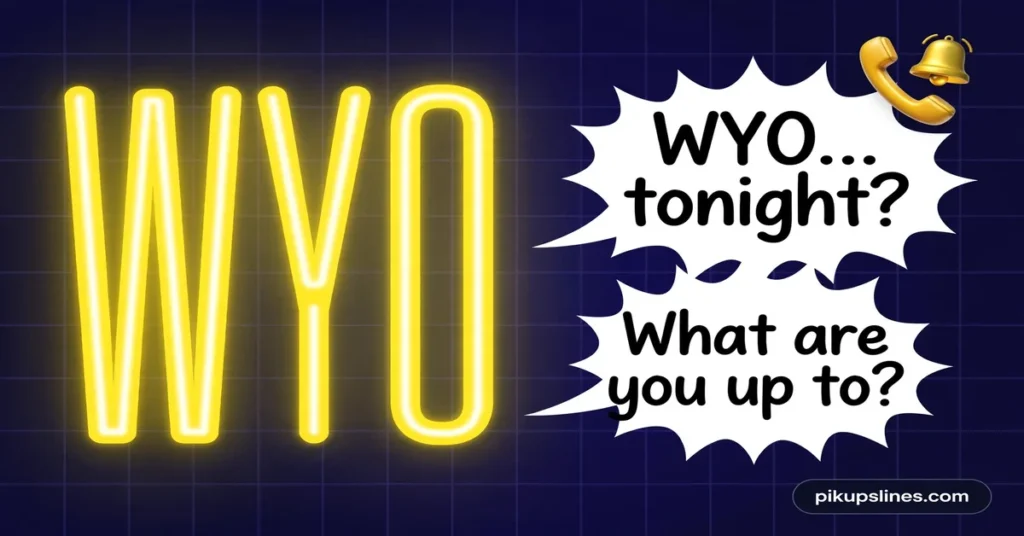
You get a text that just says WYO, and you pause. Is that a friendly check-in, a plan in disguise, or something flirty?
This guide answers that in plain words.
You will learn what WYO means, how to tell what the sender is really asking, how it differs from WYD, how to reply to it, and when not to use it.
Quick Answer
WYO = What You On?
WYO is a casual, open-ended way to ask what someone is doing, what their plans are, or whether they are free. It is not a formal question, and it is not a promise of plans on its own.
WYO Meaning Table
| Meaning | Where you see it | How to spot it |
|---|---|---|
| What You On? | Texts, Snapchat, Instagram, TikTok, Discord | A question to a friend, often with a time word |
| Wyoming | Addresses, sports scores, travel, news | A place, a team, or a code, not a chat question |
| What You Doing? (WYD) | Texts and chats, close cousin of WYO | Asks about right now, more than about plans |
| Where You At? (WYA) | Plans and meet-ups | Asks about location, not activity |
| Write Your Own | Contests, creative prompts, business forms | Only if writing or a form is already the topic |
| Watch Your Own | Gaming lobbies, livestream chats | An instruction, not a question about plans |
| What You Offering? | Buying, selling, trading chats | Only if a price or a trade is already the topic |
| Wish You Over | Very rare, romantic texts | Only if romance is already clear, otherwise do not assume it |
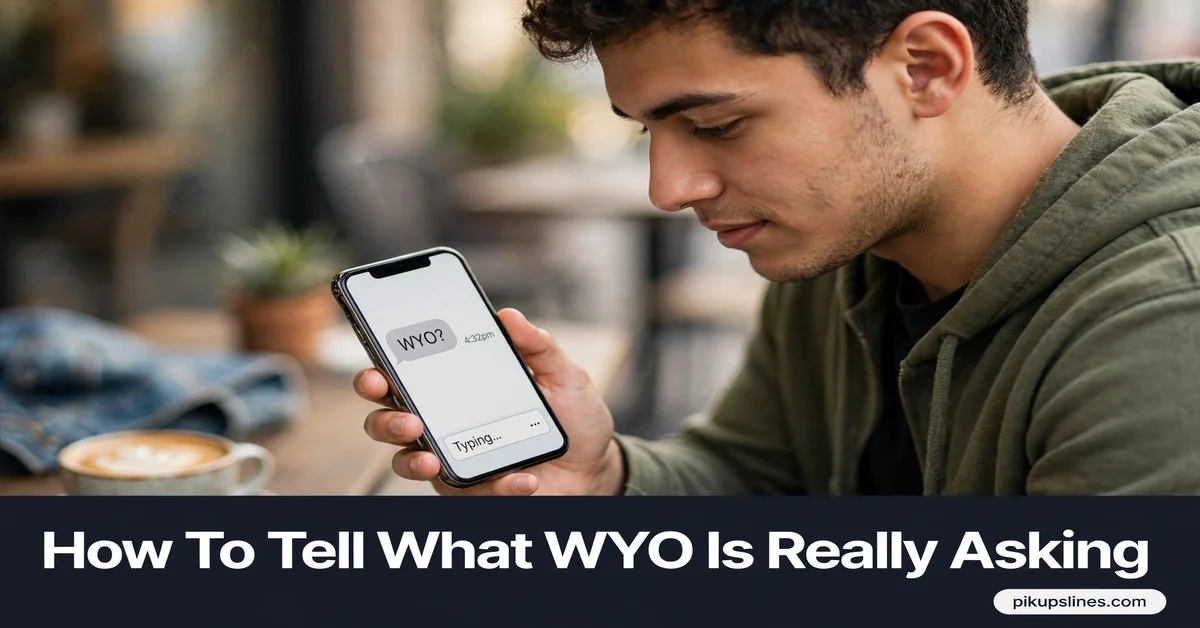
How To Tell What WYO Is Really Asking
WYO always asks about activity or availability, but it does not always ask the same follow-up question. Three clues tell you which one it is: the time word, the follow-up, and the sender.
If WYO comes with a time word, it is about plans. “WYO tonight?” means “What are your plans tonight?” “WYO this weekend?” means “What are you doing this weekend?” “WYO rn?” means “What are you doing right now?” The time word narrows an open question into a plan question.
If WYO comes alone, with no time word and no follow-up, it is usually a conversation opener. “WYO?” on its own is closer to “What’s up?” than to a plan. The sender may just want to talk, and the conversation that follows will show whether plans appear.
If WYO is followed quickly by a suggestion, it was a plan in disguise. “WYO tonight? Wanna grab food?” was never just a question. It was a test of availability before an invitation. That test is the point: WYO lets the sender check if you are free before committing to a specific plan, which feels less awkward than inviting you outright and being turned down.
Sender and timing change the tone again. A close friend at noon is usually checking in. A crush late at night may be testing whether you are free to talk or meet. An ex late at night may be testing whether the door is still open. The letters do not tell you that. The history, the hour, and the follow-up do.
If you are not sure, answer the literal question first, then ask what they had in mind. “Nothing much, why, what’s up?” keeps the chat open without assuming a plan, a flirt, or a reopening that was not intended.
WYO as What You On?
WYO stands for “What You On?” It comes from spoken American English, especially African American Vernacular English, where dropping “are” is normal, as in “what you doing” and “what you saying.” When SMS texting took off in the 2000s, people compressed phrases they already said out loud, and WYO followed the same path as BRB, TTYL, and IDK. Snapchat and Instagram DMs in the early to mid 2010s, then TikTok comment culture, made it a default low-effort opener.
In standard English, the same question would be “What are you doing?” “What are you up to?” or “What are your plans?” WYO is shorter, but it is also broader than any one of those. It can cover right now, tonight, this weekend, or in general, depending on the time word attached to it.
That breadth is why WYO works as a social tool, not just as shorthand. A full question like “Are you free tonight, and do you want to meet for food?” puts pressure on the receiver to answer yes or no to a specific plan. WYO puts almost no pressure on anyone. The receiver can answer with an activity, a plan, a joke, or a simple “nothing much,” and the sender can then decide whether to suggest something, keep chatting, or let the chat end. Both people keep an easy exit.
WYO is also a reconnecting tool. After a long silence, “Hey stranger, WYO these days?” is easier than “Why haven’t we talked?” It says “I’m thinking of you” without asking for an explanation for the gap. That is close to the feeling in IMY meaning in text, except WYO asks about activity, while IMY says you are missed. A WYO after silence can lead to an IMY feeling, but the two codes are not the same job.
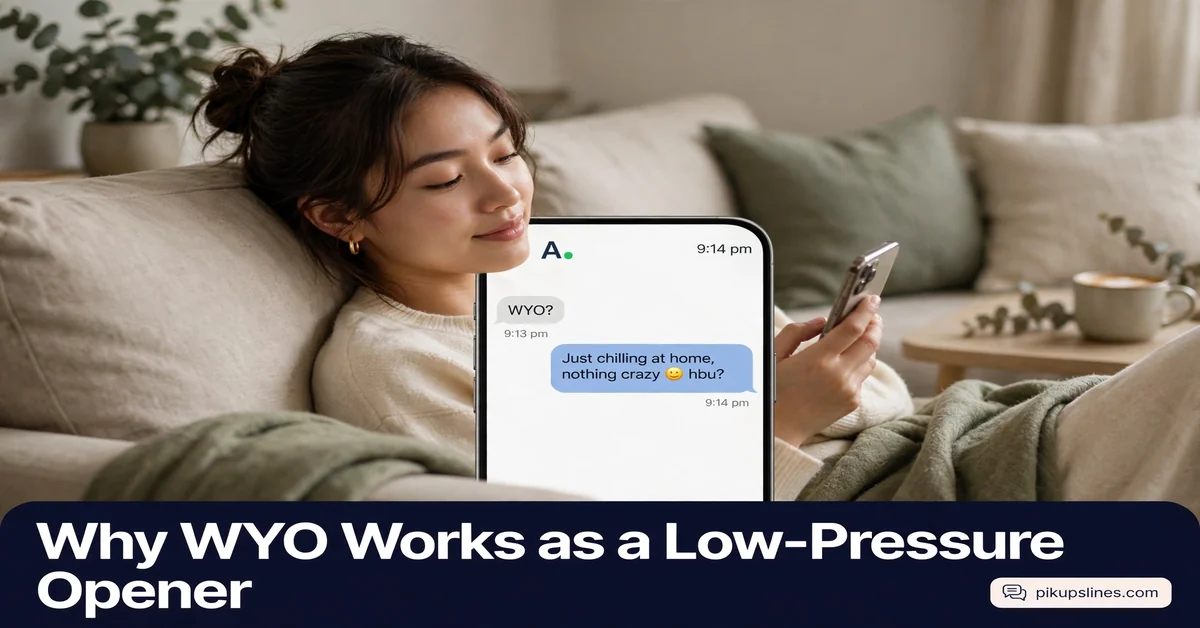
Why WYO Works as a Low-Pressure Opener
Competitors often call WYO lazy, but that misses its social function. WYO works because it gives the sender plausible deniability and the receiver an easy reply, and both sides know it.
For the sender, WYO tests availability without vulnerability. If the receiver is busy, the sender has not been rejected from a specific plan, only from a vague question. If the receiver is free, the sender can then suggest something specific. That two-step move, test first, invite second, is smoother than inviting first and hoping.
For the receiver, WYO is easy to answer honestly. “Just watching a show, why?” “Nothing much, you?” and “Busy today, but free tomorrow” are all complete replies. None of them requires a long explanation, a yes, or a no to a plan that was not yet offered.
That low pressure has a downside, which is also an information gain competitors often skip: a WYO with no follow-up, sent late at night to several people, can feel like a broadcast, not a personal message. If a sender opens a door and then ghosts the reply, the receiver learns that the WYO was about boredom, not about them. The cure is simple for senders: if you open with WYO, be ready to actually talk or suggest something when the reply comes.
Timing matters more than most guides say. An afternoon or evening WYO fits plans and check-ins, a 9 AM WYO with no context can feel random, and a late-night WYO from someone you are dating can feel flirty. The same three letters, at different hours, are different messages.
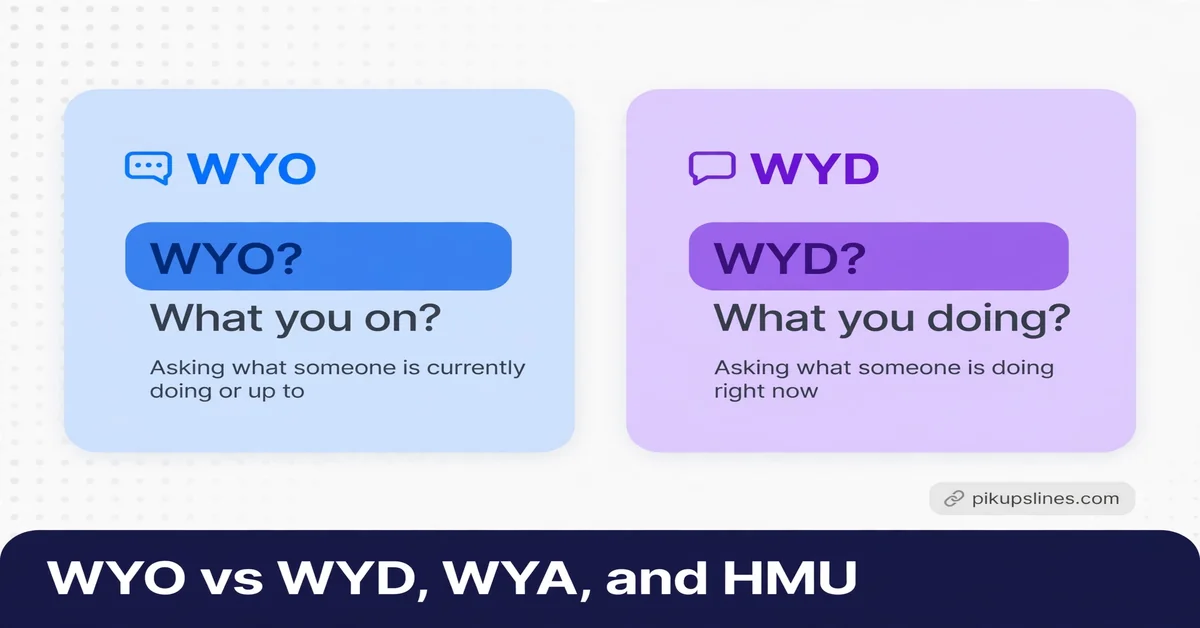
WYO vs WYD, WYA, and HMU
WYO is often mixed up with WYD, but the difference is emphasis, not a completely different meaning.
WYD means “What You Doing?” It asks about this exact moment. WYO means “What You On?” It is broader, covering right now, tonight, or in general, and it leans more toward plans and availability. WYA means “Where You At?” It asks about location, not activity, so “WYA?” after a plan is made is a location check, while “WYO tonight?” before a plan is made is an availability check. HMU means “Hit Me Up,” an invitation to contact later, not a question now. A simple rule helps: WYD is now, WYO is now plus plans, WYA is where, and HMU is “contact me later.” Answering a WYO with both activity and a question, “Just chilling, why, what’s up?”, covers both jobs.
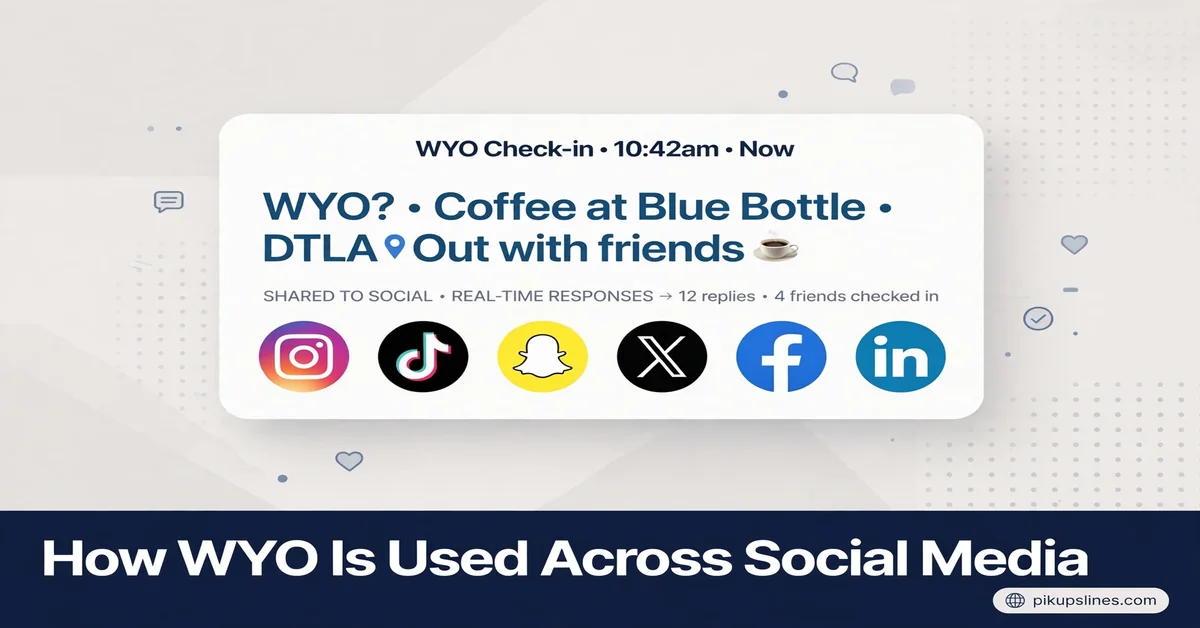
How WYO Is Used Across Social Media
On Snapchat, WYO is a quick check-in, often alone as “WYO?” A late-afternoon or evening WYO there is often a plan test, while a morning WYO is more often a simple opener. On Instagram, it appears in DMs, often as a reply to a Story, and in comments such as “WYO this weekend?” under a group photo.
On TikTok, WYO in comments and captions is less often a real plan, because the audience is public, and more often a shared joke about being bored or free. On WhatsApp and in private texts, it is most often a real plan question, because the audience is already close: “WYO Saturday?” in a group is a plan poll in disguise. On Discord, “WYO tonight, wanna run a game?” is the clearest form, because the activity is attached.
In a group chat, WYO can also work like a group greeting, similar to GNG meaning in text, but it is not the same job. GNG addresses the group. WYO asks the group what they are doing.
Other Meanings You Should Not Assume
In a text or a DM, WYO almost always means “What You On?” The other meanings below are real in narrow settings, but they are not general texting meanings.
Wyoming is the state abbreviation, written as Wyo. in addresses, sports scores, and travel contexts. “Cheyenne, WYO” is a place, not a question. Write Your Own fits contests and forms, Watch Your Own fits gaming lobbies as an instruction, What You Offering fits buying and trading chats, and Wish You Over is a very rare romantic expansion. Each only fits when its topic is already clear. If you mean one of them, spell it out first, rather than making a friend guess.
Common Mistakes and Confusions
The biggest mistake is assuming every WYO is flirty. Flirt comes from the sender, the hour, the emoji, and the follow-up, not from WYO alone. The second mistake is assuming every WYO is an invitation. Sometimes it is just a conversation starter, so answer with activity plus a question, “Nothing much, why?”, and let the sender reveal whether a plan was intended.
The third mistake is treating WYO and WYD as exact synonyms. WYD is about right now, while WYO is broader and more plan-leaning, so reading them as identical can miss a plan question. The fourth mistake is sending WYO and then ghosting the reply, which teaches the receiver that your check-ins are low-effort. The fifth mistake is using WYO when you need specific information, such as a deadline or a travel time. Finally, a WYO is not a warning. If the chat that follows turns heavy, label that topic first. See TW meaning in text for how to do that.
When Not To Use WYO
Do not use WYO in a work email, a school assignment, or a message to a manager, a teacher, or a client, where it can look careless or confusing. “What are you working on?” or “Are you available?” is clearer and safer. Do not use it with people you do not know well, unless the chat is already casual, and do not use it when you need a specific answer, such as a time or a decision, because a vague opener will usually get a vague reply. Do not send it repeatedly after no reply, as pressure. Use WYO with close friends, in casual chats, when you want to check in or test plans.
How To Reply To WYO
Your reply depends on what you think WYO is asking, and on what you want to do next.
If it is a simple check-in, answer with your activity and ask back: “Just watching a show, wbu?” If it is a plan question, answer with availability, not just activity: “Nothing planned tonight, why, what’s up?” or “Free tomorrow, what are you thinking?” If it is flirty and you want to match that tone, try “Nothing, why, what did you have in mind?” If you do not want that tone, answer plainly, change the subject, or say you are busy. You do not owe a flirty reply just because the question was casual. If you are busy, say so briefly and offer another time: “Kinda busy rn, but free tomorrow.” If you do not want to continue, a short, polite reply is enough.
WYO Examples in Real Chats
Short examples show how WYO actually sounds in a chat. The words stay the same, but the plan behind them changes. The same idea applies to other short codes, like BR meaning in text.
Making Weekend Plans
Ana: WYO this weekend?
Ben: Nothing yet. Why, what are you thinking?
Ana: Movie night on Saturday? I will bring snacks.
A Crush Checking In
Sara: WYO rn?
Ali: Just chilling. You?
Sara: Same. Want to call for a bit?
A Group Chat
Zain: WYO all tonight?
Mia: Free after 7.
Leo: Same here. Game night at my place?
A Late-Night Text
Emma: WYO?
Noah: Still up, watching a show. You?
Emma: Same. Could not sleep, so I texted you.
WYO From a Guy or a Girl
From a Girl
When a girl sends WYO, it usually means she wants to talk or make plans. With a friend, it is a simple check-in. With a crush, it can be a soft way to start a conversation. The time of day and the follow-up tell you which one it is.
From a Guy
When a guy sends WYO, it usually means the same thing: he is checking if you are free. Guys often use WYO as a first step before suggesting a plan. With a friend, it is casual. Late at night, it can carry a flirty hint.
Is WYO an Invitation?
Sometimes, yes. “WYO tonight?” is often a plan in disguise. The sender is testing whether you are free before suggesting something specific. If you answer that you are free, expect a plan to follow.
But not every WYO is an invitation. Sometimes it is just a conversation starter, a way to say hello without a plan in mind. Answer with your activity plus a question, like “Nothing much, why?”, and let the sender show whether a plan was intended.
WYO Late at Night: What It Usually Means
A WYO sent late at night usually means more than a daytime one. At night, people are free, relaxed, and thinking about someone. A late WYO often means “I am thinking of you” or “Are you still up?”
It can also be flirty, especially from a crush. But it is not always flirty. A friend who cannot sleep might send the same message. Check the sender, the hour, and what came before it. If you are not sure, a light reply keeps things easy.
Is WYO Still Popular in 2026?
Yes, WYO is still common in 2026. It shows up on Snapchat, Instagram, and TikTok every day. It grew from spoken slang in the 2010s, and short forms like WYO stay popular because they feel casual and quick.
On Snapchat, WYO is still a go-to opener for plans. On TikTok, it appears in comments and captions as a joke about being bored or free. The letters are old, but the habit is not.
Frequently Asked Questions About WYO Meaning in Text
What does WYO mean in a text message?
WYO means “What You On?” in a text message. It is a casual way of asking someone what they are doing, what their plans are, or whether they are free, often used between close friends to start a conversation or kickstart plans.
Is WYO the same as WYD?
They are similar, but not exactly the same. WYD, meaning “What You Doing?”, focuses on what someone is doing at this specific moment. WYO is slightly broader and often implies checking on plans or availability, not only right now.
Can WYO be used in a romantic context?
Yes. WYO can carry a flirty or romantic undertone depending on who sends it and how. A “WYO later?” from someone you like is often an indirect way of suggesting they want to spend time with you, but context and relationship make all the difference.
What is the best way to reply to WYO?
The most natural replies are “nothing much, wbu?”, “just chilling, why, what’s up?”, or “free tonight, what are you thinking?” Match the casual energy, keep it light, and if you are busy, say so briefly.
Is WYO rude?
Generally, WYO is casual and friendly, not rude. Misunderstanding can happen if tone is missing, so adding an emoji can help clarify intent, and sending it repeatedly after no reply can feel pushy.
Can WYO be used professionally?
No. WYO is informal slang, best reserved for friends, peers, or casual online chats. In a work email or a formal message, ask “What are you currently working on?” or “Are you available?” instead.
Is WYO flirty?
Sometimes, but WYO is not inherently flirty. Whether it feels romantic depends on who sends it, the timing, and what happens next. A friend at noon is usually just checking in, while a late-night message from someone you are dating can feel more suggestive.
What does WYO mean besides “What You On?”
In geographical or official contexts, Wyo. can mean Wyoming, the US state. In a text conversation, however, WYO almost always means “What You On?”, unless travel or geography is already the topic.
What does “WYO tonight?” mean?
It means “What are your plans tonight?” It is usually a plan question or an invitation, not just small talk. If you are free, expect the sender to suggest something next.
Is WYO the same as “What’s up?”
Not quite. “What’s up?” is a greeting. WYO asks what you are doing or whether you are free. It expects a real answer, not just “nothing much.”
Is WYO still popular in 2026?
Yes. It is still common on Snapchat, Instagram, and TikTok. Short forms like WYO stay popular because they feel casual and quick.
Conclusion
WYO has one main meaning in making plans with friends: What You On?, a casual, open-ended question about activity, plans, and availability.
The time word, the follow-up, and the sender tell you what kind of question it really is. A plan question, a simple check-in, and a flirty test can all start with the same three letters.
Answer the literal question first, ask what they had in mind, and you will not need to guess what WYO means in the message in front of you.