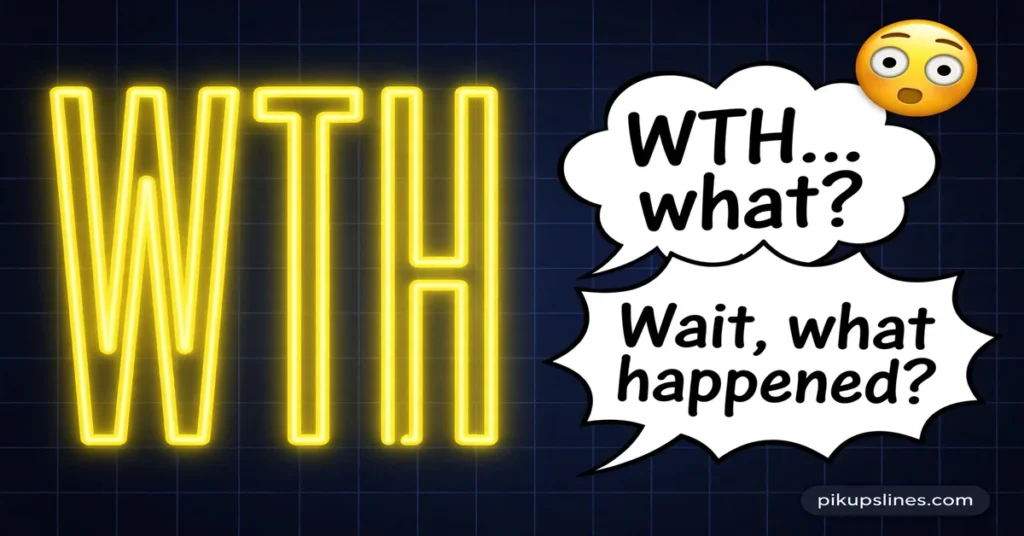
You opened a message that just says WTH, and you cannot tell if your friend is shocked, annoyed, or joking.
This guide sorts it out in plain words.
You will learn what WTH stands for, why heck and hell both show up, how punctuation changes the volume, and how to reply without starting a fight.
Quick Answer
WTH = What The Heck
WTH = What The Hell
Both readings are used, and the sender does not get to pick which one you hear. That is the first thing to understand about WTH, and it explains why the same three letters can feel mild to one person and stronger to another.
WTH Meaning Table
| Feeling | Where you see it | How to spot it |
|---|---|---|
| Surprise | News, plot twists, unexpected photos | WTH alone, or WTH with a laughing emoji |
| Confusion | Unclear instructions, strange messages | WTH followed by a question about what happened |
| Disbelief | Claims that sound unlikely | WTH, really? or WTH, no way |
| Mild annoyance | Tech trouble, changed plans, bad service | WTH is wrong with this? or WTH, again? |
| Playful frustration | Jokes, teasing, funny fails | WTH with a laughing face, in a chat that is already joking |
| A demand for an explanation | A message with no context, a sudden change | WTH?? with two question marks, or WTH about what? |
How To Tell Which Feeling WTH Carries
WTH is an interjection, not a full thought. It is a burst of feeling first, and an explanation second, if there is one at all. That is why it is easy to misread. Use four checks, in order, before you react to it.
First, what happened just before it? A wild piece of news points to shock. A confusing message points to “I do not understand.” A bad service experience points to annoyance. A laughing emoji points to amusement. The event is the strongest clue.
Second, what does the rest of the message say? “WTH, you got me tickets?!” is happy shock. “WTH is wrong with this app today?” is frustration. A lone WTH with no rest of the message is the hardest case, and there you should ask, not assume.
Third, who sent it, and how do they usually text? A close friend who jokes all day can send a playful WTH. A person you barely know, sending WTH in all caps, is harder to read as playful. A pattern across the whole conversation tells you more than one message does.
Fourth, what is the volume? That is the next section, because punctuation and case do more work in a WTH message than they do in most slang.
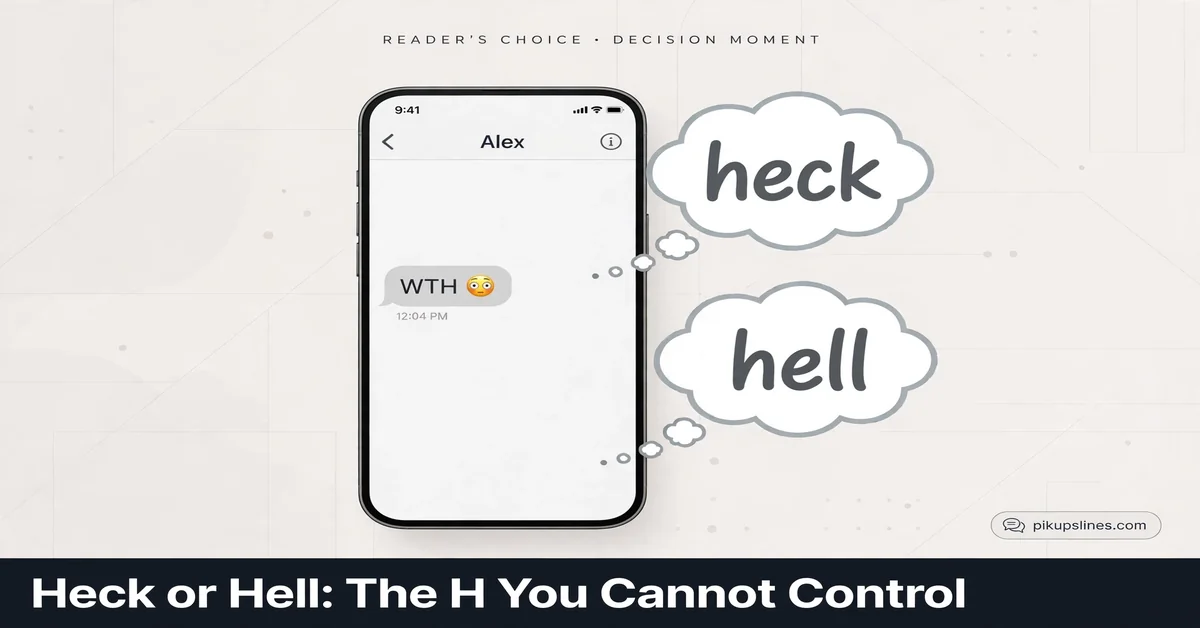
Heck or Hell: The H You Cannot Control
Here is the point most guides skip, and it is the reason WTH causes arguments that the sender did not expect. When you type WTH, you do not write out the H word. You write a letter. The reader fills in that letter in their own head, and different readers fill it in differently.
Some readers hear “heck.” That is the mild, family-friendly reading, and it is the reading many senders intend. Some readers hear “hell.” That is stronger, and for people who dislike swearing, it is enough to make the message feel rude, even if the sender meant it lightly. Dictionaries that track slang label WTH as mildly vulgar for exactly this reason, because of the hell reading, not because the letters themselves are a swear word.
You cannot control which reading the other person picks, and you cannot add a footnote that says “I meant heck.” That is why audience matters more with WTH than with many other abbreviations. In a conservative area, or with a person who dislikes swearing, “heck” is the safer assumption, but it is still an assumption. If you would not say “what the hell” to this person out loud, do not text WTH to them and hope they hear “heck.”
The same split explains regional differences in a general way, without pretending to have exact statistics. In the United States, “heck” is common in more conservative regions and “hell” is more common in urban speech, while in the United Kingdom many people prefer “what on earth?” in the same situation. The point is that the H is not neutral, and the reader, not the sender, decides how strong it sounds.
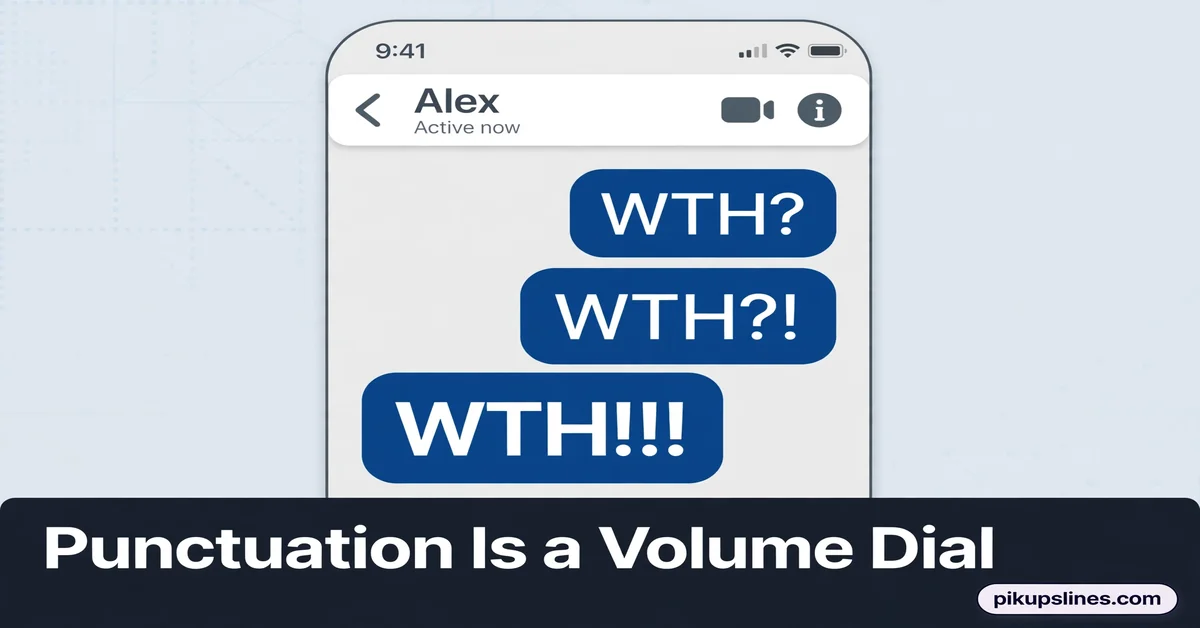
Punctuation Is a Volume Dial
With WTH, punctuation is not decoration. It is volume, and it is often the only tone clue in the message.
“WTH?” with one question mark sounds curious. It asks for an explanation, even though WTH itself is not a full question. “WTH?!” sounds louder and more upset. “WTH!!!” sounds like shouting, and in a sensitive chat it can read as an attack, even if the sender was only surprised.
Lowercase “wth” usually feels relaxed and casual. It is the version you see in a quick, joking chat. Uppercase “WTH” in the middle of a sentence is normal, because abbreviations are often written in capitals. Uppercase “WTH!!!” with several exclamation marks is a different message, and it should be read as a louder one.
“WTH??” with two question marks is a special case. It does not just express surprise. It demands an explanation, and it often means “I have no context for what you just did, explain it now.” If you get a “WTH??” with no other words, do not answer with another short reaction. Answer with the missing context, or ask what part needs explaining.
Emojis steer the meaning in the same way. A laughing face softens WTH. An angry face sharpens it. A skull emoji in a TikTok comment usually means “I am shocked, but entertained,” not “I am angry.” No emoji at all leaves the most room for misreading, which is why a lone WTH after you did something can feel like possible irritation, even when the sender only meant surprise.
WTH in Speech, and the Meanings You Should Not Assume
In text, WTH is common. In speech, people mostly say the full phrase, “what the heck” or “what the hell,” with a laugh, a gasp, or a frown that tells you which feeling it is. Saying the letters aloud, “double-u tee aitch,” is less common, though some people do it as a joke. In speech the voice does the work that punctuation has to do in text.
Outside of chat, a few other uses of wth exist, but they are rare, and you should not assume them in a normal message. In older English writing, wth was sometimes used as a short form of “with,” but that use is obsolete today. Wiktionary also lists wth as a symbol linked to the Wathaurong language, an Australian Aboriginal language. Some brands or groups may use WTH as initials. If you see WTH in a business or school setting, check the surrounding text. In a normal message from a friend, the texting meaning is the one to assume.
WTH also has a long history behind it, though no reliable source pins down an exact first use, so treat any specific year you see online with caution. The phrase “what the hell” is much older than texting. The abbreviation only made sense once typing became the main way people talked, in chat rooms, instant messaging, and SMS, when every character counted.
How WTH Is Used Across Social Media
The core meaning of WTH stays the same everywhere. The flavor changes a little by platform, because each platform has a different kind of conversation.
On Instagram, people drop WTH in comments and story replies when a post shocks or confuses them. Under a funny photo, it reads as amusement. Under a serious post, it reads as concern. On TikTok, comments use WTH for plot twists and unexpected endings, often paired with laughing or skull emojis to show “I am shocked, but entertained.” On Snapchat, WTH in a private reply usually points to something a friend just did or sent, and it is rarely meant to start a fight. On X, WTH appears in reactions to news, product bugs, and public mistakes, and here it leans more toward annoyance than humor.
In gaming and Discord chats, WTH is a quick reaction to a surprising move or match moment. In group chats, it works best when the group already knows each other well. In a mixed group, it can feel too bold. A group plan that suddenly changes is a classic WTH moment, and the same group will often follow it with a plan question, as with WYO meaning in text, to sort out what happens next.
WTH vs Similar Reactions
WTH sits in the middle of a ladder of reactions, and that middle position is why people reach for it so often. It is stronger than “wow,” but milder than WTF.
WTF is a stronger, ruder version. It uses a much stronger swear word, and it reads as intense anger or shock, not mild surprise. If you want the feeling without the edge, WTH is the safer choice, but it is not a clean word, because of the hell reading above.
WDYM, short for “what do you mean,” is a gentler way to ask for an explanation. It does not carry the emotional spike of WTH. If you are confused and you do not want to sound annoyed, WDYM is often the better choice. OMG is surprise, usually without annoyance, and it can be positive. SMH, shaking my head, is disappointment or disbelief, not surprise, and it judges the other person more than WTH does.
A useful test is this: if you want to ask for clarity, use WDYM. If you want to share shock, use WTH. If you want to show disappointment, use SMH.
When Not To Use WTH
Skip WTH when the setting or the person calls for care. That includes work emails and formal messages, messages to a boss, a client, or a teacher, school assignments, and business presentations. In those settings, clearer, calmer words work better, such as “Wait, what happened?” or “That is surprising.”
Skip it in serious or emotional topics. After bad news, WTH may seem careless, even if you meant it as shock. The same is true in conflicts and arguments, where it can pour fuel on the fire.
Skip it with people who dislike swearing, even the mild version, and with younger children, for the same reason.
Skip it as your only reply to a serious warning. Some messages need care, not a reaction, as with KMS meaning in text. A WTH there does not show you understood the seriousness. It shows you were surprised and moved on. The same care applies to sensitive content that needs a warning first, as with TW meaning in text. If a topic needs a warning or a careful reply, give it that, not a three-letter reaction.
A simple test helps: if you would say “what the heck” to this person out loud, you can probably text WTH. If you would not say it out loud, do not text it.

How To Reply To WTH
Your reply should match the mood of the message, not just the letters. Read it first, then respond to the feeling behind it.
If they are confused, explain. “Sorry, let me explain.” If they are shocked about news, share the surprise. “I know, I could not believe it either.” If they sound upset, check in. “Hey, are you okay? What happened?” If it is playful, laugh with them. “Haha, I know, it is wild.”
If you do not understand the WTH at all, ask for the missing piece. “WTH about what? Can you tell me more?” A calm follow-up question is almost always better than a defensive reply, and it is better than replying with another WTH, which only loops the confusion.
If a WTH felt like the start of a fight, do not match its volume. A short, calm acknowledgment works better than a louder reaction, and you can move a serious topic to a call, as in IGHT meaning in text, where a plain “ight, let me explain” can acknowledge the message and then give the explanation it was asking for. In a group chat, the same idea applies, and the group itself matters, as with GNG meaning in text, because a WTH in a close group reads differently from a WTH in a mixed group.
If you sent a WTH and it landed badly, repair it in plain words. “I meant surprised, not angry.” That one sentence does more than another abbreviation, because it removes the heck-or-hell guesswork that caused the problem in the first place.
Frequently Asked Question
What does WTH mean in text?
It means “what the hell” or “what the heck.” People use it to show surprise, confusion, or annoyance in casual chats, comments, and group messages.
What is the full form of WTH in chat?
The full form is “What The Hell,” also read as “What The Heck.” The heck reading is milder, and many people prefer it to avoid sounding offensive.
Is WTH a bad word?
Not exactly. It is mild slang, but it comes from a phrase with “hell,” so some people see it as slightly rude. The abbreviation feels softer than the full phrase, but it is not a clean word for every audience.
Is WTH the same as WTF?
No. Both express shock, but WTH is softer and less offensive than WTF. WTF uses a much stronger swear word and reads as intense anger or shock.
Does WTH always mean anger?
No. It can also show confusion, shock, happy surprise, or playful frustration. Emojis and the rest of the message tell you which way it leans.
Can I use WTH at work?
Usually not. Stick to clear, neutral language in work emails unless your team chats very casually. In formal messages, WTH can sound unprofessional and emotionally reactive.
What does WTH mean on TikTok and Instagram?
On TikTok and Instagram, it appears often in comments and replies to react to surprising posts or videos. On TikTok it often pairs with laughing emojis for shock mixed with amusement, while on Instagram it can read as amusement or concern depending on the post.
How do I reply to WTH?
Match the mood. Explain if they are confused, share the surprise if they are shocked, and check in if they sound upset. If you do not understand, ask what part needs explaining instead of replying defensively.
Conclusion
WTH means what the heck, and sometimes what the hell, and the difference is not in the letters, but in handling conflict over text with care, in the reader, the punctuation, and the situation around it.
A question mark asks for an explanation. A laughing emoji softens it. All caps and several exclamation marks make it louder.
Check the event, check the volume, and check the person, and you will not need to guess.