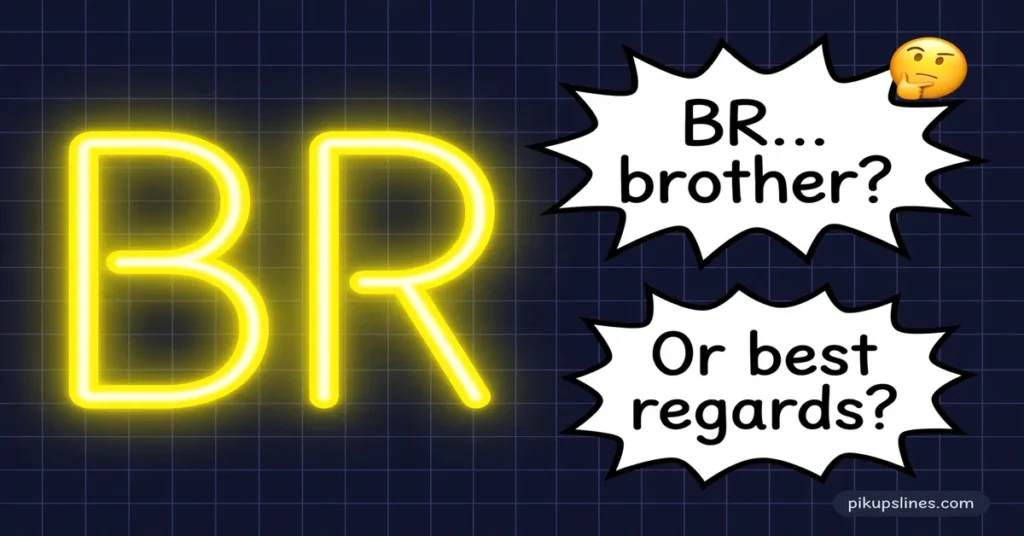
You saw BR in a message and stopped, because it could be a friend, a sign-off, or a game.
This guide sorts it out in plain words.
You will learn the position test that settles most cases, the three main meanings, the BRB trap, and how to reply without guessing.
Quick Answer
BR = Brother, or Bro
BR = Best Regards
BR = Be Right, as a clipped pause
Those are the three main meanings in chat and email. A fourth, Battle Royale, appears only when gaming is already the topic. No single one of these is “the” meaning of BR on its own. Position and topic decide which one you are looking at.
BR Meaning Table
| Meaning | Where you see it | How to spot it |
|---|---|---|
| Brother, or Bro | Friendly chats, comments, gaming talk | Used as an address, often lowercase br, in a friendly message |
| Best Regards | Work chats, business emails | At the very end of a message, often before a name |
| Be Right, as a pause | Live chats, streams, group messages | At the start, with a reason or a time after it, as in br, need a sec |
| Battle Royale | Gaming chats, game comments | Used as a noun for a game mode, when games are already being discussed |
| Bathroom Break | Live chats, group messages | Less common, only as a pause, with a return implied |
| Brazil, or HTML line break | Country topics, code, technical chats | Topic-only meanings, never assume them in a normal chat |
The Position Test: Where BR Sits Tells You What It Means
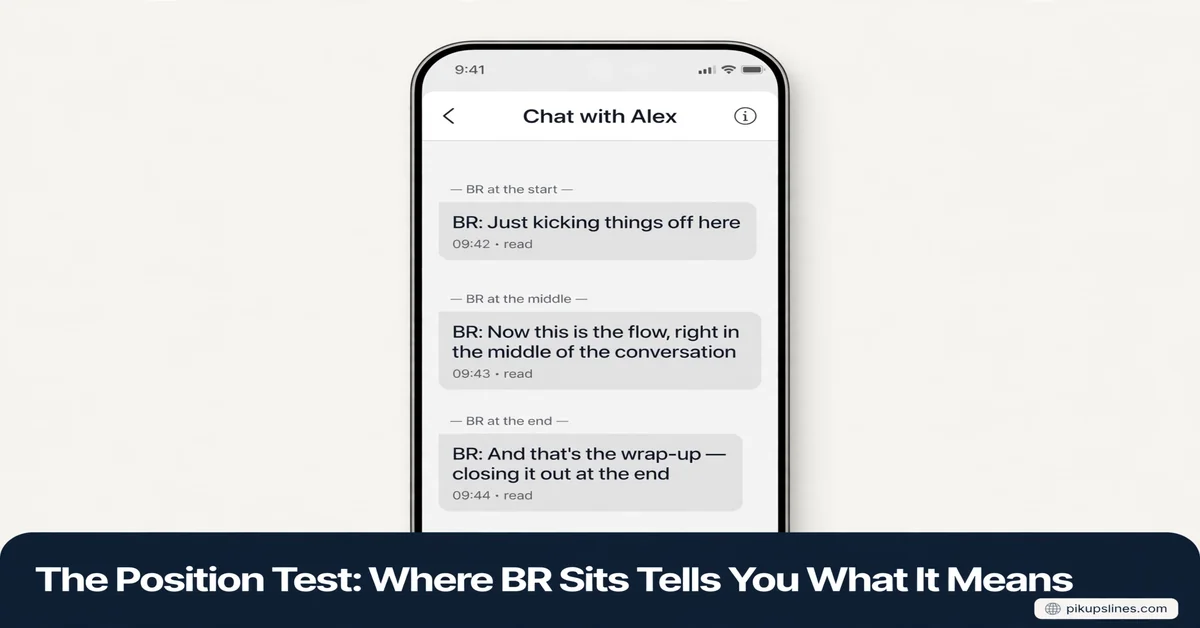
Most guides list BR meanings and then say “context matters,” without saying how to use context. Position is the fastest check, and it settles most cases.
If BR comes at the start, with a reason or a time after it, it is usually a pause. “Br, need a sec.” “Br, phone call.” “Br 2 mins.” The sender is stepping away and plans to return. The words after BR are the clue, because a sign-off would not be followed by a reason to leave, and an address would not be followed by a time.
If BR comes at the very end of a work message, often before or after a name, it is usually Best Regards. “Please review the attached file. BR, Ahmed.” The message is finished, and BR is doing the job of a closing. If the same BR came at the end of a friendly message, as in “Thanks br,” it is an address, not a closing.
If BR sits in the middle of a friendly message, or at the end of a friendly message as a name for the other person, it is usually Brother or Bro. “Hey br, what is up?” “Thanks br.” Here BR is not closing anything and it is not pausing anything. It is calling the other person a friend.
If BR sits before a noun for a game, as in “BR games are addictive,” it is Battle Royale. The noun after it, and the gaming topic around it, do the work. Without a gaming topic, do not read Battle Royale into a chat BR.
Position is not perfect. A work message can end with “Thanks br” from a friendly colleague, and a gaming chat can start with “br, dinner,” meaning a pause, not a game mode. Position gives you the most likely reading. Topic, sender, and the words around BR confirm it. If position and topic point in different directions, ask.
BR as Brother or Bro
In casual chats, lowercase br is most often a short form of bro, which itself is short for brother. It is friendly, warm, and relaxed, and it is used as an address, not as a statement.
“Thanks br.” “You coming later br?” “Nice play br.” In each case, br names the other person as a friend. It does not add new information about a plan or a topic. It adds closeness.
That closeness is why br can feel wrong in the wrong chat. Calling a date “br” in a romantic chat can signal a platonic, friend-zone tone, even if the sender did not mean it that way. The word itself is not romantic, and it is not affectionate in the way a message that says someone is missed is, as with IMY meaning in text.
Br as brother is not limited to men, and it does not change meaning by the sender’s gender. Position and the chat decide the meaning, not the sender’s gender.
BR as Best Regards
In work chats and business emails, BR at the end of a message usually means Best Regards. It is a polite closing, shortened for speed.
“Looking forward to hearing from you. BR.” “Thanks for your support. BR, Sarah.” In each case, BR comes after the main message is finished, and it does the job that “Best regards,” would do in a full email.
Best Regards has a long history as a polite letter closing, and BR grew as email and fast work messaging made shorter closings useful. Another shorthand is BRGDS. Neither is more polite than the full phrase. They are faster, not warmer.
That speed has a cost. In a first email to a client, an executive, or someone you do not know well, writing out “Best regards,” looks more polished than “BR.” In a fast internal chat with colleagues who already use BR, the shorthand is normal. The rule is “match the formality of the relationship.”
Do not confuse Best Regards with a greeting. BR as Best Regards never opens a message. If BR opens a message, it is not a sign-off, no matter how formal the sender sounds.
BR as Be Right, and the BRB Trap
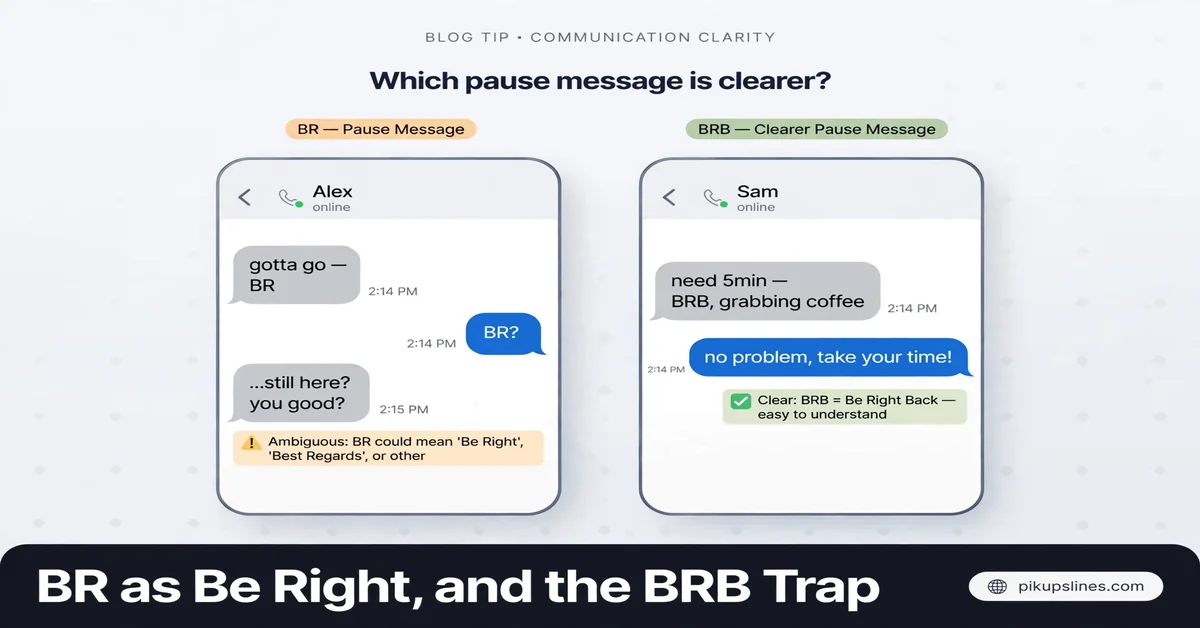
Here is the trap that causes the most confusion, stated plainly: BR is not the standard abbreviation for “be right back.” BRB is.
BRB grew up in early instant messaging and chat rooms in the 1990s, as a quick way to say “do not wait for my reply for a minute, I will return.” BR as a pause is a clipped, shorter form of the same idea, as in “br, need a sec,” used in live chats and streams.
The problem is that BR alone already has two other strong meanings, Brother and Best Regards, so a bare BR pause is ambiguous in a way BRB is not. “BR” on its own could be a pause, a sign-off, or an address. “BRB” on its own is almost always a pause.
If clarity matters, use BRB for a pause, not BR. If you are replying to a BR pause, a short acknowledgment works, as with IGHT meaning in text, where “ight, take your time” acknowledges the pause and then waits. If you sent a BR pause and people kept talking to you, add a reason or a time: “br, back in 5” is clearer than “br” alone, and “brb, back in 5” is clearer still.
Bathroom Break belongs in this same pause family, but it is less common and it only works as a pause in a live chat. Do not assume it for a BR in an email or a comment.
BR in Gaming, and Other Topic-Only Meanings
In gaming, BR usually means Battle Royale, a game mode where players compete until one winner remains. “You play BR games?” Popular examples include Fortnite, PUBG, Apex Legends, and Warzone. In that setting, BR is a noun, not a pause and not a sign-off.
Battle Royale only applies when gaming is already being discussed. A BR in a work email is not a game mode. A BR in a gaming chat could still be a pause, as in “br, dinner,” so even in gaming, position matters.
Other BR meanings are topic-only, and you should never assume them in a normal chat. BR is the country code for Brazil, <br> is an HTML line break in code, it can mean bed rest in medicine, and Br is bromine in chemistry. If the topic is not already set to one of those subjects, do not use those meanings to decode a chat message.
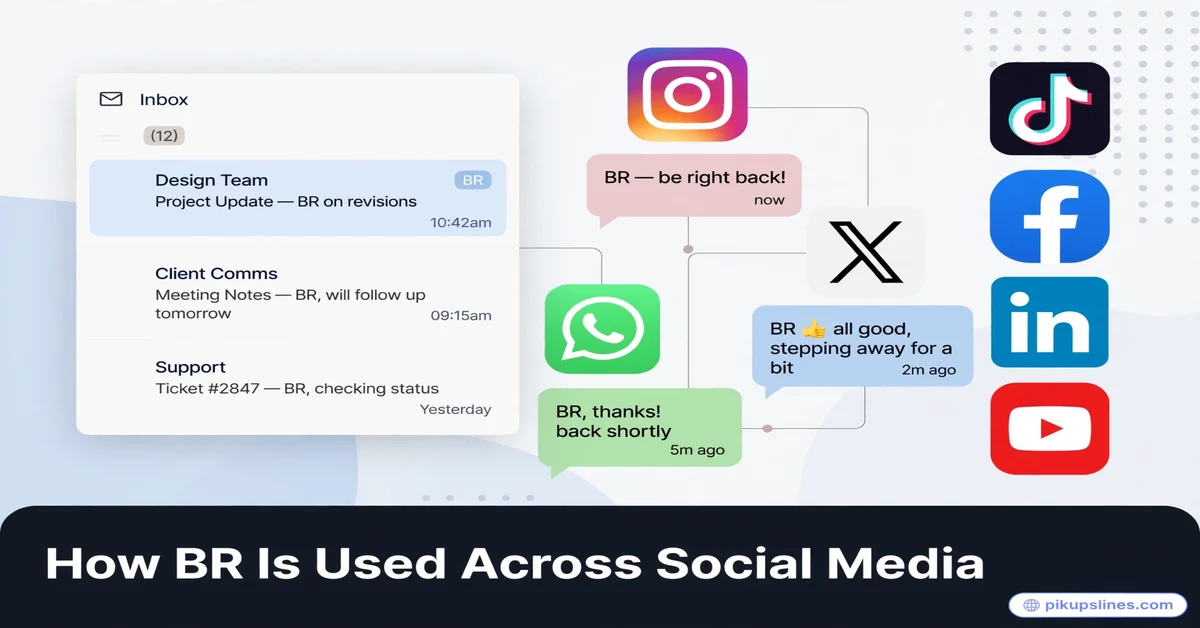
How BR Is Used Across Social Media
Platforms lean toward different BR meanings, but they do not own them. A platform lean is a hint, not a rule.
On Instagram and TikTok, br in comments is usually Brother or Bro. “Fire fit br.” On Snapchat, br in a private reply can be Brother, or a short reaction, as in “br, what was that?” On WhatsApp, br can be Brother or Best Regards, depending on whether the sender is a friend or a colleague. On Discord, br can be Brother, a pause, or Battle Royale, depending on the chat.
Email is the clearest lean. In email, BR at the end is almost always Best Regards. A friendly “thanks br” in an internal work chat is the exception: even in a work tool, a br used as an address is still Brother, not a sign-off.
In group chats, BR as Brother works when the group already knows each other. The same is true of slang that names the group itself, as with GNG meaning in text. If you mean a whole group, a group name is clearer than a single br.
Common Mistakes and Confusions
The biggest mistake is picking one BR meaning and applying it everywhere. Competitors disagree on the “main” meaning for a reason: email guides call Best Regards the main meaning, chat guides call Be Right Back the main meaning, and social guides call Brother the main meaning. Position and topic decide the case in front of you.
The second mistake is treating BR and BRB as identical. They are related, but they are not the same. BRB is more widely recognized as a pause, and BR is shorter and more ambiguous.
The third mistake is reading gender into BR. BR does not mean one thing from a woman and another from a man. It means what its position and topic say it means, whoever sent it.
The fourth mistake is reading a confusing BR as a judgment. A message that just says “br” with no context is usually a sign that context is missing, not that the sender is being rude. A short question clears it up faster than a guess, as with WTH meaning in text, where a confusing reaction is best answered with “what do you mean by that?”
The fifth mistake is using BR in a formal email and assuming the reader will hear Best Regards. In a first email, the reader may hear Brother, or may simply be confused. Write the full phrase for first contact.
When Not To Use BR
Do not use BR in a formal email to a new client, a job application, an academic paper, or a client-facing document. In those settings, write “Best regards,” in full. A bare BR can look rushed, and it can be misread as Brother.
Do not use BR as a pause in a serious or important chat. If people are waiting for an answer that matters, “br” alone does not tell them when you will return. Give a time, or a reason, or use BRB.
Do not use BR as Brother with a person you do not know well, a teacher, a boss, or an older relative who may read it as too familiar.
Do not use BR to address a date if you want a romantic tone. Br signals a friendly, platonic tone.

How To Reply To BR
Your reply depends on which BR you just got, and the position test gives you that answer in most cases.
If BR was Brother, reply as a friend. “Got you br.” “Thanks br!” The message was an address, not a question.
If BR was Best Regards, reply as a colleague. “Thank you.” “Noted.” You do not need to sign off with BR yourself. A full “Best regards,” is safer for a first reply to a new contact.
If BR was a pause, wait, or acknowledge it briefly and then wait. “Take your time.” Do not start a new topic while the other person is away.
If BR was Battle Royale, reply about games. “Which BR game?” If the topic was a plan, a plan question helps sort out what happens next, as with WYO meaning in text, where a check-in question turns a vague group message into a concrete plan.
If you are not sure which BR it was, ask one short question. “Br as in brother, or be right back?” That question is faster, and safer, than guessing wrong.
Frequently Asked Question
What does BR mean in texting?
It usually means Brother or Bro in friendly chats, Best Regards at the end of a work message, or Be Right as a short pause in a live chat. Position and topic decide which one it is.
Is BR the same as BRB?
Almost, but not exactly. Both can relate to a temporary pause, but BRB, short for Be Right Back, is more common and easier to recognize as a pause. BR is shorter and more ambiguous, because it also means Brother and Best Regards.
What does BR mean in gaming?
In gaming, BR often means Battle Royale, a game mode where players compete until one winner remains. It can also mean a pause or Brother in a gaming chat.
Can BR mean Best Regards?
Yes. In work emails or professional chats, BR may stand for Best Regards, usually at the end of a message, often before or after a name. For a first email, writing the full phrase looks more polished.
Is BR formal?
It can be, in professional chats where it means Best Regards. It is not formal on its own, and in a casual chat it means Brother. Formality comes from the setting, not from the letters.
Does BR mean the same as bro?
Almost. Br feels shorter and more rushed than bro, but in a friendly chat it works the same way, as an address for a friend. Bro is clearer, because it cannot be misread as Best Regards.
Should I use BR in emails?
You can, in quick internal chats where it is already normal. For a first email to a client or a new contact, use the full phrase instead of BR.
Is BR rude?
Not usually. It can feel too familiar with a stranger, too rushed in a formal email, or too platonic on a date, but on its own it is friendly or neutral, not rude.
Conclusion
BR has three main meanings in chat and email, and the position test settles most of them, with professional email sign-offs as the clearest example of the end-of-message reading.
At the start, it is usually a pause. At the end of a work message, it is usually Best Regards. In the middle of a friendly message, it is usually Brother.
Check the position, the topic, and the sender, and you will not need to guess.