You got a message that ends with HBU, and you are not sure what the other person is asking.
It is simpler than it looks, and this guide makes it clear.
You will learn the one rule that decodes almost every HBU, how to reply without getting stuck in a loop, and when not to use it at all.
Quick Answer
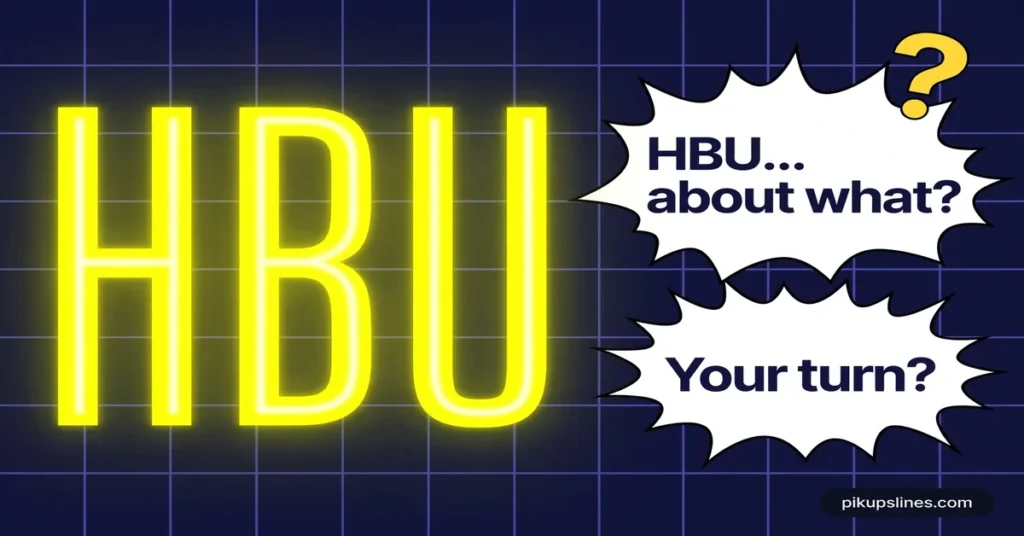
HBU = How About You?
That is the only common meaning in chat. HBU is a return question. It takes the statement before it and hands the same question back to the other person. It is not a greeting, and it is not a separate question of its own.
HBU Meaning Table
| Meaning | Where you see it | How to spot it |
|---|---|---|
| How About You? | Texts, DMs, group chats, dating chats | After a statement, handing the same topic back to the other person |
| What About You? (WBU) | Same chats, interchangeable in most cases | Same job as HBU, with a slightly different wording |
| How Are You? (HRU) | Greetings, check-ins | Opens a chat, asks about feelings, does not borrow a topic |
| What You Doing? (WYD) | Check-ins, plan chats | Asks about activity, not a return of your statement |
| Specialist initials | Academic, industry, or organization writing only | Never assume these in a normal chat |
The Borrowed Topic Rule: HBU Copies the Sentence Before It
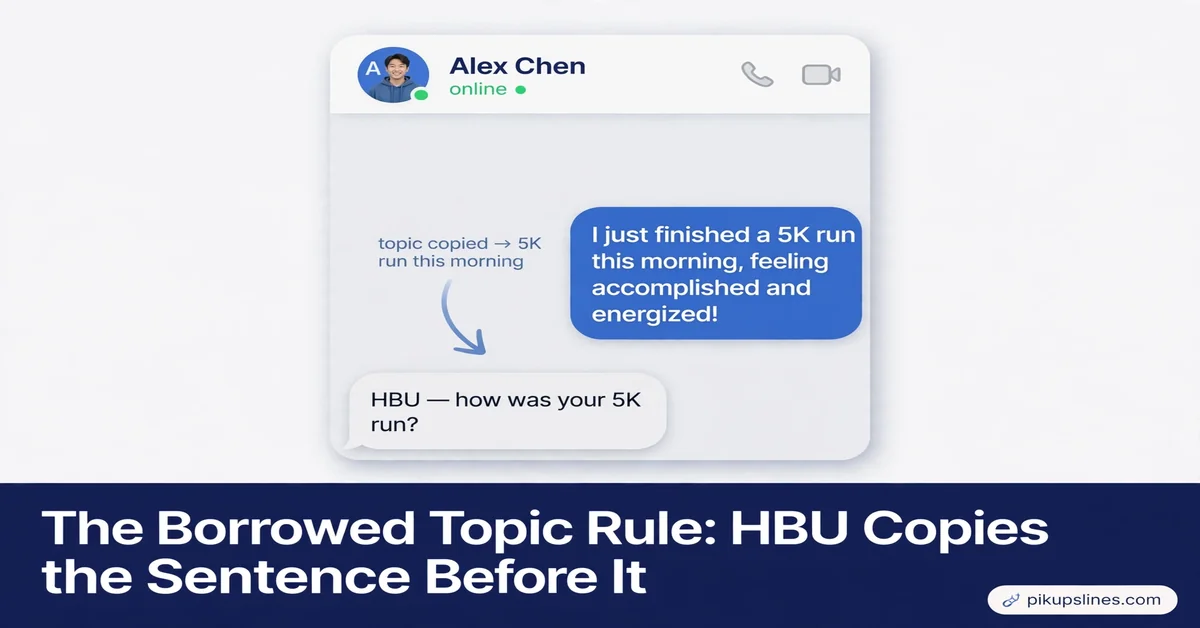
Most guides say HBU “relates to the previous statement” and then move on. That undersells the rule, because the borrowed topic is the whole meaning of HBU. HBU has no topic of its own. It copies the topic from the sentence right before it, and asks the same thing back.
“I love pizza. HBU?” means “Do you love pizza?” “I am tired today. HBU?” means “Are you tired today?” “I am going hiking this weekend. HBU?” means “What are your weekend plans?” The question changes every time, because the statement before it changes every time. If you read HBU as a fixed question like “how are you?”, you will answer the wrong question half the time.
This is also why HBU cannot stand alone. A message that just says “HBU?” with no statement before it has nothing to borrow, so the other person has to guess what you are asking about. “HBU?” after a long silence is not a greeting. It is a return question with nothing to return. If you want to open a chat, ask a real question: “How was your day?” HBU only works after you have said something first.
The borrowed topic rule also explains why HBU feels warm. It is a signal that says “I shared my side, now I want yours, on the same topic.” That balance keeps a chat two-sided instead of one person talking while the other only reacts.
How To Tell What HBU Is Asking in Seconds
Use this three-step check when you get an HBU and you are not sure what to answer.
First, read the sentence right before HBU. That sentence is the question. Ignore everything earlier in the chat, because HBU borrows from the sentence next to it, not from the whole conversation.
Second, turn that sentence into a question for yourself. “I finished my run” becomes “What did you do?” “I really do not like sushi” becomes “Do you like sushi?” “That course was brutal” becomes “How did you find the course?”
Third, answer that question, not a general “how are you?” If the statement was about food, answer about food. If it was about a day, answer about your day. A reply that matches the borrowed topic feels natural. A reply that ignores it feels like you did not read the message.
One warning: if the statement before HBU was a joke, a reaction, or a plan, the borrowed topic follows that too. “That movie was wild. HBU?” is asking what you thought of the movie, not how your day went. A plan question works the same way, as with WYO meaning in text, where a check-in question turns a vague message into a concrete plan. WYO asks what you are on or up to, while HBU asks for your side of whatever was just said.
HBU Examples That Show the Rule in Action
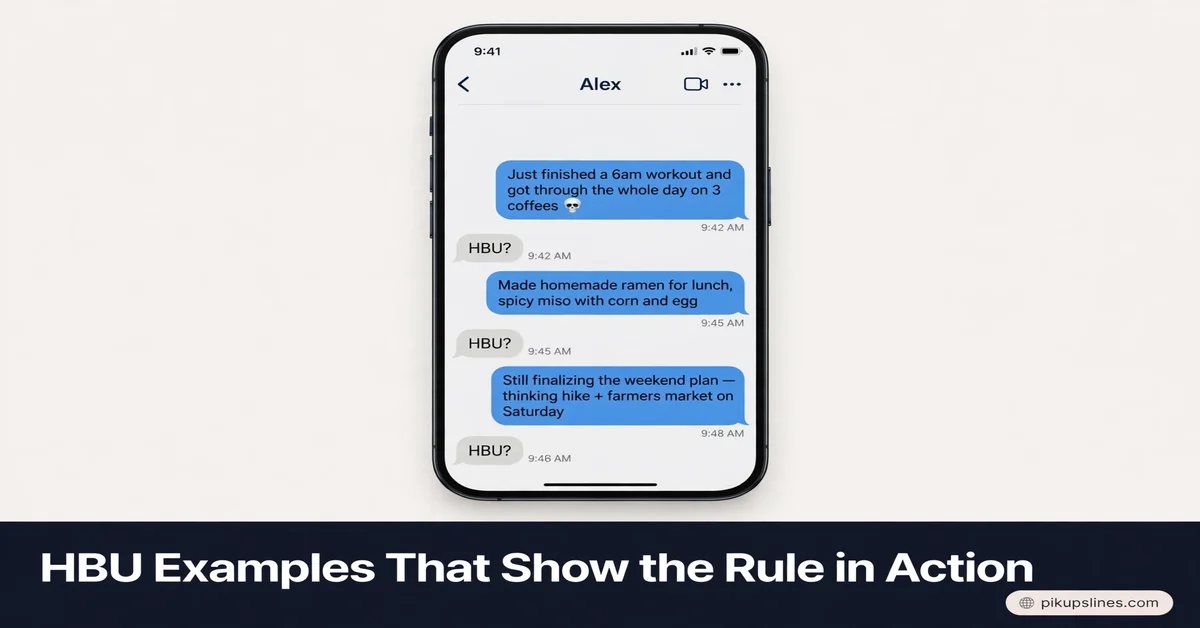
Here are the same HBU in different chats, so you can see how the borrowed topic changes the answer.
“I am doing great today. HBU?” Answer with your day. “Pretty good, just finished work.”
“I love sushi. HBU?” Answer with your food opinion. “Not for me, I prefer pizza.”
“I am going hiking this weekend. HBU?” Answer with your weekend plan. “Staying home, probably a movie night.”
“I just watched the new movie. HBU?” Answer with your movie opinion, or whether you have seen it. “Not yet, is it worth it?”
Notice what none of these answers do: none of them answer “how are you?” in general. Each one answers the borrowed topic. That is the habit that makes HBU replies feel natural.
HBU vs WBU vs WYD vs HRU
These four look alike, and they are easy to mix up, but they do different jobs.
HBU, “How About You?”, flips your statement back. WBU, “What About You?”, does the same job with slightly different wording. In everyday chats they are interchangeable. There is only a soft lean worth knowing: HBU feels slightly more natural after a mood or a status update, as in “I am feeling tired today, hbu?”, while WBU feels slightly more natural after an opinion or a plan, as in “I am thinking of ordering pizza tonight, wbu?” Treat that as a lean, not a rule.
WYD, “What You Doing?”, is different. It asks about activity, and it does not need a statement before it. “WYD?” works as an opener. “HBU?” does not, because it has nothing to borrow. HRU, “How Are You?”, is also different. It opens a chat and asks about feelings in general. It does not borrow a topic, and it does not flip a statement.
A quick test: if you can delete the letters and the message still makes sense as a question, you are looking at WYD or HRU. If deleting the letters leaves a statement with no question at all, you are looking at HBU or WBU, because the question was borrowed from the statement.
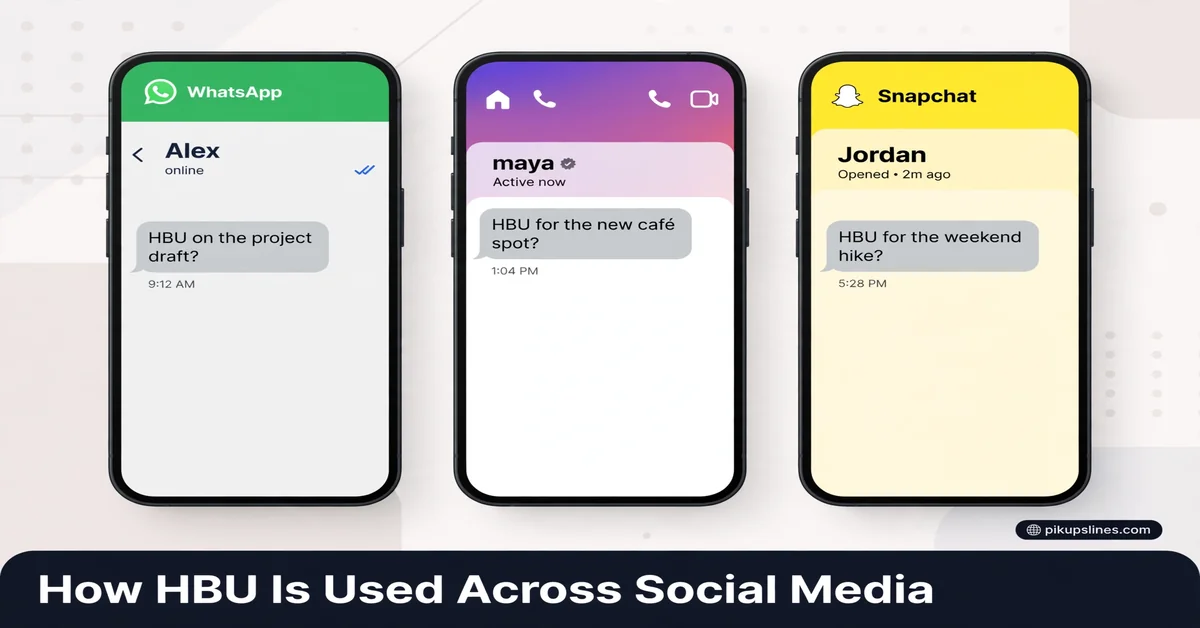
How HBU Is Used Across Social Media
HBU looks the same on every platform, but the chats around it change what it borrows.
On WhatsApp and in text messages, HBU usually borrows a day, a mood, or a plan. “Had a busy day today. HBU?” On Instagram DMs, HBU often borrows an opinion or a reaction. “That reel was so funny. HBU?” On Snapchat, HBU is fast and short, often after a mood or a moment. “Bored rn. HBU?” On TikTok comments, HBU borrows a trend or an opinion. On dating apps, HBU borrows a plan or a preference, and it is often the move that turns a statement into an invitation. “I am thinking of grabbing coffee later. HBU?”
In group chats, HBU changes in one important way. “HBU guys?” borrows the topic for the whole group, not for one person, and it invites several replies at once. That is useful when you want a group opinion, and it is the same group-address idea as slang that names the group itself, as with GNG meaning in text. If you mean one person, reply to them directly. If you mean the group, say “hbu guys?” so the whole group knows it is theirs.
On gaming chats, HBU borrows a score, a level, or a game opinion. “Reached level 50 today. HBU?” The platform never changes what HBU means. It only changes what it borrows.
Is HBU Flirty?
HBU alone is not flirty. It is friendly, and it is one of the most neutral return questions in texting. Flirtiness comes from what HBU borrows, and from the timing and the emojis around it, not from the letters themselves.
A daily check-in is friendly. “My day was pretty good. HBU?” A late-night personal chat can feel warmer, because the topic is personal. A compliment followed by HBU can feel warm, because the topic is a compliment. An emoji-heavy message can feel playful, because the emojis set the tone. A direct ask after HBU, as in “HBU, want to meet up?”, is romantic because of the ask, not because of HBU.
Do not read gender into HBU either. HBU from a girl does not automatically mean one thing, and HBU from a guy does not automatically mean another. The borrowed topic, the timing, and the rest of the chat decide the tone, whoever sent it.
If you are not sure whether an HBU is flirty, look at the borrowed topic. If the topic is a plan, a compliment, or something personal, warmth is a fair reading. If the topic is a day, a meal, or a show, friendly is the fair reading. When in doubt, reply friendly and let the other person make the next move clearer.
Common Mistakes and Confusions
The first mistake is treating HBU as a greeting. HBU does not open a chat, and it does not mean “hello.” A message that starts with “HBU?” and nothing before it leaves the other person guessing. Open with a real question or a statement, then use HBU to flip it.
The second mistake is answering the wrong question. If someone says “I love sushi. HBU?” and you answer “I am good,” you answered “how are you?” instead of the borrowed food question. Read the sentence before HBU, and answer that.
The third mistake is the HBU loop. One person says “Good, hbu?” The other says “Good, hbu?” The first says “Good, hbu?” again, and the chat goes nowhere, because no one added a new detail. Break the loop by adding a detail: “Good, just finished a run. HBU?” A detail gives the next HBU something to borrow.
The fourth mistake is overusing HBU. Ending every message with HBU makes a chat feel like a script, not a conversation. Use it when you genuinely want the other person’s side on the same topic.
The fifth mistake is using HBU after serious news without acknowledging it first. If someone says “I am upset about work,” and you reply “HBU?”, it feels dismissive, because you flipped the question before you reacted to their news. Acknowledge first, then flip: “That sounds rough. HBU, how was your day?” The same care applies when a chat turns serious, as with KMS meaning in text, where telling a joke apart from a serious warning changes the whole reply.
When Not To Use HBU
Do not use HBU in a professional email, a job application, a formal business message, or an academic paper. In those settings, write the full phrase: “How about you?” or “What are your thoughts?”
Do not use HBU as the first message in a chat. It has nothing to borrow, so it reads as confusing, not friendly. Open with a statement or a real question, then flip with HBU if you want the other person’s side.
Do not use HBU to change the subject. HBU borrows the current topic, so it cannot introduce a new one. If you want to change the subject, say so directly: “Anyway, did you see the game last night?”
Do not use HBU when the other person shared something serious and you have not acknowledged it yet. Acknowledge first, as above, or your flip will feel cold.
Do not use HBU with a person who does not use texting slang, such as an older relative or a formal contact, unless you are sure they will understand it.

How To Reply To HBU
Your reply depends on the borrowed topic, and on how much you want to share.
If it is a friend, answer the borrowed topic and flip it back with a detail. “Pretty good, just finished lunch. HBU?” If it is someone you like, show interest without overthinking. “I am great, just wrapped up work. What about you?” If you are unsure of the intent, keep it neutral. “Not bad. How is your day going?”
A short acknowledgment before the flip also works well, as with IGHT meaning in text, where a brief “ight” before a question keeps the tone warm instead of abrupt. “Ight, I am good. HBU?” is warmer than a bare “Good. HBU?” because it reacts first and flips second.
If you do not want to flip it back, you do not have to. Answer the borrowed topic and end with a statement, a reaction, or a new question. “Pretty good, just finished lunch. Anyway, did you see the game?” That is a complete reply, and it does not trap the chat in an HBU loop.
If you got a bare “HBU?” with no statement before it, ask what they mean. “HBU about what?” That is faster than guessing. A friendly address before the question can also soften a reply, as with BR meaning in text, where “thanks br, hbu?” pairs a warm address with a flip.
Frequently Asked Question
What does HBU stand for in texting?
HBU stands for “How About You?” It asks someone the same question after sharing your own answer, on the same topic.
Is HBU rude?
No. HBU is generally friendly and polite, because it invites the other person into the conversation. It only feels rude when it flips a serious topic without acknowledging it first.
What is the difference between HBU and WBU?
HBU means “How About You?”, while WBU means “What About You?” Most people use them interchangeably, though HBU leans slightly toward mood and status updates, and WBU leans slightly toward opinions and plans.
Can I use HBU in professional emails?
No. It is better to use the full phrase “How about you?” in formal communication, because HBU is informal slang.
Is HBU popular on Snapchat?
Yes. HBU is very common on Snapchat, Instagram, WhatsApp, TikTok, and text messaging apps, where quick replies are normal.
Is HBU only used by teenagers?
No. Teens use it a lot, but adults text it too in casual chats. It is common on messaging apps, social media, and dating platforms.
Does HBU show romantic interest?
Not by itself. It simply asks about you on the borrowed topic. It can feel flirty if the topic is personal, emojis are used, or the conversation already has chemistry.
Why do people prefer HBU over the full phrase?
Speed and convenience. Short forms make texting faster and feel relaxed.
Conclusion
HBU means “How About You?”, and the borrowed topic rule is the key to reading it, with keeping a conversation going as the wider skill behind a good flip.
Read the sentence before HBU, turn it into a question for yourself, and answer that question.
Add a detail when you flip it back, acknowledge serious news first, and you will never get stuck in an HBU loop.