Have you received a message saying HYY and wondered what it means? You’re not alone. This short expression often confuses people unfamiliar with modern texting slang.
The most common HYY meaning in text is a casual way of saying “Hey” or “Hi.” People use it to greet friends, start conversations, or express friendliness. The extra Y adds a playful touch.
But does HYY ever sound flirty? Let’s explore its meanings and uses.
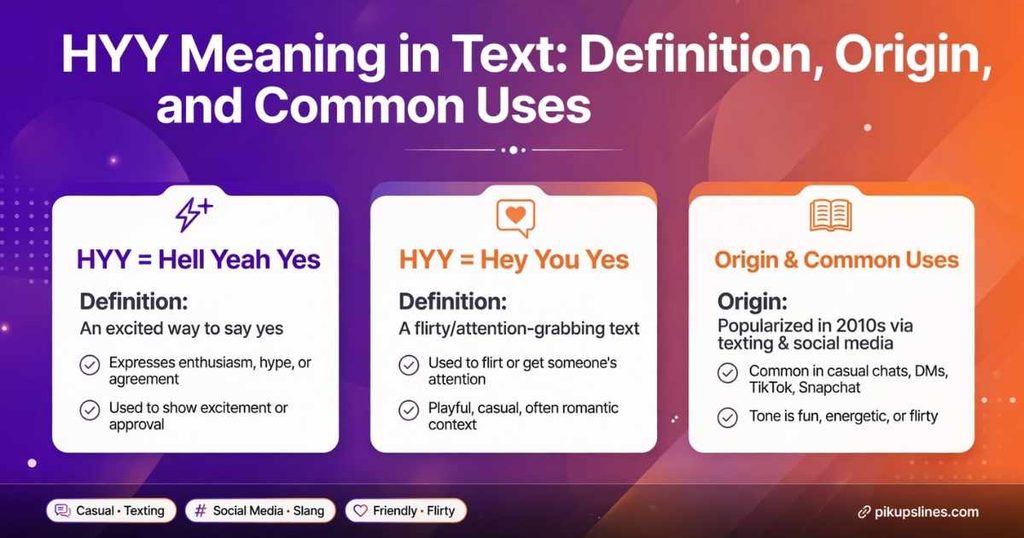
HYY Meaning in Text: Definition, Origin, and Common Uses
QUICK DEFINITION
HYY usually means “Hey” in casual digital communication. It’s a stylized greeting that makes a simple hello feel more expressive, friendly, or playful.
What Does HYY Mean in Text?
HYY is an informal greeting commonly used in text messaging and online chats. Think of it as a slightly stretched version of the familiar word “Hey.” Instead of typing the traditional spelling, someone adds another Y to create a more relaxed appearance.
For example:
- Hey: A simple and neutral greeting.
- HYY: A casual greeting with a little extra expression.
- Hyyy: A more playful or enthusiastic version.
- Hyyyyy: An exaggerated greeting that can suggest excitement.
The difference isn’t necessarily about the literal meaning. Rather, it comes from how people use repeated letters to express tone.
Imagine receiving two messages from a friend:
- “Hey”
- “Hyyy!!”
Both can start the same conversation. However, the second message looks more energetic and informal. It might suggest that the sender feels excited to talk.
Therefore, the HYY meaning in texting is generally connected to greetings rather than a complicated abbreviation.
What Does HYY Stand For?
Unlike established abbreviations such as LOL (Laughing Out Loud) or BRB (Be Right Back), HYY doesn’t have one universally accepted expanded form.
Most commonly, people use it as a stylized version of Hey. It functions as an informal conversation starter rather than an acronym with separate words behind each letter.
Some important distinctions include:
| Expression | Common meaning | Typical use |
|---|---|---|
| HYY | Hey | Casual greeting |
| HY | Hey | Short informal greeting |
| Hey | Hello | Everyday greeting |
| Heyy | Hey | Friendly or expressive greeting |
| Hyyy | Hey | Playful greeting |
| HRU | How are you? | Asking about someone’s well-being |
| HBU | How about you? | Continuing a conversation |
| WYD | What are you doing? | Asking what someone is doing |
One important point: HYY shouldn’t automatically be interpreted as “How are You?” That expression is usually shortened to HRU.
Likewise, don’t assume HYY has a hidden full form every time someone sends it. The surrounding conversation provides the most useful clues.
Is HYY an Acronym or an Abbreviation?
Technically, HYY is better understood as an informal spelling variation than a conventional acronym.
An acronym forms a word from the initial letters of several words. NASA is a familiar example. An abbreviation shortens an existing word or phrase. HYY doesn’t consistently follow either pattern.
Instead, it belongs to the flexible world of internet language. People adjust familiar spellings to make messages feel more personal.
This is why you might see HYY, Hyy, Hyyy, and Hyyyyy used by different people. Their spelling preferences can vary even when their intended greeting remains similar.
HYY vs. Hey: What’s the Difference?
The difference between HYY and Hey mainly involves presentation and tone.
Hey is a standard informal greeting. It works in everyday conversations and doesn’t necessarily communicate excitement.
HYY, on the other hand, looks more playful and expressive. The extra letter makes the greeting feel less formal.
Consider these examples:
- “Hey, are you coming today?” sounds straightforward.
- “HYY, are you coming today?” feels more relaxed.
- “Hyyy, are you coming today?” can sound particularly friendly.
However, these differences aren’t fixed rules. Some people type HYY simply because they like its appearance. Others use it to match the other person’s texting style.
Why Do People Type HYY Instead of Hey?
People often modify ordinary words when communicating online. It’s a simple way to make short messages feel less mechanical.
Several reasons explain why someone might choose HYY:
- Personal texting style: Some people naturally prefer unusual spellings.
- Friendliness: Extra letters can make a greeting look warmer.
- Excitement: A stretched greeting may communicate enthusiasm.
- Playfulness: Informal spelling makes conversations feel relaxed.
- Social habits: People sometimes copy expressions they see in friends’ messages.
- Visual expression: Repeated letters add emphasis without requiring additional words.
This habit is part of expressive texting. Since digital messages lack facial expressions and vocal tone, people use spelling, punctuation, and emojis to communicate feelings.
For instance, saying “Hey” aloud can sound cheerful or serious. Written messages don’t automatically carry those vocal details. A greeting such as “Hyyy 😊” adds a visual hint about the intended mood.
Origin and Background of HYY Slang
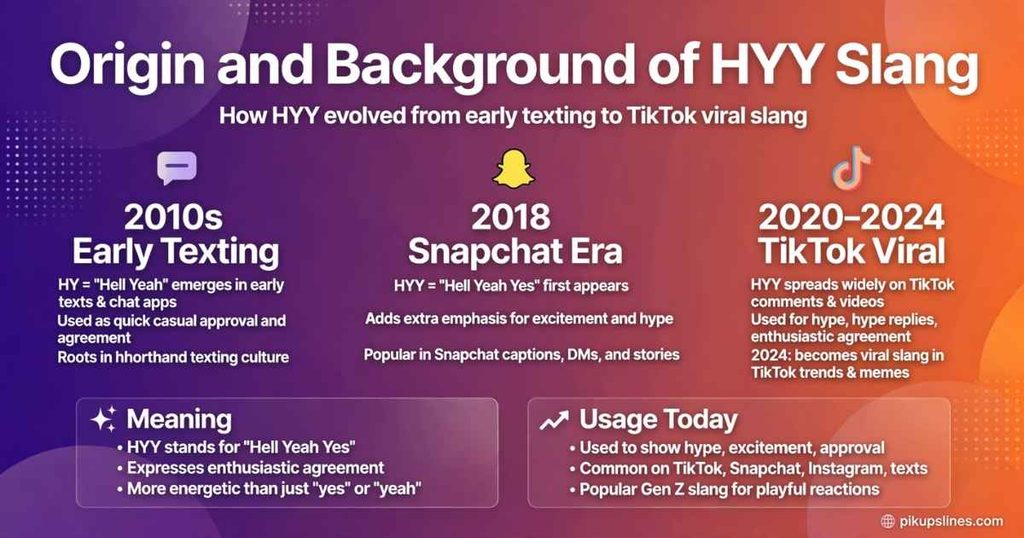
There isn’t a clearly established historical record identifying one person, platform, or year as the origin of HYY.
However, its spelling style fits a much broader trend in internet communication: extending letters to express emotion.
This habit existed long before modern social media platforms became popular.
Early internet communities used informal spellings to communicate quickly. Chat rooms, instant messaging services, and social networking websites helped spread relaxed writing styles.
Platforms such as MySpace and Tumblr also contributed to expressive online communication. Later, Twitter, Instagram, WhatsApp, and Snapchat made short greetings part of everyday digital conversations.
The exact spelling HYY shouldn’t be assigned a specific origin without reliable evidence. Its structure simply resembles a familiar pattern in online language.
Why does letter repetition matter?
Repeated letters can change the perceived tone of an ordinary word.
For example:
- “No” can sound neutral.
- “Nooo” can communicate disappointment or playful disbelief.
- “Hey” can sound straightforward.
- “Heyyy” can appear warmer or more enthusiastic.
Linguists study related features through concepts such as digital discourse, expressive lengthening, and computer-mediated communication.
The key idea is simple: people use written language to imitate some features of spoken conversation.
HYY Meaning on Social Media and Messaging Platforms
HYY doesn’t have a separate official definition on every social media platform. Its meaning generally depends on how users communicate there.
Nevertheless, the surrounding environment can influence how the greeting feels.
| Platform | How HYY may appear | Typical context |
|---|---|---|
| HYY in direct messages | Starting a private conversation | |
| HYY in personal chats | Greeting friends or family | |
| TikTok | HYY in comments or messages | Casual social interaction |
| Snapchat | HYY in private snaps or chats | Playful communication |
| Twitter (X) | HYY in replies or direct messages | Informal online interaction |
| Tumblr | HYY in messages or community discussions | Friendly interaction |
HYY meaning on Instagram: Someone might send HYY after following your account or viewing your story. Usually, they’re simply opening a conversation. Whether they’re interested in friendship or flirting depends on what follows.
HYY meaning on WhatsApp: Friends might use HYY instead of Hey when starting a private conversation. It can also appear in family chats or informal group discussions.
HYY meaning on TikTok: You might encounter the expression in comments or private messages. Its interpretation generally remains the same as other casual online greetings.
Remember that platform-specific meaning shouldn’t be invented. HYY doesn’t automatically become a different abbreviation on Instagram, WhatsApp, or TikTok.
How to Use HYY in Conversations: Tone, Examples, and Best Replies
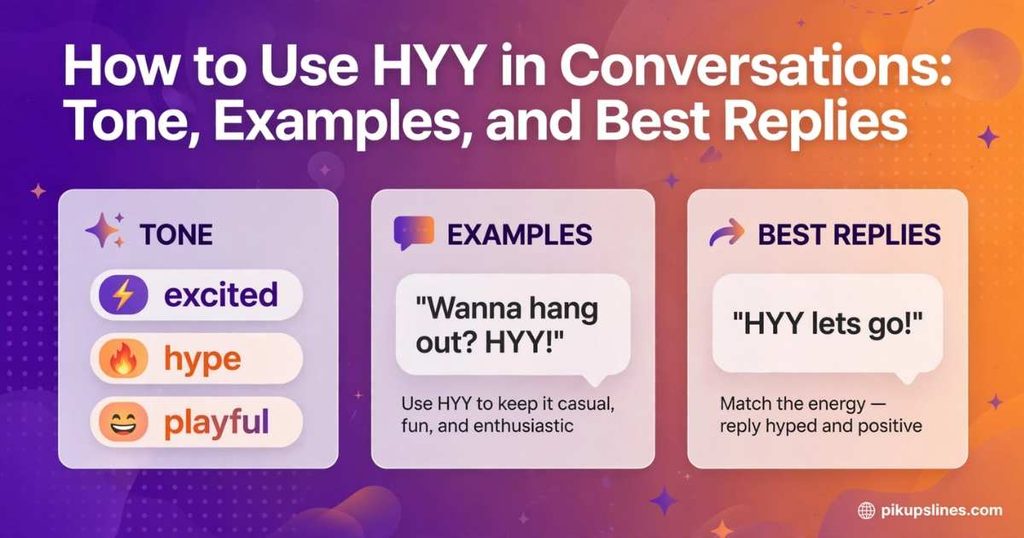
Understanding the basic HYY slang meaning is only half the picture. The real interpretation often depends on who sends it, when they send it, and what happens afterward.
A three-letter greeting can carry different social signals. For example, a close friend might use HYY casually. Someone you’ve recently met might use the same expression to break the ice. A romantic interest could also choose it as a playful conversation opener.
However, the spelling alone doesn’t reveal someone’s intentions.
HYY Meaning From a Girl
When a girl sends you HYY, she is usually saying hello in a relaxed and friendly way.
The message might suggest that she wants to start talking. Perhaps she saw you online or remembered something from an earlier conversation. She might simply be checking whether you’re available.
Consider these possibilities:
| Message | Possible interpretation |
|---|---|
| Hyy | Casual greeting |
| Hyyy 😊 | Warm or friendly greeting |
| HYY!! | Energetic greeting |
| Hyy, wyd? | Starting a conversation |
| Hyyy ❤️ | Affectionate or potentially flirty greeting |
| Hyy, long time! | Reconnecting after a break |
Does it mean she likes you?
Not necessarily. A friendly greeting doesn’t establish romantic interest. Look for other signs, such as consistent communication, personal questions, playful exchanges, and genuine interest in your life.
Even then, avoid treating individual messages as proof. People express friendliness differently.
HYY Meaning From a Guy
When a guy sends HYY, the basic meaning remains the same. He’s usually saying hey or hi.
The message might appear when he wants to:
- Start a conversation without sounding formal.
- Reconnect with someone he hasn’t contacted recently.
- Get a friend’s attention.
- Respond to an Instagram story.
- Begin a playful conversation.
- Check whether someone is available.
For example:
Him: Hyyy, what’s up?
You: Not much! What about you?
Him: Just relaxing. Thought I’d say hi.
This exchange shows a straightforward greeting. There’s no reason to assume a hidden romantic message.
On the other hand, if he continues asking questions and showing interest, the conversation might develop into something more personal.
Is HYY Flirty, Friendly, or Just Casual?
This is probably one of the most interesting questions about HYY.
The answer depends on the surrounding message and your relationship with the sender. Extra letters can make a greeting feel warmer, but they don’t automatically make it romantic.
Here’s how different versions might come across:
| Text message | Possible tone | What to consider |
|---|---|---|
| HYY | Casual | A simple hello |
| Hyyy 😊 | Friendly | Warm and welcoming |
| Hyyyy ❤️ | Affectionate | Could suggest romantic interest |
| HYY!! | Excited | High-energy greeting |
| Hyy, miss you | Affectionate | Expresses missing someone |
| Hyy, stranger | Playful | Might suggest familiarity or teasing |
A useful rule: Pay attention to the entire conversation instead of analyzing one greeting.
Someone who sends HYY and disappears might simply have wanted to say hello. Someone who follows up with thoughtful questions may want a longer conversation.
The difference becomes clearer through consistent behavior.
Real-Life HYY Conversation Examples
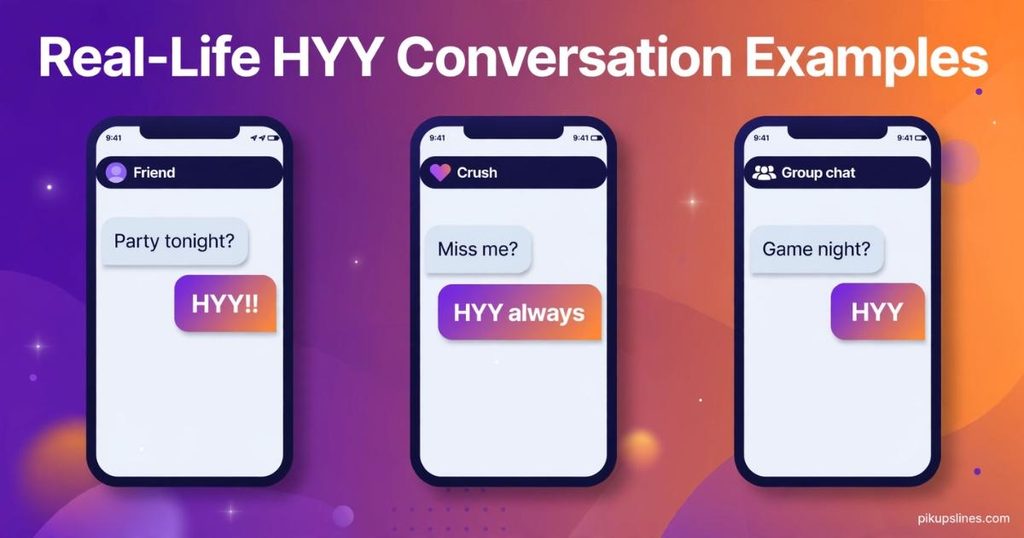
Sometimes, examples explain texting slang better than dictionary definitions. These conversations show how HYY works in different situations.
Example: Between Close Friends
Alex: Hyy!
Sam: Heyyy! What’s happening?
Alex: Nothing much. Are you coming tomorrow?
Sam: Definitely. See you there!
Here, HYY works as a relaxed greeting between friends. Neither person needs a formal introduction.
Example: Starting an Instagram DM
Person A: Hyy 😊
Person B: Hey! How are you?
Person A: I’m good. I saw your recent story.
Person B: Oh really? Haha, thanks!
In this situation, HYY opens the door to a private conversation. The emoji adds a friendly touch.
Example: A Conversation With Someone You Like
Person A: Hyyy ❤️
Person B: Heyyy! What’s up?
Person A: Just wanted to talk to you.
Person B: That’s sweet. How’s your day going?
The heart emoji and follow-up message create a potentially affectionate tone. However, the relationship provides the real context.
Example: Reconnecting After a Long Time
Person A: Hyy, long time no talk!
Person B: I know! How have you been?
Person A: Pretty good. What about you?
Person B: Doing great, thanks!
Here, HYY introduces a friendly attempt to reconnect.
Example: In a Group Chat
Person A: HYY everyone!
Person B: Heyyy!
Person C: What’s up?
Person A: Who’s free this weekend?
The greeting attracts attention before the sender introduces a topic.
Example: When Someone Wants a Quick Reply
Person A: Hyy?
Person B: Hey, what’s going on?
Person A: Are you there? Need to ask something.
The question mark makes the greeting feel like an attempt to get someone’s attention. It doesn’t necessarily communicate anger or impatience.
How to Respond to HYY Naturally
Receiving HYY doesn’t require a complicated response. In most situations, a simple greeting works perfectly.
However, your reply can depend on your relationship with the sender and the direction you want the conversation to take.
Here are some natural options.
| Your situation | Suggested reply |
|---|---|
| Casual conversation | Hey! What’s up? |
| Friendly response | Hyyy! How are you? |
| Talking to a close friend | Heyyy, what’s happening? |
| Someone you like | Hyyy 😊 How’s your day? |
| Playful conversation | Well, hello there! |
| Reconnecting | Hey! It’s been ages. |
| Busy at the moment | Hey! Can I text you later? |
| Unknown sender | Hi! Do we know each other? |
| Professional acquaintance | Hello! How can I help? |
Friendly replies
If a friend sends HYY, match their relaxed energy.
Try these responses:
- “Heyyy! How’s everything?”
- “Hyyy, what’s new?”
- “Hey! How have you been?”
- “Hi there! What’s going on?”
Cute and playful replies
If you already share a playful relationship, a cheerful response can keep things interesting.
For example:
- “Well, look who’s here!”
- “Hyyyy! What’s the occasion?”
- “Hey you! 😊”
- “Someone’s feeling chatty today!”
Flirty replies
When the conversation already has a romantic tone, you can respond with something slightly more affectionate.
Consider these:
- “Hyyy, nice to hear from you.”
- “Heyyy! I was wondering when you’d text.”
- “Well, hello, stranger 😉”
- “Hyyy! How’s my favorite person?”
Use these responses when they suit your relationship. Sending an overly affectionate reply to someone you barely know might create confusion.
Short and casual replies
Sometimes, you don’t need a long response.
These work perfectly well:
- “Hey!”
- “Hii!”
- “What’s up?”
- “Yo!”
- “Heyy!”
The goal isn’t to find a perfect response. It’s to keep communication comfortable and natural.
When Should You Use HYY?
HYY works best when you’re communicating with people who understand informal texting.
It’s particularly useful for everyday conversations where a relaxed greeting feels appropriate.
You can use it when:
- Greeting close friends.
- Starting a casual WhatsApp conversation.
- Sending someone an Instagram DM.
- Replying to a Snapchat message.
- Joining a friendly group chat.
- Reconnecting with an online acquaintance.
- Starting a playful conversation with someone familiar.
For instance, imagine messaging a friend after school. Writing “HYY, are you free?” feels natural because the conversation is informal.
Similarly, sending “Hyyy 😊” to a friend can make your greeting appear warmer.
When Should You Avoid Using HYY?
Although HYY works well in casual settings, it isn’t suitable everywhere.
Some conversations require clear and professional language. In those situations, standard greetings are a better choice.
Avoid using HYY when:
- Writing a formal business email.
- Contacting a potential employer.
- Messaging an unfamiliar client.
- Communicating with a professor about an academic matter.
- Sending an official request.
- Writing professional documents.
- Addressing someone who prefers formal communication.
For example:
| Informal message | More appropriate alternative |
|---|---|
| HYY, need your help | Hello, could you help me? |
| Hyyy, send the details | Hi, could you please send the details? |
| HYY boss! | Good morning. |
| Hyy, any updates? | Hello, do you have any updates? |
The point isn’t that HYY is disrespectful. It’s simply informal.
Professional communication benefits from clarity and appropriate etiquette. A standard greeting helps establish the right tone.
Common Misunderstandings About HYY
Internet slang often creates confusion because people assume every unusual spelling represents a hidden phrase.
HYY is a good example. Its meaning can become unnecessarily complicated when people interpret individual letters too literally.
Here are some common misunderstandings worth clearing up.
Misunderstanding: HYY always stands for a longer phrase.
Not necessarily. In ordinary texting, it’s usually a stylized greeting rather than a fixed acronym.
Misunderstanding: HYY always means someone likes you.
A greeting cannot establish romantic interest. The sender might simply be friendly.
Misunderstanding: HYY is grammatically incorrect in every situation.
Formal English has standard spelling rules. However, informal texting often uses creative spellings deliberately.
Misunderstanding: More Y’s always mean stronger feelings.
Repeated letters can suggest enthusiasm, but there’s no universal measurement. Some people simply enjoy expressive spelling.
Misunderstanding: HYY has a completely different meaning on every platform.
The basic greeting interpretation generally stays consistent across messaging services.
Regional and Cultural Usage of HYY
Online communication connects people from different countries. Consequently, informal expressions can travel between communities and languages.
You may encounter HYY in conversations involving people from the United States, United Kingdom, Singapore, Philippines, and other English-speaking or multilingual communities.
In South Asian digital communication, including conversations involving Pakistan and India, Roman-script English greetings are also common.
For example, someone might write:
- “Hyy, kya haal hai?”
- “Hyyy, how are you?”
- “HYY, free ho?”
- “Heyy, what’s going on?”
These examples combine informal English greetings with other conversational language.
The spelling itself doesn’t have a confirmed regional origin. Nor is there reliable evidence that HYY has one fixed meaning in Dubai, Riyadh, Singapore, or any other particular city.
What matters is the communication style of the people involved.
Age and generation can also influence texting preferences. Gen Z, Millennials, and Boomers may have different habits, although individual preferences vary considerably. No generation owns this expression.
Is HYY Safe and Appropriate for Kids?
HYY is generally a harmless greeting. It doesn’t contain an inherently offensive or adult meaning in ordinary texting.
Children and teenagers might use it when messaging friends, classmates, or relatives.
However, the safety of a conversation depends on more than one greeting.
Parents should consider the following:
- Unknown contacts: Children should be careful when communicating with strangers.
- Personal information: Avoid sharing home addresses, passwords, or private details.
- Uncomfortable messages: Children should feel comfortable blocking or reporting inappropriate contacts.
- Online boundaries: Friendly greetings shouldn’t create pressure to share photographs or personal information.
- Privacy settings: Review account visibility and messaging permissions on social media platforms.
HYY itself isn’t a warning sign. The surrounding conversation deserves attention.
HYY and Digital Communication Etiquette
Good texting etiquette involves more than choosing the right abbreviation. It also means understanding the other person’s communication preferences.
Some people love expressive greetings. Others prefer short, direct messages.
Here are a few useful guidelines:
- Match the sender’s general communication style without forcing it.
- Avoid excessive repeated letters in serious conversations.
- Use emojis when they genuinely help communicate your tone.
- Don’t assume romantic interest from a casual greeting.
- Choose standard English when professionalism matters.
- Respect people who prefer straightforward communication.
Digital body language includes small details such as punctuation, capitalization, emojis, and repeated letters.
A message like “Hey.” may appear more direct than “Heyyy 😊.” Neither is automatically better. Their suitability depends on the situation.
Research also supports the broader idea that repeated letters can serve as nonverbal cues in computer-mediated communication. A 2014 study by Yoram M. Kalman and Darren Gergle examined letter repetitions across more than 500,000 email messages. The researchers found that repetitions often imitate spoken nonverbal cues, although not in every case. ScienceDirect
This helps explain why people stretch ordinary greetings. They’re adding a little personality to otherwise plain text.
Can HYY Have Other Meanings?
Although the greeting interpretation is the safest starting point, abbreviations can have different meanings in specific communities.
For example, some online explanations associate HYY with “Hell Yeah.” This interpretation may make sense when someone uses it as an enthusiastic response rather than a conversation opener. However, it isn’t a universally established definition. englishpairs.com+1
Compare these situations:
| Message | Likely interpretation |
|---|---|
| HYY 😊 | Hey or hi |
| Hyy, how are you? | Friendly greeting |
| Are you coming? HYY!! | Possibly enthusiastic agreement |
| HYY, what’s up? | Conversation starter |
The surrounding words provide important clues. If someone sends HYY at the beginning of a conversation, a greeting is generally the most reasonable interpretation.
If it appears as a response to a question, consider whether the sender means an enthusiastic yes. When the meaning remains unclear, simply ask.
Frequently Asked Questions About HYY Meaning in Text
What does HYY mean in text messages?
HYY usually means “Hey” or “Hi.” It’s an informal greeting used to start conversations, get attention, or communicate with friends. The additional Y makes the spelling look more expressive.
What does HYY stand for in texting?
HYY doesn’t have one officially established full form in everyday texting. It’s generally a stylized spelling of Hey rather than an acronym representing three separate words.
Is HYY the same as Hey?
Yes, in most casual conversations. Both expressions serve as greetings. However, HYY can look slightly more playful or expressive because of its unusual spelling.
Does HYY mean Hi or Hello?
It can communicate the same basic greeting as Hi or Hello. The exact interpretation depends on the conversation, but its usual purpose is to say hello.
What does HYYY mean in chat?
HYYY is an extended variation of HYY. People may use the additional letters to make their greeting appear warmer, more playful, or more enthusiastic.
What does HYYYYY mean?
HYYYYY is an exaggerated greeting similar to an extended Heyyy. It can suggest excitement, friendliness, or playful enthusiasm. However, the number of letters doesn’t have a fixed emotional meaning.
What does HYY mean from a girl?
When a girl sends HYY, she is usually greeting you casually. It might be friendly or playful. Whether it’s flirty depends on the broader conversation and your relationship.
What does HYY mean from a guy?
A guy generally uses HYY as an informal way to say Hey or Hi. He might want to start a conversation, reconnect, or get your attention.
Is HYY a flirty greeting?
It can appear in flirty conversations, especially alongside affectionate emojis or playful messages. However, HYY alone doesn’t prove romantic interest.
What is the difference between HYY and HEYY?
Both are informal greetings. HYY uses an unusual spelling of Hey, while HEYY extends the standard spelling. Their basic meaning is generally similar.
What does HYY mean on WhatsApp?
On WhatsApp, HYY usually means Hey or Hi. People commonly use it to open personal conversations or greet friends in informal chats.
What does HYY mean on Instagram?
On Instagram, HYY is generally a casual greeting used in direct messages, comments, or story replies. It can help someone start a conversation without writing a lengthy introduction.
Can HYY mean Hell Yeah?
In some contexts, people may interpret HYY as an enthusiastic affirmative expression. However, this isn’t its universally established meaning. Check whether the sender is greeting you or responding positively to something.
Is HYY appropriate for professional communication?
Generally, no. HYY is informal texting language. Use Hello, Hi, or Good morning when communicating with clients, employers, professors, or professional contacts.
Is HYY still used in 2026?
HYY appears in contemporary online texting explanations and casual messaging examples. However, there isn’t reliable usage data establishing its popularity or ranking compared with other greetings.
How should you respond when someone says HYY?
A simple “Hey! What’s up?” works in most situations. You can also respond with “Hyyy!” or “Hi, how are you?” depending on your relationship.
Final Thoughts on HYY Meaning in Text
Understanding HYY meaning in text doesn’t require decoding a complicated acronym. In most everyday conversations, it’s simply a casual and expressive way of saying “Hey” or “Hi.”
People use it to greet friends, start conversations, and make digital communication feel more welcoming. The additional Y gives the spelling a playful appearance. Depending on the situation, it might also suggest excitement or friendliness.
You’ll likely encounter HYY in WhatsApp messages, Instagram DMs, Snapchat conversations, and other online interactions. Its basic greeting meaning generally remains consistent across these platforms.
Remember three important things:
- HYY usually means Hey: It’s a stylized greeting rather than an established acronym.
- Context determines tone: It can sound friendly, playful, casual, or occasionally flirty.
- Your response can stay simple: “Hey! What’s up?” is perfectly appropriate in most situations.
Ultimately, don’t overthink a three-letter greeting. Look at the conversation, understand the sender’s tone, and respond naturally. Sometimes, a simple HYY is just someone’s way of saying hello!