Have you ever received a text saying “ion know” or “ion care” and wondered what it means? You’re not alone! This popular internet slang appears across TikTok, Instagram and everyday text messages.
So, what does ion mean in text? Simply put, “ion” means “I don’t.” It’s a phonetic spelling that reflects casual speech and informal digital communication.
Rooted in African American Vernacular English (AAVE), this expression has gained wider popularity through social media and modern texting culture. Let’s explore its meaning, origin and everyday uses.
What Does Ion Mean in Texting?
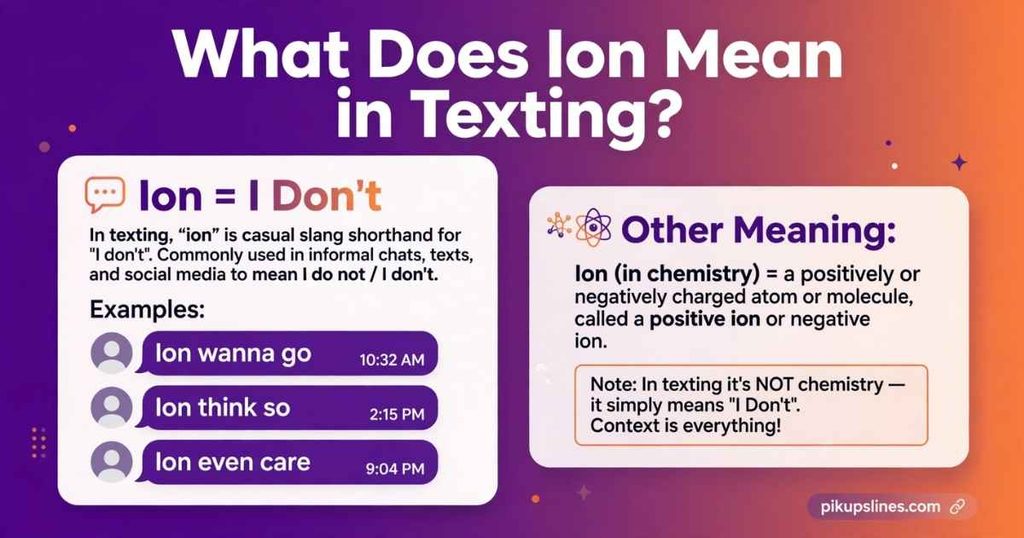
The most common ion meaning in text is “I don’t.” People use it as an informal expression when communicating their thoughts, feelings, preferences or opinions.
Unlike traditional internet abbreviations, “ion” doesn’t represent the first letters of several words. Instead, it’s a phonetic spelling that captures the relaxed pronunciation of “I don’t” in certain varieties of spoken American English.
For instance:
- Ion know: I don’t know.
- Ion care: I don’t care.
- Ion want it: I don’t want it.
- Ion like that: I don’t like that.
- Ion think so: I don’t think so.
Notice how the word appears before another verb. It replaces the words “I don’t” without changing the basic meaning of the sentence.
People commonly use this expression in casual texting, direct messages (DMs), social media posts and online conversations. You’ll also encounter it in TikTok comments, Snapchat messages, Instagram stories and Twitter (X) discussions.
Quick Meaning of Ion at a Glance
If you need a quick explanation, here’s what the expression means:
| Category | Explanation |
|---|---|
| Slang term | Ion |
| Main meaning | I don’t |
| Full expression | I do not |
| Language style | Informal English |
| Word formation | Phonetic spelling |
| Common usage | Text messages and social media |
| Cultural background | African American Vernacular English |
| Common audience | People participating in casual online conversations |
| Formality | Informal |
| Example | Ion know = I don’t know |
Important: “Ion” isn’t always an abbreviation for “I don’t.” In certain conversations, uppercase ION can mean “In Other News.” The surrounding sentence helps determine which interpretation makes sense.
Where Did Ion Slang Come From? Origin and Background
Understanding the history of “ion” requires looking beyond TikTok and modern texting habits. Its roots connect to spoken language, regional pronunciation and African American linguistic traditions.
The expression comes from African American Vernacular English (AAVE), a systematic variety of English with its own grammatical patterns, pronunciation features and vocabulary.
In certain forms of AAVE, speakers pronounce “I don’t” in a way that sounds closer to “ion.” The spelling reflects this spoken pronunciation rather than following standard written English conventions.
The Connection Between AAVE and Ion
African American Vernacular English has influenced American vocabulary, music, entertainment and digital communication for generations.
Many expressions that people recognize as internet slang have roots in Black American speech communities. Their popularity often increases through music, social media and everyday conversations.
“Ion” follows a similar path.
Rather than inventing a completely new word, people began representing an existing spoken-language pattern through informal writing.
This distinction matters because the expression isn’t simply a random typing shortcut. It reflects a particular pronunciation pattern with cultural and linguistic roots.
How Social Media Helped Popularize Ion
Social media made regional expressions easier to encounter across different communities.
Platforms such as Instagram, Snapchat, TikTok and Twitter (X) allow people to share conversations, captions, jokes and personal opinions instantly.
As a result, expressions rooted in particular speech communities can reach much wider audiences.
Several factors helped “ion” become recognizable online:
- Black digital culture: Black creators and online communities helped maintain and circulate the expression.
- Hip-hop influence: Rap music and popular culture introduced listeners to related speech patterns.
- Twitter (X): Short posts and conversational discussions helped informal spellings circulate.
- TikTok: Videos, captions and comments exposed more users to the expression.
- Instagram and Snapchat: Private messages and everyday social interactions encouraged casual spelling.
Gen Z and Gen Alpha users may encounter “ion” regularly, although neither generation invented it. Millennials and older internet users may also recognize or use the expression.
The important distinction is that social media helped spread the written form rather than creating its original pronunciation.
Why Do People Use Ion Instead of I Don’t?
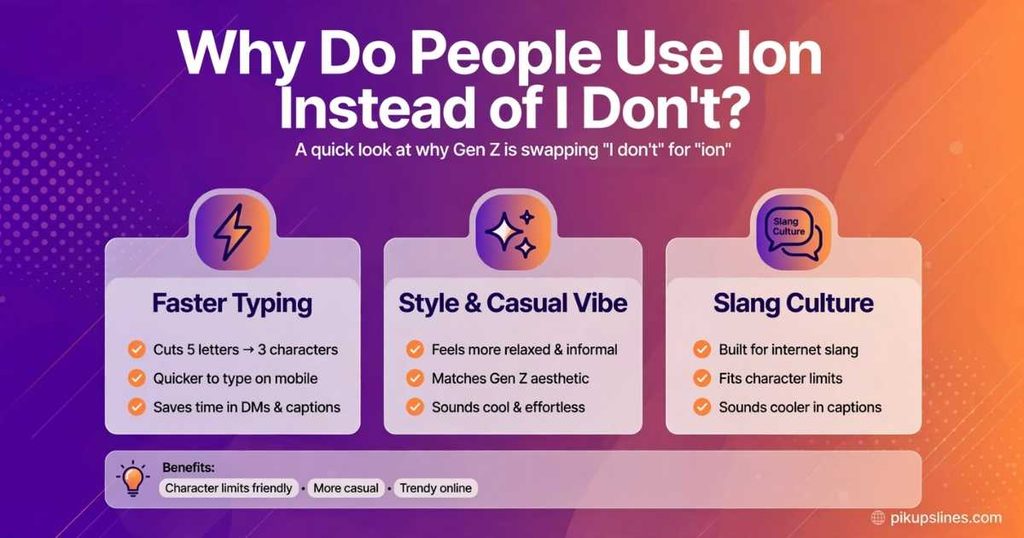
At first glance, writing “ion” might seem unnecessary when “I don’t” already works perfectly. However, casual communication isn’t always about following formal writing conventions.
People often type the way they speak. This makes digital conversations feel more natural and personal.
Here are some common reasons behind its popularity.
1. It reflects everyday speech.
Some speakers naturally pronounce “I don’t” in a way represented by “ion.” Writing it this way preserves their conversational voice.
2. It creates a relaxed tone.
Compare these two messages:
- “I don’t want to go.”
- “Ion wanna go.”
Both communicate the same basic idea. However, the second sounds more casual and conversational.
3. It expresses personality.
Informal spellings can help people communicate humor, frustration, confidence or playful indifference.
4. It fits internet culture.
Modern texting slang often reflects spoken language. Expressions such as “gonna,” “wanna,” “tryna” and “ion” show how people adapt writing to everyday speech.
5. It feels familiar within certain communities.
People often use expressions they hear among friends, family members and online communities. Familiar language can create social comfort and conversational warmth.
However, not everyone uses “ion” for the same reasons. For some, it reflects their everyday pronunciation. Others simply recognize it as familiar internet slang.
How to Use Ion in a Sentence: Common Examples
The easiest way to understand ion in texting is to examine how people use it in everyday conversations.
Generally, “ion” appears before a verb and expresses a negative statement. Its exact emotional meaning depends on the rest of the sentence.
Here are common expressions worth knowing.
Ion Know
“Ion know” means “I don’t know.”
People use it when they feel uncertain, lack information or cannot provide an answer.
Example:
Person A: Are we meeting at 6 or 7?
Person B: Ion know yet. I’ll ask everyone.
In this conversation, the speaker simply doesn’t have the answer.
Ion Care
“Ion care” means “I don’t care.”
It communicates a lack of concern or interest. Depending on the situation, it can sound neutral, dismissive or slightly annoyed.
Example:
Person A: Everyone is talking about that new show.
Person B: Ion care about it. I’m watching something else.
Here, the speaker expresses personal disinterest rather than uncertainty.
Ion Want
“Ion want” means “I don’t want.”
People use this expression when rejecting an offer, explaining a preference or expressing unwillingness.
Example:
Person A: Do you want to come shopping?
Person B: Ion want to go out today. Maybe tomorrow.
Ion Think So
“Ion think so” means “I don’t think so.”
It usually communicates doubt, disagreement or uncertainty.
Example:
Person A: Do you think he’ll arrive before lunch?
Person B: Ion think so. He’s running late.
Ion Even
“Ion even” means “I don’t even.”
This expression often appears in emotional reactions, especially when someone feels surprised, confused or frustrated.
Example:
Person A: Did you understand what happened?
Person B: Ion even know what to say!
The remaining thought may be understood from the conversation.
Ion Mind
“Ion mind” means “I don’t mind.”
People use it to show that something doesn’t bother them or that they’re comfortable with a particular choice.
Example:
Person A: Is it okay if we meet a little later?
Person B: Ion mind. Take your time.
More Common Ion Expressions
| Expression | Standard English meaning | Common conversational use |
|---|---|---|
| Ion get it | I don’t get it | Confusion |
| Ion like | I don’t like | Dislike or preference |
| Ion feel like | I don’t feel like | Lack of motivation |
| Ion remember | I don’t remember | Forgetfulness |
| Ion need | I don’t need | Lack of necessity |
| Ion see | I don’t see | Disagreement or uncertainty |
| Ion understand | I don’t understand | Confusion |
| Ion wanna | I don’t want to | Refusing an activity |
| Ion even know | I don’t even know | Surprise or frustration |
These expressions demonstrate the flexibility of the slang term. Rather than representing one complete sentence, “ion” works as an informal replacement for “I don’t.”
What Does Ion Mean on TikTok, Instagram and Snapchat?
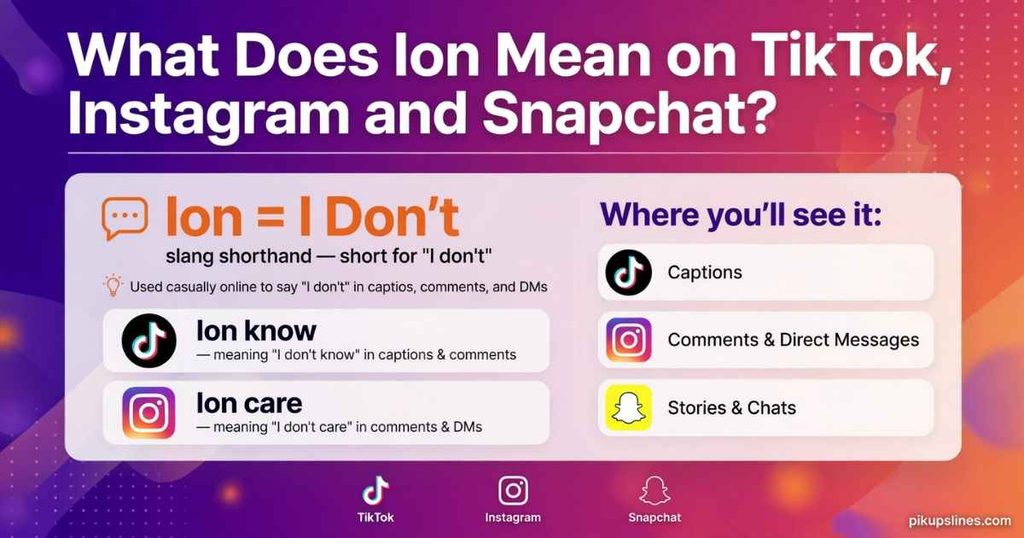
The ion meaning on social media generally remains the same: “I don’t.” However, the platform and conversation can influence how people interpret its tone.
Here’s how you might encounter it across different digital spaces.
TikTok: Users may write “ion even know” in comment sections when reacting to confusing videos, unexpected events or surprising situations.
Instagram: Friends may use “ion care” in direct messages or replies to express disinterest or playful indifference.
Snapchat: The expression frequently fits quick, informal exchanges where people communicate without worrying about formal grammar.
Twitter (X): Users may include “ion think so” in replies, discussions and personal opinions.
WhatsApp: Friends and family members may use it in everyday conversations, particularly when they prefer informal language.
Online gaming communities: Players might use “ion know” when discussing game strategies, team decisions or unexpected gameplay.
Remember that the meaning doesn’t change simply because someone uses a different platform. Context remains the most reliable guide.
Ion vs. IDK vs. IDC: What’s the Difference?
“Ion,” “IDK” and “IDC” can look similar because they all involve negative statements. However, they serve different purposes in digital communication.
Understanding their differences helps prevent confusion.
| Slang | Full meaning | Purpose | Example |
|---|---|---|---|
| Ion | I don’t | Expresses a negative statement | Ion want to go |
| IDK | I don’t know | Expresses uncertainty | IDK what happened |
| IDC | I don’t care | Expresses indifference | IDC about the result |
| IDGAF | I don’t give a f*** | Expresses strong indifference | IDGAF what they say |
| IMO | In my opinion | Introduces a personal viewpoint | IMO, it’s better |
| NGL | Not gonna lie | Introduces an honest opinion | NGL, that was funny |
The biggest difference is how these expressions are formed.
IDK and IDC are initialisms. They use the first letters of their corresponding words.
On the other hand, “ion” is a phonetic spelling of “I don’t.” It can connect with different verbs to create several expressions.
For example:
- Ion know = I don’t know.
- Ion care = I don’t care.
- Ion like it = I don’t like it.
- Ion want that = I don’t want that.
Therefore, “ion” offers more flexibility than a fixed abbreviation such as IDK.
Does Ion Mean I’m On or In Other News?
One common misunderstanding involves confusing the slang expression with other interpretations of the same letters.
Although lowercase “ion” usually means “I don’t” in casual slang, uppercase ION can also stand for “In Other News.”
This alternative appears when someone wants to introduce a different topic or shift the conversation.
For example:
“ION, did you finish your assignment?”
Here, ION means “In Other News,” not “I don’t.”
You might also encounter confusion with “I’m on.” However, these expressions have different meanings.
| Expression | Meaning | Example |
|---|---|---|
| ion | I don’t | Ion know |
| I’m on | I am currently doing something or participating | I’m on my way |
| ION | In Other News | ION, here’s another update |
| iron | A chemical element | Iron is used in steel production |
Capitalization can provide clues, but it doesn’t guarantee the intended meaning. Some people type entire messages in lowercase, while others capitalize the first word automatically.
Look at the words surrounding “ion” before deciding what someone means.
How Does Ion Affect the Tone of a Conversation?
Although “ion” generally means “I don’t,” its emotional effect changes with the sentence.
Sometimes it sounds relaxed and friendly. In other situations, it can communicate annoyance, disbelief or strong disagreement.
Consider these examples:
| Message | Possible emotional tone |
|---|---|
| Ion know lol | Uncertainty with humor |
| Ion care fr | Strong indifference |
| Ion wanna argue | Avoiding conflict |
| Ion even understand | Confusion |
| Ion believe that | Disbelief |
| Ion feel like going | Lack of motivation |
| Ion think that’s fair | Polite disagreement |
It’s also important to remember that tone isn’t determined by slang alone.
For example, “ion care” might sound playful between close friends. However, the same message could feel dismissive during a serious discussion.
Emojis, punctuation, previous messages and personal relationships all influence interpretation.
When Should You Use or Avoid Ion?
“Ion” works best in relaxed communication where everyone understands the expression.
It’s particularly suitable for informal conversations with friends, familiar online communities and people who regularly use similar digital slang.
Situations Where Ion Works Naturally
- Casual text messages between friends.
- Instagram and Snapchat conversations.
- TikTok comments and captions.
- Informal family group chats.
- Conversations with romantic partners.
- Online gaming discussions.
- Personal social media posts.
Situations Where You Should Avoid Ion
- Workplace emails.
- Academic assignments.
- Official documents.
- Professional client presentations.
- Formal business conversations.
- Important communication with unfamiliar audiences.
For example, writing “ion understand the instructions” in a workplace email might confuse the recipient.
A clearer alternative would be:
“I don’t fully understand the instructions. Could you please clarify?”
The goal isn’t to reject informal language. Instead, choose expressions that suit your audience and situation.
Is Ion Proper English or Just Internet Slang?
“Ion” isn’t a standard written replacement for “I don’t” in formal American English.
However, that doesn’t mean the expression lacks linguistic structure or cultural significance.
It represents a pronunciation-based spelling associated with African American English. Like many informal expressions, it works within particular speech and writing contexts.
English contains numerous examples of informal spellings that reflect everyday pronunciation:
- Gonna: Going to.
- Wanna: Want to.
- Gotta: Got to.
- Tryna: Trying to.
- Y’all: You all.
- Ion: I don’t.
These forms aren’t interchangeable with standard spellings in every situation. Their suitability depends on audience, purpose and communication style.
It’s also worth recognizing that AAVE is a legitimate, systematic language variety rather than incorrect English. Its grammatical patterns and pronunciation features follow established linguistic conventions.
Therefore, “ion” makes sense within its linguistic background even though formal writing generally favors “I don’t.”
Is Ion Safe for Kids and Teenagers?
Generally, yes. The expression itself isn’t offensive, threatening or inappropriate.
“Ion” simply represents “I don’t” in informal communication. Children and teenagers may encounter it while chatting with friends or browsing social media.
However, parents should understand its meaning rather than assuming every unfamiliar expression carries a negative message.
A few useful points:
- The term doesn’t contain profanity.
- Its meaning depends on the surrounding sentence.
- It can communicate disagreement or disinterest.
- It frequently appears in casual online conversations.
- It isn’t inherently harmful or unsafe.
For example, “ion wanna go” simply means “I don’t want to go.”
As with any internet slang, the surrounding conversation matters more than the individual word.
How to Respond When Someone Uses Ion in Text?
Once you understand the meaning, responding becomes straightforward.
You don’t need to copy the slang or change your usual writing style. Simply respond according to the message’s actual meaning.
Here are a few examples:
| Their message | What they mean | Possible response |
|---|---|---|
| Ion know | I don’t know | No worries, I’ll check. |
| Ion care | I don’t care | Okay, that’s fine. |
| Ion wanna go | I don’t want to go | That’s completely fine. |
| Ion think so | I don’t think so | What makes you think that? |
| Ion feel like talking | I don’t feel like talking | Take your time. |
| Ion understand | I don’t understand | Let me explain it again. |
If you’re unsure what someone means, ask a simple question.
For instance, “Do you mean you don’t want to?” can clear up confusion without making the conversation awkward.
Common Misunderstandings About Ion Slang
Because “ion” has several possible interpretations, people sometimes misunderstand it when reading messages without enough context.
Here are the most common mistakes.
Mistake: Thinking ion means IDK.
Not exactly. “Ion” means “I don’t,” while IDK specifically means “I don’t know.” The phrase “ion know” carries the same meaning as IDK.
Mistake: Assuming ion means I’m on.
These expressions aren’t interchangeable. “I’m on” has a different grammatical meaning.
Mistake: Confusing ion with chemistry terminology.
In scientific writing, an ion is an electrically charged atom or molecule. In casual texting, the same spelling can represent “I don’t.”
Mistake: Believing ion is a newly invented Gen Z abbreviation.
Its written popularity grew through internet culture, but its linguistic background connects to African American English.
Mistake: Assuming ion always sounds rude.
The expression itself doesn’t automatically communicate disrespect. Its tone depends on the complete message.
Frequently Asked Questions About Ion Meaning in Text
What does ion mean in a text message?
“Ion” usually means “I don’t” in informal text messages. People use it to express disagreement, uncertainty, preferences or a lack of interest. For example, “ion know” means “I don’t know.”
What does ion stand for in texting?
“Ion” represents the spoken pronunciation of “I don’t.” It’s a phonetic spelling rather than an initialism made from several words.
Is ion short for I don’t?
Yes. In common internet slang, “ion” is an informal spelling of “I don’t.” It reflects how the phrase sounds when pronounced casually.
What does ion know mean in texting?
“Ion know” means “I don’t know.” People use it when they lack information, feel uncertain or cannot answer a particular question.
What does ion care mean?
“Ion care” means “I don’t care.” Depending on the conversation, it can express indifference, disinterest or mild frustration.
Is ion the same as IDK?
No. “Ion” means “I don’t,” whereas IDK means “I don’t know.” However, “ion know” and IDK communicate the same basic message.
Where did ion slang originate?
The expression has roots in African American Vernacular English (AAVE). Its spelling represents a spoken pronunciation of “I don’t” that became recognizable in internet writing.
Why does Gen Z use ion instead of I don’t?
Some Gen Z users choose “ion” because it reflects casual speech and creates a relaxed conversational tone. However, the expression predates Gen Z’s widespread social media use.
Does ion mean I’m on?
No. “Ion” usually means “I don’t” in casual slang. However, uppercase ION can also mean “In Other News” when someone changes the conversation’s topic.
Is ion proper English?
It’s an informal spelling associated with African American English. Although it works in casual communication, standard written English generally uses “I don’t.”
Is ion rude or offensive?
No, “ion” isn’t inherently rude or offensive. However, expressions such as “ion care” can sound dismissive depending on the situation and relationship between speakers.
Can I use ion in professional conversations?
It’s better to avoid it in professional communication. Use “I don’t” instead, especially in workplace emails, academic writing and official messages.
Final Thoughts on What Ion Means in Text
Understanding the ion meaning in text is easier once you recognize its connection to everyday spoken language. In most casual digital conversations, “ion” means “I don’t” and appears in expressions such as “ion know,” “ion care” and “ion want.”
Its linguistic background connects to African American Vernacular English, while social media has helped introduce the written expression to wider audiences.
Remember that context matters. Uppercase ION can sometimes mean “In Other News,” while chemistry uses ion to describe an electrically charged atom or molecule.
Ultimately, “ion” is an informal expression that makes sense in the right conversational setting. Use it naturally when appropriate, but choose standard English when clarity and professionalism matter most.