NTY is a popular texting abbreviation that stands for “No Thank You.” People use it in messages and online conversations to politely decline an offer, invitation, suggestion, or request without typing the complete phrase.
You might see NTY on Snapchat, Instagram, WhatsApp, TikTok, or Discord. It offers a quick way to say no while still acknowledging someone’s offer.
In this guide, you’ll learn what NTY means, how to use it, and how to respond naturally in different conversations.
What Does NTY Mean in Text?
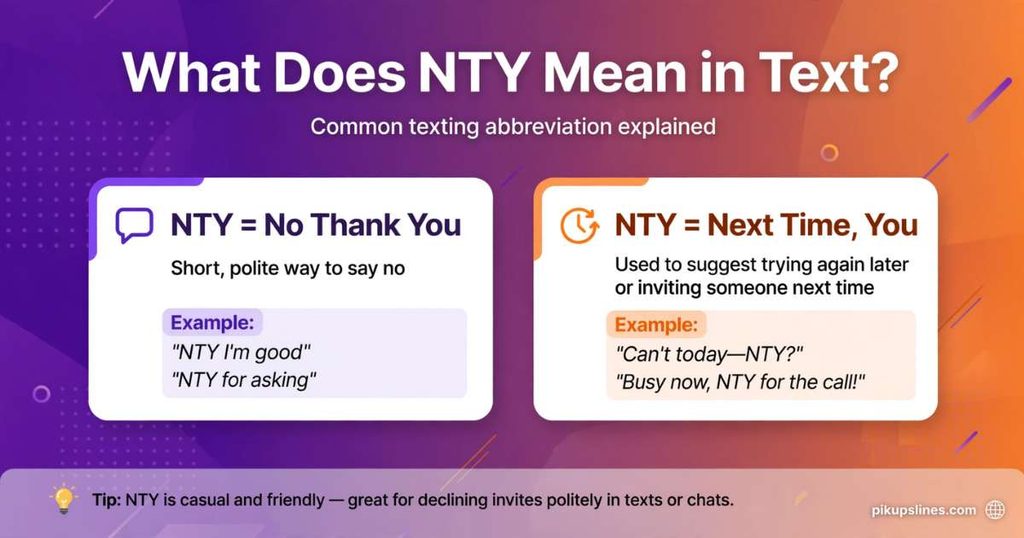
NTY means “No Thank You” in texting and online communication. It is an abbreviation used to politely turn down something that another person offers or suggests.
Instead of writing the full phrase, someone can type three letters: N, T, and Y. The message communicates two things at once: the person does not want what is being offered, but they recognize and acknowledge the offer.
Consider this simple conversation:
Friend: Do you want me to bring you a coffee?
You: NTY, I already had one.
In this example, the reply declines the coffee without sounding unnecessarily harsh. The sender is not ignoring the offer; they are simply saying they do not need it.
NTY can be used in many everyday situations, including:
- Declining an invitation to a party or social event.
- Turning down food, drinks, or other items.
- Refusing an offer to buy or exchange something.
- Saying no to a recommendation or suggestion.
- Declining help when you can manage on your own.
- Rejecting an online request or invitation.
- Responding to promotional messages or unwanted offers.
The abbreviation is especially suitable for casual digital conversations. It is short enough for quick replies but still includes the polite idea of saying thank you.
NTY Meaning in Simple Words
In simple words, NTY means “No, thanks” or “No, thank you.”
It is a quick way to refuse something while keeping your response reasonably courteous. You can think of it as a shorter version of a sentence such as:
“I appreciate you asking, but I do not want it.”
For example:
Person A: Would you like another slice of pizza?
Person B: NTY, I’m full.
Person B is politely declining the food. There is no complicated hidden message in the abbreviation.
Here are a few other ways to understand it:
- “No, thank you.”
- “Thanks, but I will pass.”
- “I appreciate the offer, but I do not need it.”
- “No thanks, I’m good.”
- “I don’t want that, but thank you for asking.”
The exact wording behind NTY depends on the situation. Someone declining a cup of tea may simply mean they are not thirsty. Someone declining a party invitation may already have other plans. Someone refusing a product offer may not be interested in buying it.
The main message remains the same: the person is saying no while acknowledging the offer.
What Does NTY Stand For?
NTY is formed from the first letters of the words in the phrase “No Thank You.”
- N stands for No.
- T stands for Thank.
- Y stands for You.
Together, the letters create a compact expression that is easy to type and understand.
Unlike some slang expressions that have unusual origins or meanings connected to a particular online trend, NTY is a straightforward abbreviation of an everyday phrase. It follows the same general pattern as other familiar texting shortcuts.If you enjoy learning common texting abbreviations, check out our guide on GL meaning in text to understand what it means and how people use it in online conversations.
For example:
- TY means Thank You.
- THX means Thanks.
- NP means No Problem.
- IDK means I Don’t Know.
- BRB means Be Right Back.
- NVM means Never Mind.
NTY belongs to this broader collection of shortened expressions. It makes a common response quicker to send, particularly when a conversation does not require a detailed explanation.
Why Do People Use NTY in Text Messages?
People use NTY because it communicates a refusal quickly without removing the polite element of the original phrase.
In face-to-face conversations, a person can say no with a friendly voice, a smile, or a gentle gesture. Text messages do not offer the same natural signals. A short phrase such as “No thank you” helps communicate that the refusal is not necessarily personal.
There are several reasons someone might choose NTY instead of typing the complete sentence.
It Saves Time
The most obvious reason is convenience. Typing three letters takes less effort than writing a complete response.
When someone is having a quick conversation, they may prefer short expressions rather than full sentences.
For example:
Friend: Want some snacks?
You: NTY.
The reply is enough to answer the question. There is no need to write a long explanation when the situation is simple.
It Keeps the Reply Polite
A plain “No” can sometimes sound abrupt, especially when someone is making a friendly offer.Online conversations are full of unfamiliar abbreviations, and our article explaining can help you understand its meaning, usage, and context.
Compare these responses:
Offer: Would you like some tea?
Reply A: No.
Reply B: NTY.
The second response includes an acknowledgment of the offer. It can therefore sound softer than a direct refusal, although the tone still depends on the conversation.
It Avoids Unnecessary Explanations
Not every refusal needs a detailed reason. You might not want another drink, another product, or another invitation. A short response can communicate your decision without making the situation awkward.
For example:
Person A: Want to try this new game?
Person B: NTY, gaming isn’t really my thing.
The person gives a clear answer and adds a short explanation. The conversation can then move forward naturally.
It Works in Fast-Moving Chats
Group chats, gaming conversations, and social media messages can move quickly. People often use abbreviations because they want to respond without interrupting the flow.
NTY fits these situations because its meaning is simple and its purpose is clear.
It Helps Set Boundaries
Sometimes a person needs to decline an offer or request firmly. NTY can help communicate that decision without turning the response into an argument.
For example:
Person A: Can you send me your account password?
Person B: NTY, I don’t share my passwords.
Here, the abbreviation introduces a refusal, while the rest of the message explains the boundary.Just like other popular chat abbreviations, DTTM can have a specific meaning depending on the conversation, so explore our guide on DTTM meaning in text for a clearer explanation.
How to Use NTY in a Text Conversation
Using NTY is simple. You can send it by itself when the situation is obvious or add a few words when you want your response to sound warmer or more specific.
The best choice depends on what the other person has said and how well you know them.
Use NTY to Decline an Offer
When someone offers you something you do not need, NTY is a convenient response.
Example:
Alex: Do you want me to order you a burger?
Sam: NTY, I already ate.
Sam declines the offer and gives a simple reason.
Use NTY to Reject an Invitation
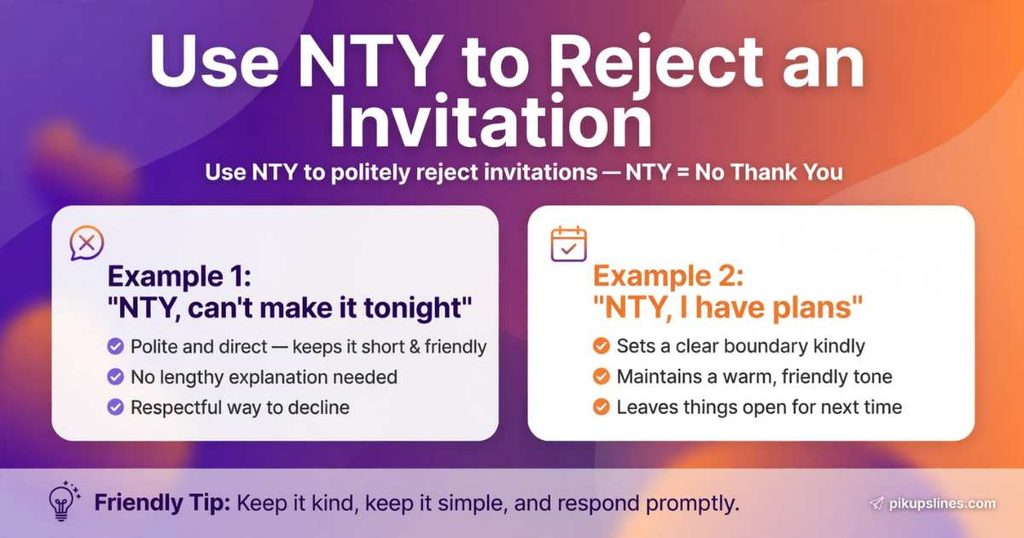
You can also use it when someone invites you to an event or activity.
Example:
Mia: We’re going shopping this afternoon. Want to join?
Lena: NTY, I have some work to finish.
The reply communicates that Lena will not be joining the group.
Use NTY to Decline Help
Sometimes people offer assistance even when you do not need it.
Example:
Friend: Should I help you carry those bags?
You: NTY, I’ve got them.
This is a short and friendly way to say that you can manage on your own.
Use NTY When Rejecting a Suggestion
If someone recommends a movie, restaurant, activity, or product that does not interest you, NTY can help you decline.
Example:
Friend: You should watch this horror movie. It’s amazing.
You: NTY, I don’t enjoy scary movies.
The reply is direct but does not criticize the other person’s recommendation.
Use NTY in Buying and Selling Conversations
NTY can also appear in online marketplaces and informal buying or selling discussions.
Example:
Seller: I can add another item for an extra $15.
Buyer: NTY, I’m only interested in the original item.
The buyer politely rejects the additional offer.
Use NTY in Group Chats
Group conversations often involve invitations, suggestions, and quick questions. NTY can help you respond without writing a long message.
Example:
Friend 1: Everyone is meeting at the park tomorrow. Who’s coming?
Friend 2: I’ll be there!
Friend 3: NTY, I have family plans.
The abbreviation lets the third person decline while keeping the conversation moving.If you come across CKFS in a message, read our detailed guide to CKFS meaning in text to learn what this abbreviation means and when people use it.
NTY Meaning on Social Media
NTY generally keeps the same meaning across social media platforms: “No Thank You.” The platform does not usually change what the abbreviation stands for. However, the situations in which people use it can vary.
You may encounter NTY in direct messages, comment sections, group conversations, gaming communities, and replies to online offers.
NTY Meaning on Snapchat
On Snapchat, conversations are often short and informal. People send quick messages, respond to snaps, and make plans through direct chats.
NTY can be used when someone declines an invitation, suggestion, or offer.
Example:
Friend: Wanna come over tonight?
You: NTY, I’m staying home.
The reply simply means that you do not want to come over.
Another example:
Friend: Want me to send you another snap?
You: NTY, I’m good lol.
The meaning remains “No Thank You,” while the added words make the response more relaxed.
NTY Meaning on Instagram
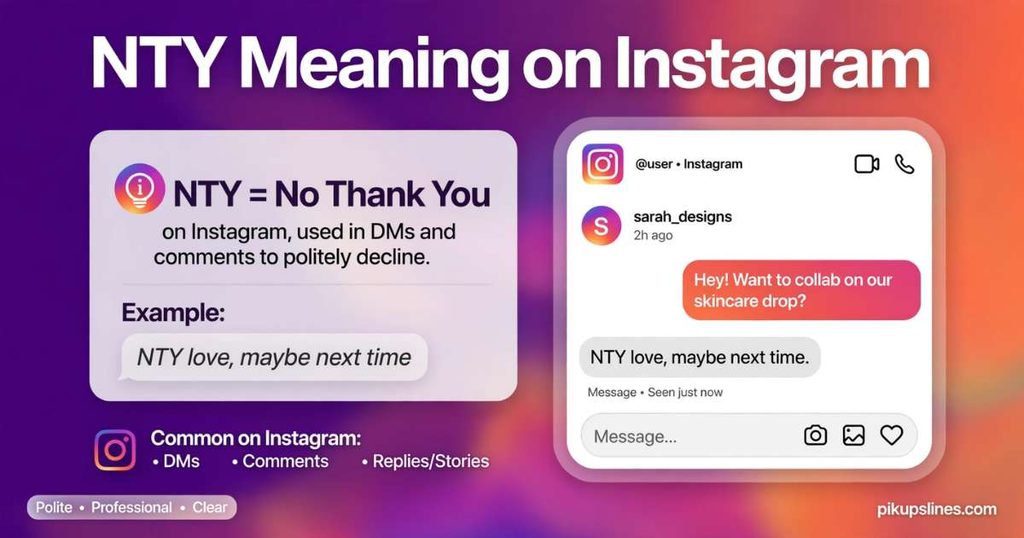
Instagram users communicate through direct messages, comments, and story replies. NTY can appear when someone declines an invitation, promotional offer, recommendation, or request.
Example:
User A: Want to follow my new page?
User B: NTY, thanks though.
The second user is politely declining the request.
You might also see the abbreviation in conversations about products, collaborations, or social media promotions.
Example:
User A: Interested in buying this hoodie?
User B: NTY, I’m looking for a different style.
Here, NTY makes the refusal clear without requiring a lengthy response.
NTY Meaning on TikTok
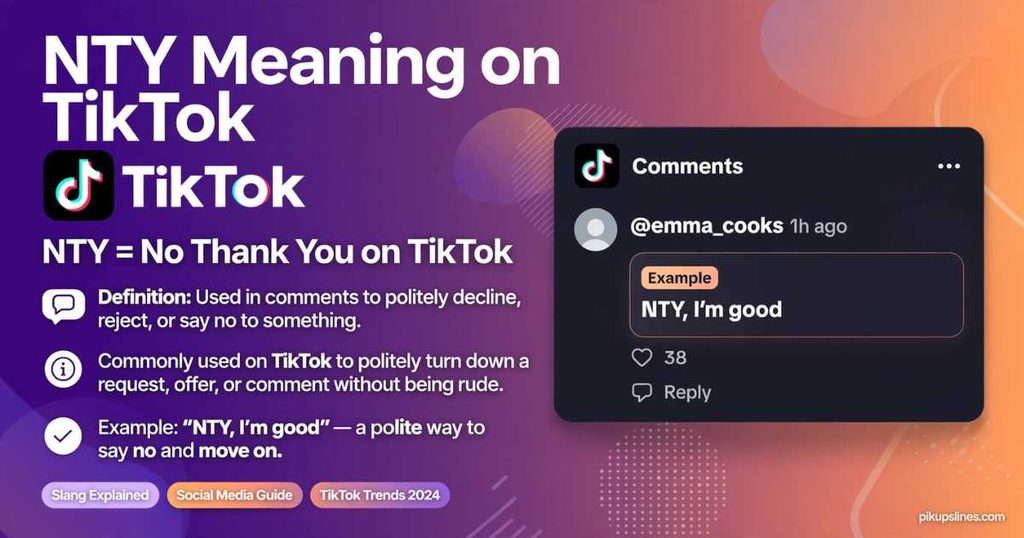
TikTok conversations often take place in comment sections and private messages. People may use NTY when reacting to suggestions, trends, challenges, or invitations.
Example:
User A: You should try this dance challenge!
User B: NTY, I have two left feet 😂
The response declines the suggestion in a humorous way.
The abbreviation can also appear when someone rejects a product recommendation or an invitation to participate in a trend.
NTY Meaning on WhatsApp
WhatsApp is commonly used for personal conversations, family groups, work-related chats, and community discussions. NTY may appear in any informal conversation where someone needs to decline something.
Example:
Cousin: We’re ordering dinner. Do you want anything?
You: NTY, I already had dinner.
The abbreviation is a quick way to respond without making the exchange unnecessarily formal.
In family or close-friend conversations, the sender may use lowercase letters, emojis, or additional words to make the message feel more personal.
NTY Meaning on Facebook Messenger
Facebook Messenger supports individual conversations and group chats. NTY can be used when declining an invitation, offer, or recommendation.
Example:
Friend: Would you like to join our weekend trip?
You: NTY, I won’t be available this weekend.
The message is clear and gives the other person enough information to understand the refusal.
NTY Meaning on Discord
Discord is popular for gaming, hobbies, communities, and group discussions. People often use abbreviations to communicate quickly while participating in active chats.
NTY can be used to decline a game invitation, team request, trade, or offer of assistance.
Example:
Player 1: Want to join our squad?
Player 2: NTY, I’m playing with my friends.
Another example:
Player 1: Want to trade this item?
Player 2: NTY, I’m keeping mine.
The abbreviation helps players communicate their decisions without slowing down the conversation.
NTY in Online Forums and Communities
NTY can also appear in discussion boards, hobby groups, and online communities.
For example, someone may offer a recommendation, invite another member to participate in a project, or suggest a particular product. The recipient can reply with NTY when they are not interested.
Because online communities often include people who do not know each other personally, adding a short explanation can make the refusal easier to understand.
NTY Meaning in Different Situations
Although NTY has one widely recognized texting meaning, the situation determines exactly what the person is declining.
Understanding the context helps you interpret the message correctly.
When Someone Offers You Food
If someone asks whether you want food and you reply NTY, you are saying that you do not want any.
Example:
Friend: Want some fries?
You: NTY, I’m full.
The response is usually neutral and friendly.
When Someone Offers You a Drink
The abbreviation works in the same way when someone offers water, coffee, tea, or another drink.
Example:
Coworker: Would you like some water?
You: NTY, I have my bottle.
You are declining because you already have something to drink.
When Someone Asks You Out
If someone invites you on a date or suggests spending time together, NTY can communicate that you are not interested.
Example:
Person A: Would you like to go out with me sometime?
Person B: NTY, but I appreciate you asking.
This is a clear refusal. The additional words make it more considerate than sending only the abbreviation.
When Someone Offers a Product
In a shopping conversation, NTY usually means that the buyer is not interested in the item or offer.
Example:
Seller: I can offer you this phone at a discounted price.
Buyer: NTY, I’m comparing a few other models.
The buyer declines without criticizing the seller.
When Someone Offers Advice
A person may suggest a solution or offer advice that you do not need.
Example:
Friend: You should try changing your study schedule.
You: NTY, my current routine is working well.
The reply politely declines the suggestion.
When Someone Requests a Favor
NTY can also help you refuse a request, although a longer explanation may be more appropriate when the request is important.
Example:
Person A: Can you lend me your laptop for the weekend?
Person B: NTY, I need it for my own work.
The response communicates a boundary and explains the reason.
Is NTY Polite or Rude?
NTY is generally intended as a polite or neutral way to decline something. The phrase includes “thank you,” which acknowledges the other person’s offer rather than rejecting it with a plain “no.”
However, the abbreviation can sometimes feel blunt because it is so short. Text messages do not include vocal tone, facial expressions, or body language. As a result, the same three letters can create different impressions.
For example:
Friend: Would you like to come to my birthday party?
Reply: NTY.
This response may feel a little cold because the invitation is personal and the reply offers no explanation.
Now compare it with:
Reply: NTY, but thanks so much for inviting me! I hope you have a great time.
The second response feels warmer because it recognizes the effort behind the invitation.
The important point is that NTY is not automatically rude. Its tone depends on the relationship, the subject, and the way it is delivered.
When NTY Sounds Polite
NTY usually sounds polite when:
- The offer is casual and does not require a detailed response.
- Both people regularly use texting abbreviations.
- The message includes a friendly explanation.
- The conversation is relaxed and informal.
- The sender adds words such as “thanks” or “I appreciate it.”
For example:
“NTY, but I really appreciate the offer!”
This is a friendly refusal that makes the sender’s intention clear.
When NTY Sounds Blunt
NTY may feel abrupt when:
- It is sent alone in response to a thoughtful invitation.
- The conversation is serious or emotionally sensitive.
- The recipient expects a more personal explanation.
- The sender uses punctuation that makes the response seem final.
- The two people are not familiar with texting abbreviations.
For example, replying only “NTY.” to someone who has offered significant help may come across as dismissive.
A more considerate response would be:
“No, thank you. I appreciate you offering to help, though.”
How to Make NTY Sound Friendlier
If you want to use NTY without sounding cold, add a few words that explain your response or acknowledge the offer.
You can try:
- “NTY, but thanks for asking!”
- “NTY, I’m good 😊”
- “NTY, maybe another time.”
- “NTY, I appreciate it!”
- “NTY, but that is really kind of you.”
- “NTY, I already have plans.”
These small additions make your intention easier to understand.
Does NTY Have Different Meanings?
In ordinary texting and online chat, the most established meaning of NTY is “No Thank You.” This is the interpretation you should usually consider first when someone sends it in response to an offer or invitation.
However, abbreviations can sometimes have specialized meanings in particular workplaces, organizations, games, or private communities. A group may create its own shorthand, and a set of letters may also appear as part of a business name, technical label, or other specialized expression.
That does not mean every possible interpretation is a common texting definition.
If you see NTY in an ordinary conversation, “No Thank You” is the most sensible starting point. If it appears in an unusual technical or professional context, consider the subject of the discussion before interpreting it.
It is also important not to confuse NTY with similar-looking abbreviations. A small change in letter order can produce an entirely different expression.
NTY vs. TY
NTY and TY are related because both contain the idea of thanking someone. However, they communicate different responses.
NTY means “No Thank You.”
TY means “Thank You.”
NTY is generally used to decline an offer, while TY expresses appreciation.
For example:
Person A: Would you like a cup of coffee?
Person B: NTY, I’m fine.
Here, the person does not want coffee.
Now consider:
Person A: I brought you a cup of coffee.
Person B: TY!
The second person is expressing appreciation for the coffee.
Remember that the presence of the letter T does not make these abbreviations interchangeable. NTY includes a refusal, while TY is simply a thank-you message.
NTY vs. No Thanks
“No thanks” and NTY communicate almost the same basic message. The main difference is how they are written.
“No thanks” uses complete words, while NTY is a shortened version suitable for quick digital communication.
For example:
Friend: Want to watch a movie?
Reply A: No thanks, I’m tired.
Reply B: NTY, I’m tired.
Both replies decline the invitation. The first may feel slightly more natural in a longer conversation, while the second is shorter and more casual.
Neither version is automatically more polite. The rest of the message and the relationship between the people matter more than the choice of abbreviation.
NTY vs. NAH
NAH is an informal way of saying “no” or “not really.” It is often used in relaxed conversations.
NTY has a clearer meaning because it directly represents “No Thank You.”
Compare these examples:
Friend: Want another piece of cake?
Reply A: Nah, I’m full.
Reply B: NTY, I’m full.
Both responses decline the offer. However, NAH sounds more conversational and informal, while NTY includes an explicit expression of thanks.
NTY vs. NVM
NTY and NVM may look similar because they are short abbreviations beginning with N, but their meanings are different.
- NTY means No Thank You.
- NVM means Never Mind.
NTY is used to decline something. NVM is used when someone wants to withdraw a question, cancel a request, or indicate that something is no longer necessary.
For example:
Friend: Do you want some help?
You: NTY, I’ve finished.
But:
Friend: Should I send you the document?
You: NVM, I found it.
The first conversation involves declining help. The second involves withdrawing a request.
NTY vs. IDC
IDC stands for “I Don’t Care.” It is often used to show indifference or a lack of concern.
NTY is different because it declines an offer while acknowledging it.
For example:
Person A: Do you want pizza or pasta?
Person B: IDC.
This means the person does not have a preference.
Now consider:
Person A: Do you want some pizza?
Person B: NTY, I already ate.
This means the person does not want the pizza.
The difference is important. IDC communicates indifference, while NTY communicates refusal.
NTY vs. TYSM
TYSM stands for “Thank You So Much.” It is an expression of strong appreciation.
NTY and TYSM may both contain a thank-you element, but they serve different purposes.
NTY: No Thank You.
TYSM: Thank You So Much.
For example:
Friend: Want me to send you the notes?
You: NTY, I already have them.
But:
Friend: I sent you the notes.
You: TYSM!
The first response declines an offer. The second expresses gratitude.
Examples of NTY in Everyday Conversations
The easiest way to understand NTY is to see how it works in natural conversations. Below are examples covering common situations.
Declining Food
Person A: Want another slice of pizza?
Person B: NTY, I’m completely full.
Meaning: Person B does not want any more pizza.
Turning Down Coffee
Person A: Should I get you a coffee?
Person B: NTY, I already had one.
Meaning: Person B appreciates the offer but does not need coffee.
Rejecting a Party Invitation
Person A: We’re having a party on Saturday. Want to come?
Person B: NTY, I have other plans.
Meaning: Person B is declining the invitation.
Refusing a Movie Recommendation
Person A: You should watch this new horror movie.
Person B: NTY, scary movies aren’t for me.
Meaning: Person B is not interested in watching the movie.
Declining a Shopping Invitation
Person A: Want to go shopping with us?
Person B: NTY, I’m trying to save money.
Meaning: Person B does not want to join the shopping trip.
Refusing an Online Offer
Seller: I can lower the price if you buy today.
Buyer: NTY, I’ll keep looking.
Meaning: The buyer is not interested in the offer.
Declining a Gaming Invitation
Player A: Want to join our team?
Player B: NTY, I’m already playing with friends.
Meaning: Player B does not want to join the team.
Refusing Unwanted Advice
Friend: You should change your hairstyle.
You: NTY, I like it the way it is.
Meaning: You are declining the suggestion.
Turning Down a Ride
Person A: Do you need a ride home?
Person B: NTY, my brother is picking me up.
Meaning: Person B does not need transportation.
Declining a Social Media Request
User A: Want to follow each other?
User B: NTY, I keep my account private.
Meaning: User B is politely declining.
Refusing an Extra Task
Coworker: Can you take another task today?
You: NTY, I already have a full workload.
Meaning: You are declining the additional responsibility. In a professional conversation, a complete sentence would generally be more appropriate than the abbreviation.
Declining a Weekend Plan
Friend: We’re going hiking this weekend. Interested?
You: NTY, I need some rest.
Meaning: You are not interested in joining the activity.
Refusing a Product Recommendation
Friend: You should buy these headphones. They’re on sale.
You: NTY, I’m happy with the ones I have.
Meaning: You do not want to buy the suggested headphones.
Declining an Offer of Help
Person A: Do you want me to finish that assignment with you?
Person B: NTY, I want to try it myself first.
Meaning: Person B prefers to work independently.
A Friendly and Playful Refusal
Friend: Want to wake up at 5 a.m. and go running?
You: NTY 😂 I’m not built for that.
Meaning: You are jokingly declining the invitation.
How to Reply When Someone Sends NTY
If someone sends you NTY, you usually do not need to make a big deal out of it. They are declining an offer, suggestion, invitation, or request.
The best response is often a simple acknowledgment. Respect their answer and continue the conversation naturally.
Your reply can depend on what you originally offered.
Reply With “No Problem”
If someone declines a casual offer, you can simply say:
“No problem!”
For example:
You: Want some coffee?
Friend: NTY.
You: No problem!
This keeps the conversation friendly and relaxed.
Say “All Good”
“All good” is another casual response. It shows that you understand and are not offended.
Example:
You: Want to join us for dinner?
Friend: NTY, I’m tired.
You: All good. Get some rest!
Say “Maybe Next Time”
If you invited someone to an event or activity, you can leave the possibility open without pressuring them.
Example:
You: Want to come to the concert?
Friend: NTY, I have plans.
You: No worries, maybe next time!
Acknowledge Their Explanation
If the person gives a reason, respond to that reason rather than repeatedly asking them to reconsider.
Example:
You: Want to go out tonight?
Friend: NTY, I have an early morning tomorrow.
You: Totally understand. Have a good night!
Respect a Clear Refusal
Sometimes the best response is simply to accept the person’s decision.
For example:
You: Would you like to buy this item?
Buyer: NTY.
You: Thanks for letting me know.
There is no need to keep making the same offer after someone has declined.
Keep It Light
If you are close friends and the conversation is playful, a humorous response may be appropriate.
Example:
You: Want to try my terrible homemade cookies?
Friend: NTY 😂
You: Fair enough, more for me!
Humor works best when both people understand each other’s style and the situation is genuinely lighthearted.
How to Use NTY Without Sounding Rude
Although NTY is generally a polite abbreviation, short messages can sometimes be misunderstood. If you want to decline an offer without hurting someone’s feelings, consider adding a little context.
Add a Thank-You Message
You can make the response warmer by acknowledging the other person’s effort.
Instead of:
“NTY.”
Try:
“NTY, but thanks for offering!”
This works well when someone is trying to be helpful.
Give a Brief Reason
A short explanation can make your refusal easier to understand.
For example:
“NTY, I already have plans.”
You do not need to share every detail of your schedule. A simple explanation is often enough.
Use a Friendly Emoji
In casual conversations, an emoji can help soften a brief response.
Examples include:
- “NTY 😊”
- “NTY, I’m good 🙂”
- “NTY 😂 maybe next time.”
- “NTY, but thanks!”
An emoji should fit the relationship and the topic. It may be suitable when chatting with a friend but unnecessary in a serious or professional conversation.
Avoid Making Your Refusal Sound Personal
If you are declining a suggestion, focus on your own preference rather than criticizing the other person’s idea.
For example:
“NTY, that isn’t really my thing.”
This sounds more considerate than:
“NTY, that’s a terrible idea.”
The first response communicates your preference without insulting the person who made the suggestion.
Use Complete Words in Important Conversations
NTY is useful for casual chats, but it is not always the best choice for serious discussions.
If someone offers meaningful support, invites you to an important event, or asks you a sensitive question, consider writing a complete response.
For example:
“Thank you for inviting me. I won’t be able to attend, but I hope you have a wonderful time.”
This communicates your decision while showing that you value the other person’s effort.
Is NTY Appropriate in Professional Conversations?
NTY is usually better suited to informal conversations than professional communication.
You might use it with a colleague you know well in a casual workplace chat, but it can appear too brief in an email to a manager, client, customer, or business partner.
Professional communication often requires a little more clarity and courtesy.
For example, instead of replying:
“NTY.”
You could write:
“Thank you for the offer, but I won’t be able to participate.”
Or:
“Thank you for considering me. I appreciate the opportunity, but I will have to decline.”
These alternatives sound more professional because they acknowledge the offer and communicate the decision in a complete sentence.
The same principle applies to academic communication. When replying to a teacher, professor, or school administrator, writing out “No, thank you” is generally a better choice than using an abbreviation.
The rule is simple: use NTY when the conversation is casual and the other person will understand it. Use complete words when the situation calls for a more thoughtful or formal response.
Does Capitalization Change the Meaning of NTY?
No. Capitalization does not normally change the meaning of NTY.
You may see the abbreviation written in several ways:
- NTY
- nty
- Nty
- nTy
All of these forms can represent “No Thank You.”
The choice is usually a matter of personal typing style. Some people prefer capital letters because they make abbreviations stand out. Others use lowercase letters because they type casually.
For example:
Friend: Want another drink?
You: nty, I’m good.
The lowercase version has the same basic meaning as “NTY.”
Does Punctuation Change the Tone of NTY?
Punctuation does not change the core meaning, but it can influence how a message feels.
Consider these examples:
NTY
A straightforward refusal. Depending on the conversation, it may sound neutral or slightly abrupt.
NTY!
The exclamation mark can make the response feel more energetic or expressive. However, it can also communicate strong emphasis.
NTY.
A period can make a short reply feel final or serious, particularly in a conversation where the sender usually writes casually.
NTY 🙂
The smiley face can make the refusal feel friendlier.
NTY lol
The added “lol” may make the message seem more relaxed or playful, depending on the context.
These differences are not fixed rules. People use punctuation differently, so you should consider the sender’s normal texting style before deciding what they mean emotionally.
Who Uses NTY?
NTY can be used by anyone who is familiar with texting and internet abbreviations. It is not limited to a particular age group, profession, or social media platform.
You may encounter it among:
- Friends chatting about plans.
- Family members discussing food or activities.
- Students communicating in group chats.
- Gamers declining team invitations or trades.
- Online shoppers responding to sellers.
- Social media users replying to suggestions.
- Members of online communities.
Some people use abbreviations frequently, while others prefer complete sentences. Therefore, you may see NTY regularly in one group and hardly ever in another.
It is better to understand NTY as a casual communication shortcut rather than a term that belongs exclusively to one generation.
Is NTY Still Used in Modern Texting?
Yes, NTY remains understandable as a short form of “No Thank You.” It is part of the wider collection of internet and messaging abbreviations that people use to make everyday communication quicker.
However, individual texting habits vary. Some people may write “nty,” while others prefer “no thanks,” “I’m good,” or a complete sentence.
The fact that an abbreviation is recognizable does not mean everyone uses it regularly. Its frequency depends on the people involved, their communication habits, and the type of conversation.
The important thing is to understand its meaning when you encounter it. If someone sends NTY after you make an offer, the most likely interpretation is that they are politely declining.
Common Mistakes to Avoid When Understanding NTY
Because texting abbreviations are short, it is easy to misread them or assume they carry more meaning than they actually do.
Here are some common mistakes to avoid.
Assuming NTY Is Always Rude
A short reply is not automatically a sign of anger or disrespect. Someone may simply be busy or accustomed to using abbreviations.
Before assuming the sender is annoyed, consider what they are responding to.
Thinking NTY Means They Dislike You
If someone declines an invitation, it does not necessarily mean they dislike you. They may have other plans, feel tired, or simply not be interested in that particular activity.
A refusal of an offer is not automatically a rejection of the person making it.
Confusing NTY With TY
TY means “Thank You,” while NTY means “No Thank You.” The additional N changes the meaning, so it is important to read the abbreviation carefully.
Assuming Every Message Needs an Explanation
A person can decline an offer without giving a detailed reason. NTY may be enough when the situation is simple.
You should not assume that someone owes you a long explanation every time they say no.
Using NTY in Every Situation
Although the abbreviation is useful, it is not suitable for every conversation. A serious or professional situation may require a more complete response.
Choose your wording based on the topic and your relationship with the other person.
Frequently Asked Questions About NTY Meaning in Text
What does NTY mean in texting?
NTY means “No Thank You.” It is a short abbreviation people use to decline an offer, invitation, suggestion, or request in a casual conversation.
What does NTY stand for?
NTY stands for No Thank You. The letters represent the first letters of each word in the phrase.
Is NTY a polite way to say no?
Yes, NTY is generally intended as a polite or neutral refusal. However, because it is short, it can sometimes sound blunt. Adding a few words, such as “but thanks for asking,” can make it warmer.
What does nty mean from a girl?
If a girl sends you “nty,” it generally means “No Thank You.” She may be declining an invitation, offer, suggestion, or request. The abbreviation alone does not reveal her feelings about you, so consider the context.
What does NTY mean from a guy?
When a guy sends NTY, it usually has the same meaning: “No Thank You.” He may be politely turning something down or letting you know that he is not interested in an offer.
What does NTY mean on Snapchat?
On Snapchat, NTY means “No Thank You.” It may appear in a conversation when someone declines an invitation, offer, or suggestion.
What does NTY mean on Instagram?
On Instagram, NTY usually stands for “No Thank You.” Users may send it in direct messages or comments to decline requests, recommendations, or offers.
What does NTY mean on TikTok?
NTY means “No Thank You” on TikTok as well. It can appear in comments or messages when someone does not want to participate in a challenge, try a suggestion, or accept an offer.
What does NTY mean on WhatsApp?
On WhatsApp, NTY means “No Thank You.” It is a casual abbreviation used in private messages and group chats to politely decline something.
What should I reply when someone says NTY?
You can respond with “No problem,” “All good,” “Maybe next time,” or “Thanks for letting me know.” The best reply depends on what you offered and how well you know the person.
Is NTY the same as no thanks?
Yes. NTY is a shortened form of “No Thank You,” which communicates essentially the same message as “No thanks.”
Is NTY an acronym or abbreviation?
NTY is commonly described as an initialism because each letter is pronounced separately when spoken as letters. In everyday conversation, people often use the broader word “abbreviation” to describe it.
Can I use NTY in a formal email?
It is better to avoid NTY in formal emails. Write “No, thank you” or use a complete sentence such as “Thank you for the offer, but I must decline.”
Does NTY mean someone is angry?
Not necessarily. NTY usually communicates a refusal, not anger. A short response may feel cold in some situations, but you should not assume that the sender is upset without considering the wider conversation.
Can NTY be written in lowercase?
Yes. Both “NTY” and “nty” are commonly understood to mean “No Thank You.” Capitalization does not normally change the meaning.
Is NTY used only by teenagers?
No. People of different ages may use NTY in casual digital communication. Its use depends more on personal texting habits than on age.
What is the difference between NTY and TY?
NTY means “No Thank You,” while TY means “Thank You.” NTY is used to decline an offer, whereas TY expresses appreciation.
Is it okay to reply with only NTY?
Yes, when the conversation is casual and the situation is clear. If the offer is personal or important, adding a short explanation may make your response sound more considerate.
Final Thoughts on NTY Meaning in Text
NTY means “No Thank You.” It is a simple texting abbreviation used to decline an offer, invitation, suggestion, or request while acknowledging the other person’s effort.
You may see it in everyday text messages, Snapchat conversations, Instagram DMs, TikTok comments, WhatsApp groups, Discord chats, and online marketplaces. Its meaning generally stays the same across these platforms, even though the tone can change depending on the situation.
The abbreviation is usually polite or neutral, but a message containing only three letters can sometimes feel a little abrupt. If you want to sound warmer, add a short explanation or a friendly phrase such as “NTY, but thanks for asking!”
Most importantly, do not overthink it when someone sends you NTY. In most ordinary conversations, they are simply saying no thank you. Respect their answer, respond naturally, and keep the conversation moving.