Have you received a text message containing STSU and wondered what it means? Internet slang can sometimes be confusing, especially when unfamiliar abbreviations appear in everyday conversations, social media comments, or private messages.
STSU meaning in text is commonly associated with “Shut That Sh*t Up.” Depending on the context, it can express surprise, disbelief, playful teasing, or annoyance.
In this guide, we will explore its full form, slang meaning, social media usage, real-life examples, and appropriate ways to respond when someone sends you STSU.
What Does STSU Mean in Text?
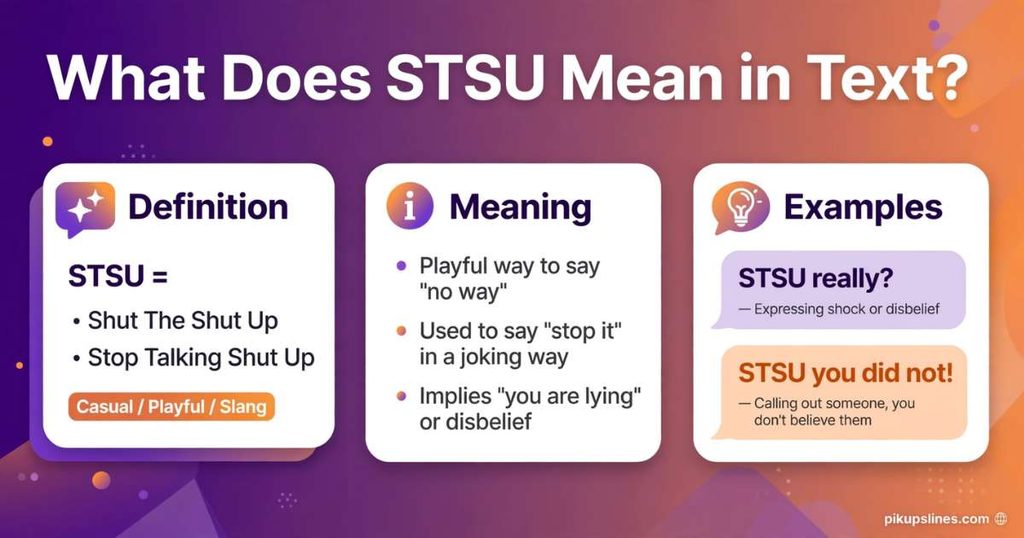
STSU most commonly stands for “Shut That Sh*t Up.” It is an informal internet abbreviation associated with telling someone to stop talking or stop going on about a particular subject.
The expression belongs to the same general family of slang as STFU, which stands for “Shut The F*** Up.” Although the two abbreviations communicate similar ideas, STSU has its own variations and is not as widely recognized.
In everyday conversations, STSU can communicate several different reactions:
- Surprise: Reacting to information that is difficult to believe.
- Disbelief: Expressing doubt about something someone has said.
- Amusement: Responding to an unexpectedly funny statement.
- Playful teasing: Joking with someone you know well.
- Annoyance: Asking someone to stop repeating something.
- Frustration: Expressing irritation during an argument.
For example:
Person A: “I just won two tickets to my favorite band’s concert!”
Person B: “STSU 😭 That’s amazing!”
In this example, the sender is probably not seriously asking the other person to stop talking. Instead, STSU works as an exaggerated expression of surprise and excitement. The sender is essentially communicating, “No way! I can’t believe that happened!”
Now consider another situation:
Person A: “I’ve already explained this three times.”
Person B: “STSU. I’m tired of hearing about it.”
Here, the abbreviation carries a much harsher meaning. It communicates frustration and an unwillingness to continue the conversation.
These examples demonstrate why STSU should not be interpreted through its full form alone. The relationship between the people, the subject being discussed, and the tone of the conversation all influence its intended meaning.
What Is the Full Form of STSU?
The most commonly documented slang expansion of STSU is “Shut That Sh*t Up.”
The letters represent the following words:
| Letter | Meaning |
|---|---|
| S | Shut |
| T | That |
| S | Sh*t |
| U | Up |
Some online users also interpret the abbreviation as “Shut The Sh*t Up.” The difference between “that” and “the” reflects the informal nature of internet slang, where expressions do not always follow one universally accepted structure.
A cleaner interpretation, sometimes used to avoid profanity, is “Shut That Stuff Up.”
Nevertheless, it is important to recognize that STSU does not have one officially standardized expansion across all texting platforms. Its meaning may differ between communities, friend groups, and specialized conversations.
When used as slang, its central idea generally revolves around stopping someone from talking, reacting to a statement, or expressing disbelief.
Understanding the Slang Meaning of STSU
To understand STSU properly, it helps to look beyond its literal definition.
Internet slang frequently uses strong expressions in humorous or exaggerated ways. A phrase that sounds aggressive when translated literally may have a completely different emotional meaning in an informal conversation.
STSU illustrates this difference.
Imagine that your friend tells you something extraordinary. Perhaps they unexpectedly met a celebrity, received an expensive gift, passed an important examination, or achieved something they had been working toward for months.
You might respond with:
“STSU! You’re joking!”
Although the original expression contains strong language, the actual intention is to communicate excitement and disbelief.
In this situation, STSU works similarly to expressions such as:
- “No way!”
- “Are you serious?”
- “You’re kidding!”
- “I can’t believe it!”
- “Stop, that’s unbelievable!”
On the other hand, the abbreviation can also be used more literally. If someone repeatedly discusses an irritating subject, another person might send STSU to communicate that they have had enough.
The difference is primarily emotional rather than grammatical.
In friendly conversations, the expression may create humor and strengthen informal communication. In tense situations, it may sound dismissive or disrespectful.
This is why understanding the slang meaning requires paying attention to both the words and the social situation in which they appear.
Is STSU a Rude or Offensive Abbreviation?
STSU can be rude or offensive, but it is not necessarily intended that way every time.
The abbreviation is associated with profanity, so its literal expansion may sound inappropriate in formal conversations. However, people sometimes use it casually among friends without intending to insult anyone.
Its level of offensiveness depends on several factors.
1. The Relationship Between the People
The relationship between the sender and receiver plays an important role.
Close friends often develop their own communication styles. They may tease one another, use sarcastic expressions, and exchange informal slang without taking every statement seriously.
For example:
Friend A: “I finished the entire assignment in twenty minutes.”
Friend B: “STSU 😂 How did you manage that?”
Because the two people share a friendly relationship, the expression may be interpreted as humorous disbelief.
However, sending the same abbreviation to a teacher, manager, colleague, or unfamiliar person could appear disrespectful.
The Subject of the Conversation
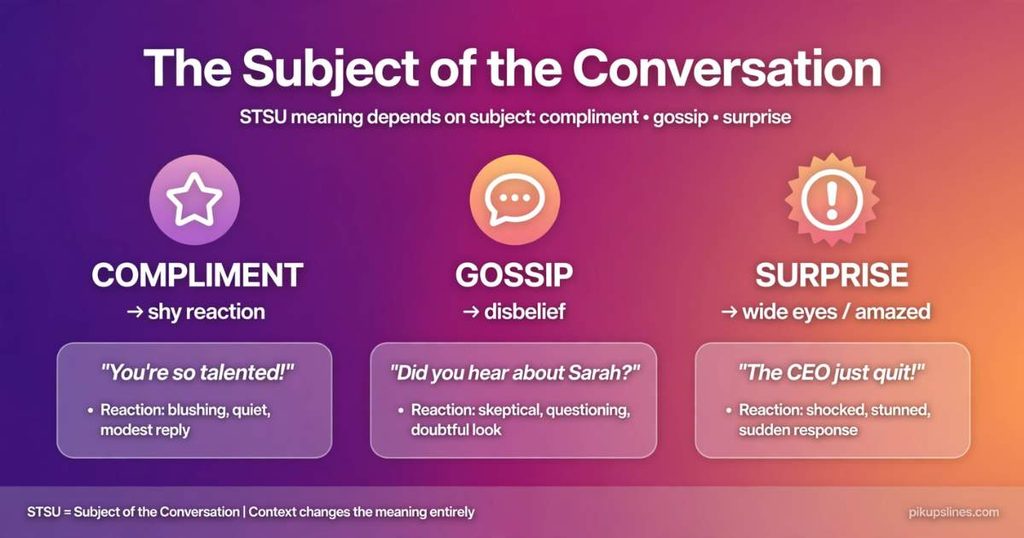
The topic also influences how STSU is interpreted.
When someone shares exciting or unbelievable news, STSU may communicate amazement.
When someone makes an offensive comment or repeatedly discusses an uncomfortable subject, it may communicate irritation.
For example:
“I just got promoted!”
“STSU 😭 Congratulations!”
This is likely a playful reaction.
Compare it with:
“Can you please stop interrupting me?”
“STSU.”
The second example sounds much more aggressive because the conversation already involves frustration.
3. Emojis and Punctuation
Emojis can help clarify the emotional intention behind an abbreviation.
For example:
- STSU 😂 — May communicate humorous disbelief.
- STSU 😭 — May express overwhelming surprise or amusement.
- STSU ❤️ — May suggest affectionate teasing in an appropriate relationship.
- STSU 🙄 — May communicate irritation or sarcasm.
- STSU. — May sound blunt, serious, or dismissive.
These interpretations are not fixed rules. Emojis can soften a message, but they cannot guarantee that the receiver will understand it as a joke.
4. The Overall Conversation
A single abbreviation rarely provides enough information to determine someone’s complete intention.
If the conversation has been friendly and humorous, STSU may simply continue that tone.
If the conversation has involved disagreement, insults, or repeated arguments, the same expression may be intended as a genuine dismissal.
Therefore, avoid immediately assuming that someone is angry simply because they used STSU.
How Is STSU Used in Text Messages?
STSU appears in informal digital conversations where people want to express their reactions quickly.
Rather than typing a complete sentence, users may choose the four-letter abbreviation because it is short, recognizable to their friends, and emotionally expressive.
Here are some common situations in which it may appear.
1. Expressing Surprise
One possible use of STSU is to react to unexpected information.
Example:
Person A: “I saw our favorite singer at the shopping mall today.”
Person B: “STSU! Did you actually talk to them?”
In this conversation, the abbreviation communicates excitement and disbelief.
The sender is surprised by the news and wants additional details.
2. Reacting to Unbelievable News
People sometimes use STSU when someone shares a story that seems almost impossible.
Example:
Person A: “My brother bought a brand-new car yesterday.”
Person B: “STSU 😭 You’re not serious!”
Here, the abbreviation works as an exaggerated reaction. The sender is expressing amazement rather than literally demanding silence.
3. Playful Teasing Between Friends
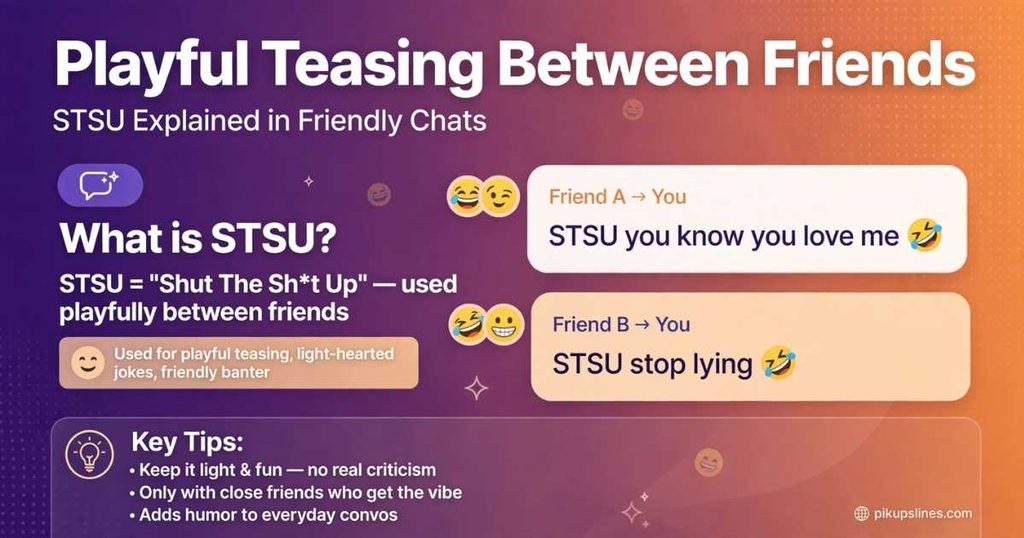
Close friends frequently use slang to create humor.
Example:
Person A: “You know I’m the smartest person in our group.”
Person B: “STSU 😂 Nobody believes that!”
The expression is used sarcastically to challenge a friend’s exaggerated statement.
In this situation, both people may understand that the comment is part of their usual joking style.
4. Showing Annoyance
STSU can also be used when someone becomes tired of a repeated subject.
Example:
Person A: “You made the same mistake again.”
Person B: “STSU. I already know.”
Here, the sender appears irritated and does not want to continue discussing the issue.
This usage is considerably less friendly than the previous examples.
5. Reacting to an Unexpected Compliment
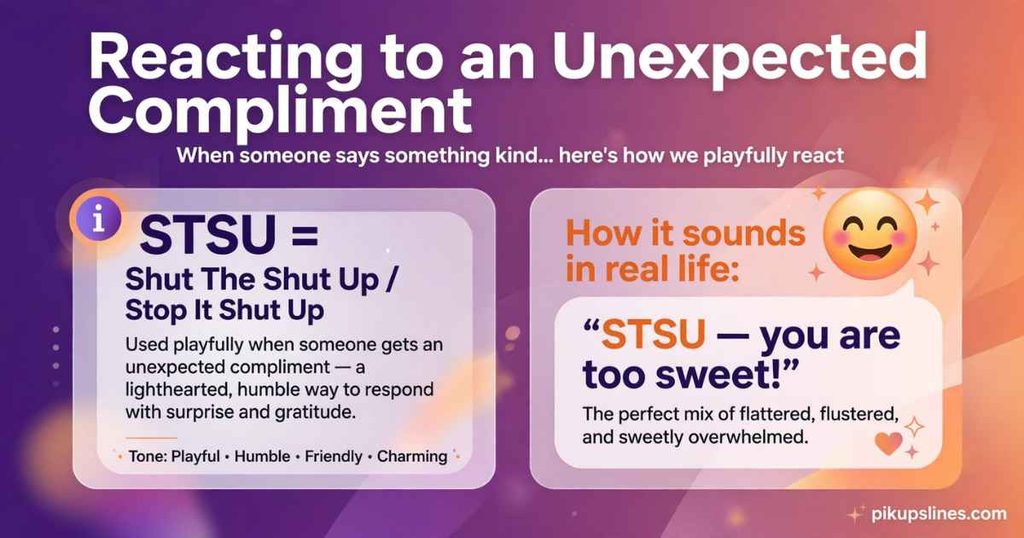
Another possible situation involves receiving an embarrassing or flattering compliment.
Example:
Person A: “Honestly, you’re the most talented person I know.”
Person B: “STSU 😭 You’re making me blush!”
The sender uses the abbreviation playfully to show embarrassment or disbelief.
The message does not necessarily mean that the compliment is unwelcome.
6. Responding to a Funny Statement
STSU may also appear in humorous exchanges.
Example:
Person A: “I tried cooking yesterday and somehow burned the water.”
Person B: “STSU 😂 How is that even possible?”
The abbreviation adds emphasis to the sender’s reaction.
It communicates that the statement is so funny or ridiculous that the sender finds it difficult to respond normally.
STSU Meaning on Different Social Media Platforms
Internet slang does not always have exactly the same meaning across every social media platform.
Different platforms encourage different communication styles. Some emphasize short comments, others encourage private conversations, and some are built around gaming communities or video-based interactions.
STSU may appear in several digital environments.
STSU Meaning on Snapchat
On Snapchat, people often communicate through short messages, pictures, videos, and informal reactions.
STSU may be used when responding to an unexpected snap, an unbelievable story, or a funny message.
Example:
Friend: “Look who I just met!”
Reply: “STSU 😭”
The sender is expressing surprise and curiosity.
Because Snapchat conversations are often personal and informal, abbreviations may carry meanings that are understood only by the people involved.
STSU Meaning on Instagram
Instagram includes direct messages, comment sections, Stories, and group conversations.
STSU may appear in any of these spaces as a reaction to an interesting post, an unexpected announcement, or a friend’s comment.
Example:
Person A: “Finally achieved my dream!”
Person B: “STSU 🔥 So proud of you!”
Here, the abbreviation may be intended as an enthusiastic reaction.
However, in public comment sections, unfamiliar readers may interpret the phrase differently. Its association with profanity can make it appear more aggressive than intended.
STSU Meaning on TikTok
TikTok is known for short-form videos, viral expressions, memes, and rapidly changing internet language.
Users sometimes adopt abbreviations from comment sections and incorporate them into their everyday conversations.
STSU may be used as a dramatic response to an unexpected video, funny situation, surprising announcement, or unbelievable story.
Example:
Video: Someone reveals an unexpected achievement.
Comment: “STSU 😭 I wasn’t expecting that!”
The expression adds emotional emphasis and helps communicate the viewer’s reaction.
However, it is not a universal TikTok expression, and its interpretation still depends on the context.
STSU Meaning on WhatsApp
WhatsApp is commonly used for personal messages, family groups, friendships, and professional communication.
In private conversations, STSU may be used as casual slang between people who understand one another’s humor.
Example:
Friend A: “I accidentally sent the wrong message to the family group.”
Friend B: “STSU 😂 What did you send?”
The abbreviation communicates amusement and surprise.
However, it is generally better to avoid using it in professional WhatsApp groups, business discussions, or conversations with people who may not understand informal slang.
STSU Meaning on Discord
Discord supports gaming communities, private servers, interest-based groups, and voice or text conversations.
In these environments, users frequently develop their own abbreviations and inside jokes.
STSU may be used as a quick reaction to a surprising gaming moment, an unexpected result, or a humorous comment.
Example:
Player A: “I defeated the final boss without losing any health.”
Player B: “STSU 😭 That’s actually impressive!”
The expression communicates disbelief and excitement.
It is also possible for a particular Discord community to use STSU in a different, locally defined way.
Examples of STSU in Everyday Conversations
The easiest way to understand an unfamiliar abbreviation is to see how it works in realistic conversations.
The following examples demonstrate several possible uses of STSU and the different emotions it may communicate.
Example 1: Surprise
A: “I got selected for the university scholarship.”
B: “STSU! That’s incredible!”
Meaning: The sender is surprised and excited about the achievement.
Example 2: Disbelief
A: “I finished the entire project in one night.”
B: “STSU 😭 How did you do that?”
Meaning: The sender finds the statement difficult to believe.
Example 3: Friendly Teasing
A: “I’m definitely the best player in this game.”
B: “STSU 😂 You lost three matches yesterday.”
Meaning: The sender is jokingly challenging a friend’s confidence.
Example 4: Exciting News
A: “We’re going on vacation next week!”
B: “STSU! Where are you going?”
Meaning: The sender is excited and wants to know more.
Example 5: Annoyance
A: “I’m going to explain the same thing again.”
B: “STSU. I understand already.”
Meaning: The sender is frustrated and wants the discussion to stop.
Example 6: Embarrassment
A: “You looked amazing in those pictures.”
B: “STSU 😭 Stop making me blush.”
Meaning: The sender is responding playfully to a compliment.
Example 7: Unexpected Achievement
A: “I passed the examination without studying the final chapter.”
B: “STSU 😂 That’s unbelievable.”
Meaning: The sender is expressing amazement.
Example 8: Responding to a Joke
A: “My phone fell into the water, but somehow it survived.”
B: “STSU 😭 Your phone has nine lives.”
Meaning: The sender is reacting humorously to an unusual situation.
Example 9: During an Argument
A: “You never listen when I explain something.”
B: “STSU. I’m not discussing this anymore.”
Meaning: The sender is dismissing the conversation in an irritated manner.
Example 10: Reacting to a Surprise Gift
A: “I bought you something special.”
B: “STSU 😭 What did you get me?”
Meaning: The sender is playfully expressing excitement and curiosity.
These examples show that STSU can function as both an emotional reaction and a direct expression of frustration. Its intended meaning cannot always be determined from the abbreviation alone.
What Is the Difference Between STSU and STFU?
STSU and STFU are closely related internet abbreviations. Both are associated with telling someone to stop talking, but their wording and levels of familiarity differ.
STSU commonly stands for “Shut That Sh*t Up.”
STFU stands for “Shut The F*** Up.”
Both expressions contain profanity and can sound disrespectful when used seriously.
However, STFU is a much more widely recognized abbreviation in mainstream internet slang. STSU is comparatively uncommon and may be unfamiliar to people outside particular online communities.
Here is a simple comparison:
| Feature | STSU | STFU |
|---|---|---|
| Full form | Shut That Sh*t Up | Shut The F*** Up |
| Basic meaning | Stop talking or discussing something | Stop talking |
| Tone | Playful, sarcastic, or rude | Playful, aggressive, or rude |
| Popularity | Less widely recognized | More widely recognized |
| Usage | Informal conversations | Informal conversations |
| Formal communication | Not appropriate | Not appropriate |
The most important similarity is that both expressions can be used jokingly among friends or aggressively during an argument.
Neither abbreviation should automatically be interpreted as a serious insult without considering the surrounding conversation.
Difference Between STSU and Other Common Texting Abbreviations
Understanding similar abbreviations can make digital conversations easier to follow.
Although STSU belongs to informal internet slang, it should not be confused with other popular expressions.
Here are some commonly encountered abbreviations:
| Abbreviation | Full Form | Meaning |
|---|---|---|
| STSU | Shut That Sh*t Up | Stop talking or expressing disbelief |
| STFU | Shut The F*** Up | Tell someone to be quiet |
| LOL | Laughing Out Loud | Express laughter |
| LMAO | Laughing My Ass Off | Express strong amusement |
| OMG | Oh My God | Express surprise |
| BRB | Be Right Back | Temporarily leaving |
| IDK | I Don’t Know | Express uncertainty |
| TBH | To Be Honest | Introduce an honest opinion |
| SMH | Shaking My Head | Express disappointment or disbelief |
| NGL | Not Gonna Lie | Introduce a sincere statement |
| FR | For Real | Express agreement or sincerity |
| WYD | What You Doing? | Ask what someone is doing |
These abbreviations serve different conversational purposes.
For example, LOL and LMAO communicate amusement, while IDK expresses uncertainty. STSU, by comparison, is associated with a stronger expression that may communicate surprise, disbelief, or irritation.
Knowing these distinctions can prevent misunderstandings when reading messages or participating in online discussions.
Does STSU Have Other Meanings?
Yes. Although “Shut That Sh*t Up” is a documented slang interpretation, STSU does not have one universal meaning in every situation.
Four-letter abbreviations are frequently used in organizations, educational institutions, workplaces, technical documents, and online communities.
Consequently, the same letters may represent completely different expressions depending on the subject.
For instance, STSU can stand for State Technical Support Unit in certain institutional or public-health contexts.
It has also appeared as an abbreviation for the State Treasury Service of Ukraine in financial and governmental documentation.Similarly, learning what DTTM means in text conversations can help you keep up with modern texting slang.
These meanings have nothing to do with texting slang.
This distinction is particularly important when reading formal documents or professional messages.
Consider the following examples:
Example 1: Casual conversation
“STSU 😂 I can’t believe you said that!”
Here, the abbreviation may represent the informal slang expression.
Example 2: Institutional discussion
“The STSU will coordinate the technical support activities.”
Here, STSU is likely the name of an organizational unit.
Example 3: Private group conversation
“Please check the STSU channel before the meeting.”
Here, it could be an internally defined abbreviation for a particular channel, project, or team.
The lesson is straightforward: never assume that an abbreviation has the same meaning in every context.
Where Did STSU Originate?
The exact origin of STSU is not reliably established.
There is no confirmed individual, social media platform, or online community that can be identified as its original creator.
However, publicly available user-submitted slang records provide evidence that the abbreviation was documented online by the mid-2000s.
One Urban Dictionary entry dated March 22, 2005, identifies STSU as a close relative of STFU and expands it as “Shut That Shit Up.” Another entry dated March 7, 2008, records the related variation “Shut The Shit Up.”
These records demonstrate that the abbreviation has been present in online slang references for many years.
They do not establish the exact date on which people first started using it.
Like many informal expressions, STSU may have circulated in private conversations, internet forums, and messaging communities before being recorded in a public slang dictionary.
Why Do Abbreviations Like STSU Develop?
The growth of internet slang can be explained through several features of digital communication.
1. Faster communication
People often prefer shorter expressions when sending messages quickly. Using a few letters instead of typing an entire sentence can make conversations more convenient.
2. Informal language
Online conversations are generally less formal than academic writing or professional communication. This encourages people to experiment with words, abbreviations, and expressions.
3. Group identity
Friends and online communities often develop their own language. Shared abbreviations can make communication feel more personal and create a sense of belonging.
4. Emotional expression
Some abbreviations communicate feelings more dramatically than ordinary sentences. STSU, for example, can express surprise or disbelief in a short message.
5. Social media influence
Digital platforms allow expressions to travel between communities. A phrase used by one group may eventually become familiar to others through comments, memes, videos, and private conversations.
These factors help explain how internet slang develops, although they do not provide a definitive history of STSU itself.
How Should You Respond When Someone Sends STSU?
Your response should depend on what the sender appears to mean.
If the abbreviation is being used playfully, you can respond with humor. If it seems aggressive, you may prefer to ask for clarification or establish a boundary.
Here are some natural ways to respond.
1. When STSU Is Used Playfully
If a friend sends STSU after hearing surprising news, you can respond with:
- “I know, right?”
- “I’m serious!”
- “Believe it or not!”
- “I swear it’s true.”
- “You should have seen it yourself!”
These replies keep the conversation friendly and entertaining.Another common abbreviation worth understanding is GL, so check out this guide on what GL means in text.
2. When Someone Is Expressing Disbelief
If someone uses STSU because they cannot believe your story, you can respond:
- “Yes, it actually happened!”
- “I wish I were joking.”
- “Wait until you hear the rest.”
- “I have proof!”
- “You won’t believe what happened next.”
These responses help continue the conversation without taking the expression too seriously.
3. When Someone Is Teasing You
If the sender is joking, you can match their playful tone:
- “Haha, don’t be jealous.”
- “You know I’m telling the truth.”
- “Stop laughing at me.”
- “I knew you’d react like that.”
- “You’re impossible!”
The goal is to maintain the friendly atmosphere.
4. When STSU Seems Rude
If someone uses STSU aggressively, you do not have to respond with another insult.
Instead, consider saying:
- “There’s no need to be rude.”
- “Can you explain what you mean?”
- “I’m just trying to have a conversation.”
- “Please speak respectfully.”
- “If you don’t want to discuss it, that’s fine.”
These responses communicate that you expect respectful communication.
5. When You Do Not Understand the Abbreviation
Sometimes the best response is simply to ask:
- “What does STSU mean?”
- “I’m not familiar with that abbreviation.”
- “Are you joking or being serious?”
- “What are you trying to say?”
Asking for clarification is often better than guessing and misunderstanding the sender.
Should You Use STSU in Your Own Messages?
You can use STSU in informal conversations if you understand its meaning and the people you are communicating with are comfortable with this type of slang.
However, it is worth considering the situation before using it.
When STSU May Be Appropriate
The abbreviation may be suitable in certain casual environments:
- Conversations with close friends.
- Informal group chats.
- Humorous exchanges with familiar people.
- Private messages where both participants understand the expression.
- Casual online discussions where strong slang is acceptable.
For example:
“STSU 😂 That story is unbelievable!”
This could work in a friendly conversation where both people understand the intended humor.
When You Should Avoid STSU
There are several situations where using STSU is not a good idea.
Professional emails: Avoid using profanity-related abbreviations in workplace correspondence.
Academic communication: Teachers, professors, and classmates may interpret the expression as disrespectful.
Conversations with strangers: Someone unfamiliar with your communication style may misunderstand your intention.
Serious discussions: Using STSU during an emotional or sensitive conversation may make the other person feel dismissed.
Formal social media interactions: Public comments can be interpreted differently by people who do not know you personally.
If your goal is to express surprise without risking misunderstanding, ordinary alternatives such as “No way!”, “Seriously?”, or “I can’t believe it!” are much safer.
Common Misunderstandings About STSU
Because STSU is relatively uncommon, people may misunderstand its meaning or interpret it incorrectly.
Here are some mistakes worth avoiding.
Misunderstanding 1: Assuming STSU Always Means Anger
One common mistake is assuming that anyone who sends STSU is annoyed or trying to insult someone.
That is not necessarily true.
Friends may use it as an exaggerated reaction to something surprising or funny.
The surrounding conversation helps determine whether the expression is playful or aggressive.
Misunderstanding 2: Treating STSU as a Completely Standardized Acronym
Unlike widely recognized abbreviations such as LOL and BRB, STSU does not have one universally accepted interpretation.
Different communities may use it differently.
Therefore, it is more accurate to describe its common slang meaning rather than claim that every person uses it in exactly the same way.You can also discover the meaning of MGS in text messages to better understand unfamiliar online abbreviations.
Misunderstanding 3: Confusing STSU With STFU
The two abbreviations are related, but their full forms are different.
STSU is commonly expanded as “Shut That Sht Up,” while STFU means “Shut The F** Up.”
Although their general meanings overlap, they should not be treated as identical expressions.
Misunderstanding 4: Assuming It Is a Romantic Expression
STSU may appear between romantic partners or people who are flirting.
However, the abbreviation itself does not have an established romantic meaning.
A partner might use it playfully after receiving a compliment, but the romantic implication comes from the relationship and the surrounding message rather than the abbreviation.
Misunderstanding 5: Assuming Every Online Definition Is Reliable
Different websites sometimes provide conflicting explanations of internet slang.If you enjoy learning internet slang, explore what FS means in texting and how people use it in everyday conversations.
Some definitions are based on actual community usage, while others may be speculative or invented.
It is better to rely on documented usage and consider the conversation rather than accept every suggested expansion as equally common.
How Context Changes the Meaning of STSU
Context is arguably the most important factor when interpreting STSU.
The same abbreviation can communicate very different emotions depending on the situation.
Consider these three examples:
Friendly situation:
A: “I just received an unexpected birthday gift.”
B: “STSU 😭 What did you get?”
Interpretation: Surprise and excitement.
Humorous situation:
A: “I can finish an entire pizza by myself.”
B: “STSU 😂 I don’t believe you.”
Interpretation: Playful disbelief.
Argumentative situation:
A: “You keep interrupting me.”
B: “STSU.”
Interpretation: Irritation or dismissal.
The letters remain unchanged, but the intended message changes considerably.
To interpret STSU accurately, consider the following questions:
- What was being discussed before the abbreviation appeared?
- Does the sender normally use informal slang?
- Are you communicating with a close friend or someone you barely know?
- Are there emojis that suggest humor or sarcasm?
- Is the conversation friendly, serious, or argumentative?
- Does the message appear to be a reaction to surprising information?
Answering these questions can help you understand the sender’s intention more accurately.
Frequently Asked Questions About STSU Meaning in Text
1. What does STSU mean in text?
STSU commonly stands for “Shut That Sh*t Up.” It is an informal texting abbreviation that can be used to tell someone to stop talking or react to something surprising or unbelievable.
2. What is the full form of STSU in slang?
The most commonly documented slang expansion is “Shut That Sht Up.” A related variation is “Shut The Sht Up.”
3. Does STSU mean shut up?
Yes. Its common slang interpretation belongs to the “shut up” family of expressions. Depending on the situation, it may be a playful reaction or a direct request for someone to stop talking.
4. Is STSU a bad word?
STSU is associated with profanity, so it can be considered inappropriate in formal communication. However, people sometimes use it jokingly among close friends.
5. Does STSU mean the same thing as STFU?
Not exactly. STSU commonly means “Shut That Sht Up,” while STFU means “Shut The F** Up.” Both communicate similar ideas, but their wording is different.
6. What does STSU mean on Snapchat?
On Snapchat, STSU may be used as an informal reaction to an unexpected message, surprising picture, or unbelievable story. It can express excitement, disbelief, or annoyance depending on the conversation.
7. What does STSU mean on Instagram?
On Instagram, STSU may appear in direct messages, comments, and group chats. It is generally associated with the same informal “shut up” expression, although its tone depends on the context.
8. What does STSU mean on TikTok?
On TikTok, STSU may be used in comments or conversations as a reaction to surprising, funny, or unbelievable content. It is not a universally standardized TikTok abbreviation.
9. Can STSU be used jokingly?
Yes. Friends sometimes use STSU as an exaggerated reaction to exciting news, unexpected compliments, or funny statements. The intended humor usually depends on their relationship and shared communication style.
10. What does STSU mean from a girl?
The abbreviation does not have a different established definition based on the sender’s gender. If a girl sends STSU, she may be expressing surprise, disbelief, playful teasing, or annoyance. The surrounding conversation provides the best clues.
11. What does STSU mean from a guy?
The meaning is generally the same regardless of the sender’s gender. A guy may use STSU jokingly with friends or more seriously when asking someone to stop talking.
12. Is STSU commonly used in texting?
STSU appears in online slang references and informal digital conversations, but it is less widely recognized than common abbreviations such as LOL, OMG, and BRB.
13. Is STSU appropriate for professional communication?
Generally, no. Because its common slang interpretation involves profanity, it is better to avoid using it in professional emails, business messages, academic discussions, and formal conversations.
14. What should I reply when someone sends STSU?
If the message seems playful, you can respond with “No way!”, “I know, right?”, or “I’m serious!” If it sounds rude, ask what the sender means or politely explain that you prefer respectful communication.
15. Does STSU have meanings outside texting?
Yes. STSU can represent institutional or technical names in certain contexts. For example, it has been used for State Technical Support Unit and State Treasury Service of Ukraine. These meanings are unrelated to internet slang.
Final Thoughts on STSU Meaning in Text
Understanding internet slang can make everyday digital communication much easier, especially when people use unfamiliar abbreviations in messages, comments, and social media conversations.
STSU most commonly means “Shut That Sh*t Up” in informal texting slang. It is associated with telling someone to stop talking, expressing disbelief, or reacting dramatically to something unexpected.
However, its meaning is not completely fixed. Among close friends, STSU may be used playfully to communicate surprise, excitement, embarrassment, or humorous disbelief. In a serious disagreement, the same abbreviation can sound rude, dismissive, or aggressive.
Its meaning can also differ in professional, educational, and institutional settings, where STSU may represent an entirely unrelated name or organizational term.
The best way to understand STSU is to consider the complete conversation rather than focusing exclusively on its letters. Pay attention to the sender’s relationship with you, the subject being discussed, the emojis, and the overall tone.
If a friend sends “STSU 😂” after hearing an unbelievable story, they may simply be expressing amazement. If someone sends “STSU.” during an argument, they may genuinely want the conversation to stop.
Ultimately, context is the key to understanding STSU. When you are unsure about its intended meaning, asking the sender for clarification is always better than making assumptions.