Have you ever received a text saying “FSS” and wondered what those three letters mean? You’re not alone. Internet slang can sometimes feel confusing, especially when people shorten everyday expressions.
So, what does FSS mean in text? It generally stands for “For Sure Sure”, an informal way to express strong agreement, certainty, or enthusiasm. It’s similar to saying “definitely” or “absolutely” in casual conversations.
However, FSS can carry different meanings depending on context. Let’s explore its meaning, examples, uses, and common misunderstandings.
What Does FSS Mean in Text Messages?
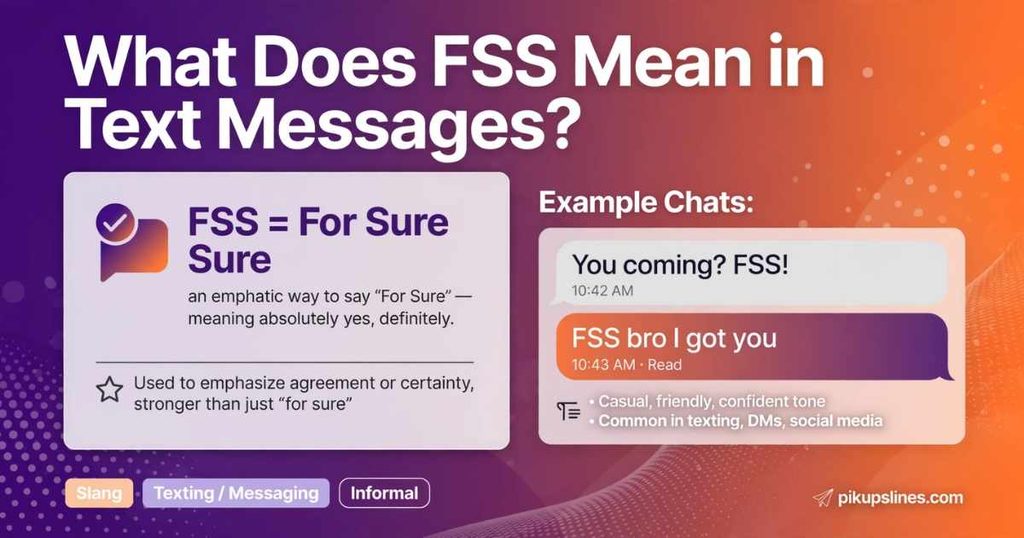
FSS usually means “For Sure Sure” in casual texting. It expresses a stronger sense of agreement than an ordinary yes or simple confirmation. People use it when they want to show enthusiasm, confidence, or complete agreement.
Think of it as turning an ordinary “sure” into a more energetic response. For example, if someone asks whether you’re attending a party, replying “FSS!” communicates that you’re definitely coming.
Here is a quick breakdown:
| Text abbreviation | Meaning | Intended message |
|---|---|---|
| FSS | For Sure Sure | Definitely! |
| FS | For Sure | Certainly |
| FR | For Real | Seriously or genuinely |
| FRFR | For Real, For Real | Completely serious |
| LOL | Laughing Out Loud | Something is funny |
| OMG | Oh My God | Surprise or excitement |
| BRB | Be Right Back | Temporarily leaving |
Although FSS is recognizable in some online conversations, it isn’t as standardized as LOL or BRB. Therefore, the surrounding message matters when interpreting it.
What Does FSS Stand For?
The most relevant expansion in casual texting is For Sure Sure. It communicates certainty by reinforcing the familiar expression “for sure.”
Some users also interpret FSS as “For Sure, Sis” in friendly conversations. This interpretation depends on the relationship and the way people communicate.
Consider these examples:
- “Are you joining us tomorrow?” — “FSS!”
- “That restaurant looks amazing.” — “FSS, let’s go!”
- “You really enjoyed the concert?” — “FSS!”
- “We should plan another trip.” — “FSS, definitely!”
In each example, the sender expresses agreement or enthusiasm.
Importantly, not everyone consciously expands the abbreviation into three separate words. Some people simply use FSS as shorthand for an emphatic yes.
Why Do People Add an Extra S to FS?
The extra S generally adds emphasis to the familiar expression “for sure.”
FS already communicates agreement or certainty. However, FSS can make that agreement feel stronger, warmer, or more enthusiastic.
Compare these responses:
- FS: “Yes, that works.”
- FSS: “Absolutely! I’m definitely in.”
The difference isn’t a strict grammatical rule. Rather, it reflects the informal way people use repeated sounds and letters to add personality.
You can see a similar pattern in expressions such as “yesss,” “nooo,” and “okayyy.” Repeated letters often make digital communication feel more expressive.
Is FSS an Acronym, Abbreviation, or Slang Expression?
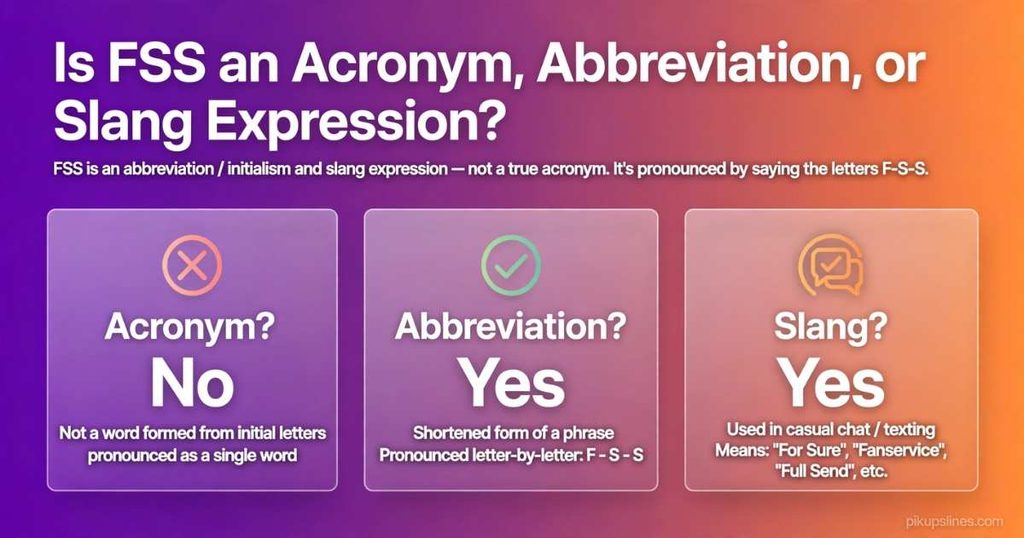
FSS is best described as an informal texting abbreviation or initialism-style expression.
People use it to shorten a familiar phrase rather than follow formal writing conventions. It belongs to internet slang, where convenience and conversational tone often matter more than grammatical structure.
Unlike established abbreviations such as LOL, FSS can have different interpretations across communities.
That’s why understanding the sender’s intention matters more than memorizing one expansion.
Where Did FSS Come From and Why Do People Use It?
FSS doesn’t have a clearly documented inventor or universally established origin date. Like many texting expressions, it appears within the broader culture of shortened digital communication.
People have used “for sure” in everyday English for years. As text messaging and social media became popular, users began shortening familiar expressions to save time.
FS became one convenient way to express agreement. FSS offers another informal variation with added emphasis.
Several features of modern communication help explain its appeal:
- Speed: Short abbreviations make quick replies easier.
- Emphasis: Additional letters can strengthen an ordinary response.
- Informality: Slang makes conversations feel relaxed.
- Social connection: Familiar expressions create a sense of shared language.
- Personality: Capitalization, emojis, and repeated letters communicate emotion.
Gen Z and other frequent social media users often experiment with informal expressions. However, FSS shouldn’t be treated as language exclusive to one generation.
How Texting Culture Popularized Short Abbreviations
Text messaging changed how people communicate. Instead of writing complete sentences every time, users began relying on shorter expressions.
Consider some familiar examples:
| Abbreviation | Full form | Purpose |
|---|---|---|
| IDK | I Don’t Know | Expressing uncertainty |
| TBH | To Be Honest | Introducing an honest opinion |
| IMO | In My Opinion | Sharing a personal view |
| BRB | Be Right Back | Indicating a short absence |
| FR | For Real | Emphasizing sincerity |
| FSS | For Sure Sure | Showing strong agreement |
These expressions make conversations quicker without necessarily losing their meaning.
Nevertheless, not every abbreviation enjoys the same level of recognition. FSS may be perfectly clear between friends but confusing to someone unfamiliar with current internet slang.
How FSS Is Used in Everyday Text Conversations
The most common FSS usage involves agreeing with someone or confirming something. It usually appears as a short response to a question, suggestion, statement, or invitation.
Rather than typing a lengthy answer, someone can use FSS to communicate their intention quickly.
Here are several common situations.
FSS When Agreeing With Someone
People frequently use FSS when they strongly agree with another person’s opinion.
For example:
Friend: “That movie deserves an award.”
You: “FSS! The acting was incredible.”
Here, FSS communicates complete agreement. It also adds enthusiasm to the conversation.
FSS When Confirming Plans
Another common use involves confirming arrangements with friends or family.
For example:
Friend: “We’re meeting outside the cinema at 7, right?”
You: “FSS! I’ll be there.”
The abbreviation confirms your availability and shows confidence about the arrangement.
However, avoid relying on FSS alone when important details require confirmation. A clear sentence is better for appointments, travel arrangements, or professional commitments.
FSS When Showing Support
FSS can also communicate encouragement or support.
For example:
Friend: “I’m finally starting my own business.”
You: “FSS! You’ve got this.”
The response expresses enthusiasm and confidence in the other person’s decision.
It works particularly well between people who already share a relaxed communication style.
FSS When Responding to Questions and Suggestions
Sometimes, FSS provides a quick answer without requiring additional explanation.
For example:
- “Should we order something to eat?” — “FSS!”
- “Want to watch the new episode?” — “FSS.”
- “Are you free this weekend?” — “FSS, what’s the plan?”
- “Let’s go shopping tomorrow.” — “FSS, I’m ready.”
In these examples, the abbreviation replaces a longer affirmative response.
FSS When Expressing Excitement
FSS can also carry an enthusiastic tone when someone discusses something exciting.
Friend: “Our favorite artist is performing next month!”
You: “FSSSS! We need tickets!”
Notice how the repeated S adds excitement. This is an informal stylistic choice rather than a fixed spelling convention.
What Does FSS Mean Depending on the Context?
Context plays an important role in understanding FSS. The same three letters may communicate different emotions depending on the surrounding conversation.
A message between close friends can sound completely different from one exchanged during an argument. Therefore, always consider the relationship, topic, punctuation, and previous messages.
FSS Between Friends
Among friends, FSS generally communicates agreement, excitement, or reassurance.
For example:
Friend: “Let’s get burgers after class.”
You: “FSS 😂”
The reply sounds relaxed and enthusiastic. The emoji reinforces the friendly tone.
FSS in Romantic and Flirty Conversations
In romantic conversations, FSS can express interest or enthusiasm. However, the abbreviation itself isn’t automatically flirtatious.
For example:
Person A: “I’d love to see you this weekend.”
Person B: “FSS ❤️”
Here, the heart emoji adds affection to an otherwise straightforward confirmation.
Without additional romantic signals, FSS simply communicates agreement.
FSS in Group Chats
Group chats often involve quick reactions and short responses. FSS fits naturally into these conversations.
For example:
Alex: “Road trip this Saturday?”
Mia: “I’m in!”
James: “FSS!”
Sam: “Let’s decide the location tonight.”
Here, FSS confirms James’s interest without interrupting the discussion.
FSS in Arguments or Heated Discussions
The meaning can become less straightforward during disagreements.
Someone might use FSS to emphasize agreement with another person’s criticism. Alternatively, a flat response might sound dismissive depending on the preceding messages.
For example:
Person A: “You never listen when I explain something.”
Person B: “FSS.”
This response is ambiguous. It could represent agreement, frustration, or sarcasm.
When emotions run high, a direct response usually prevents unnecessary misunderstandings.
FSS in Professional and Workplace Messages
FSS is generally better suited to informal communication than professional correspondence.
Although colleagues might use it in friendly workplace chats, it can sound too casual in formal settings.
Consider these alternatives:
- “Yes, absolutely.”
- “Certainly.”
- “That works for me.”
- “Confirmed.”
- “I agree with that approach.”
Professional communication benefits from clarity. There’s no reason to make important instructions harder to understand.
Understanding the Tone Behind FSS in Texting
The emotional meaning of FSS depends on how someone uses it. Capitalization, punctuation, emojis, and conversation history can all influence interpretation.
A short message rarely communicates every emotion clearly. That’s why reading the surrounding conversation is essential.
| Message style | Possible tone | Likely interpretation |
|---|---|---|
| FSS! | Enthusiastic | Definitely! |
| fss | Relaxed | For sure |
| FSS 😂 | Playful | Absolutely, haha |
| FSS ❤️ | Affectionate | Definitely, with warmth |
| FSS. | Neutral or firm | Yes, certainly |
| FSSSS! | Excited | Absolutely! |
| fss 🙄 | Potentially sarcastic | Depends on context |
These interpretations aren’t universal. The sender’s usual communication style matters too.
Can FSS Be Sarcastic?
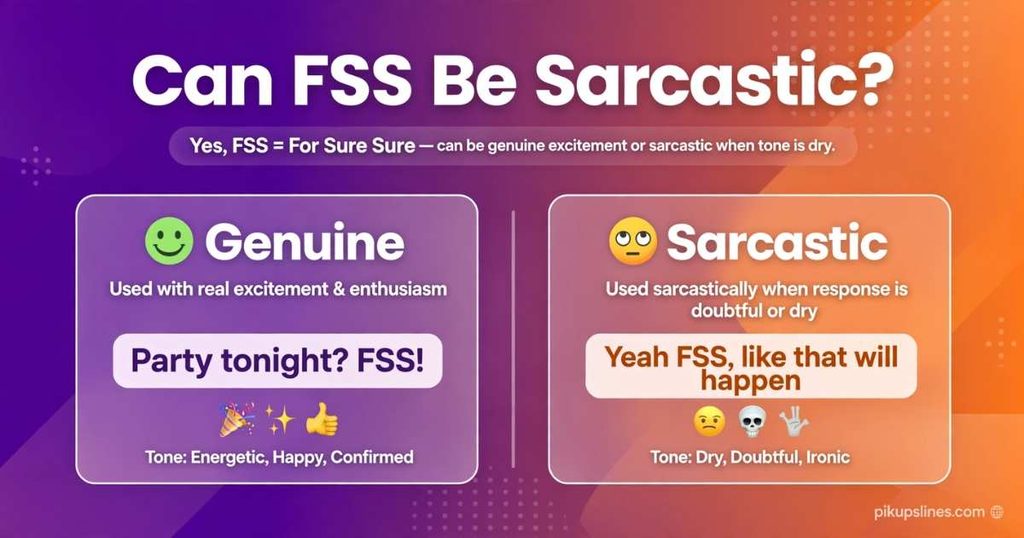
Yes, although sarcasm isn’t the default meaning.
People sometimes use ordinary agreement expressions sarcastically. FSS can work similarly when the conversation suggests irritation or disbelief.
For example:
Friend: “I forgot my keys again.”
You: “FSS, very organized 😂”
The sarcastic meaning comes from the complete sentence, not the abbreviation alone.
Can FSS Express Annoyance or Frustration?
It can, but the surrounding conversation must support that interpretation.
For example:
Person A: “We have to change the meeting time again.”
Person B: “FSS. This is getting ridiculous.”
Here, the frustration appears in the second sentence.
Remember that FSS isn’t automatically an expression of anger. Its usual casual interpretation remains agreement or certainty.
How to Reply When Someone Sends You FSS
Receiving FSS doesn’t require a complicated response. In most situations, you can simply continue the conversation.
Your reply should match the original message and the relationship you share with the sender.
Casual Replies Between Friends
If a friend uses FSS to confirm something, respond naturally.
Try these:
- “Perfect!”
- “Sounds good.”
- “Awesome!”
- “Bet!”
- “See you there!”
- “Let’s do it!”
These expressions keep the conversation moving.
Funny and Playful Responses
If the conversation feels lighthearted, you can match the sender’s energy.
For example:
- “Now that’s what I like to hear 😂”
- “You already know!”
- “Let’s gooo!”
- “Say less!”
- “I knew you’d agree!”
A playful response makes the exchange feel more personal.
Flirty Responses
When the conversation already has a romantic tone, you can respond warmly.
Examples include:
- “Can’t wait ❤️”
- “Looking forward to it.”
- “Only if you’re coming 😉”
- “That’s exactly what I wanted to hear.”
- “See you soon!”
However, don’t assume romantic interest from FSS alone.
What If You Don’t Understand FSS?
There’s nothing wrong with asking for clarification.
You can simply say:
- “What does FSS mean?”
- “Do you mean for sure?”
- “Is that another texting abbreviation?”
A short question is better than guessing incorrectly.
FSS vs. Similar Texting Abbreviations
FSS belongs to a wider collection of internet slang expressions. Several abbreviations communicate similar ideas, but their meanings and emotional tones differ.
Understanding these differences helps you choose the right expression.
| Slang | Full form | Main purpose |
|---|---|---|
| FSS | For Sure Sure | Strong agreement |
| FS | For Sure | Agreement or confirmation |
| FR | For Real | Emphasizing truth |
| FRFR | For Real, For Real | Strong emphasis |
| ONG | On God | Emphasizing sincerity |
| TBH | To Be Honest | Introducing an honest opinion |
| LOL | Laughing Out Loud | Expressing amusement |
| Bet | Agreement or confirmation | Accepting a suggestion |
| Say Less | Understood | Showing quick acceptance |
| ISTG | I Swear to God | Emphasizing sincerity or frustration |
FSS vs. FS: What’s the Difference?
The main difference is emphasis.
FS usually means “for sure.” It’s a straightforward way to agree or confirm something.
FSS is often understood as an emphasized version of that expression.
For example:
Question: “Are you coming to dinner?”
- FS: “Yes, definitely.”
- FSS: “Absolutely! Count me in.”
Both communicate agreement. However, FSS can sound more enthusiastic.
FSS vs. FR
FR means “For Real.” People use it to express sincerity, agreement, or disbelief.
For example:
Friend: “That concert was incredible.”
You: “FR!”
This response communicates genuine agreement.
FSS, meanwhile, is more naturally associated with certainty or confirmation.
FSS vs. FRFR
FRFR means “For Real, For Real.” It reinforces sincerity or emphasizes that someone genuinely means what they’re saying.
For example:
Friend: “You really think I can do it?”
You: “FRFR. You’ve got this.”
FSS would communicate stronger agreement or confirmation instead.
FSS vs. Bet and Say Less
Bet and Say Less are popular informal expressions with slightly different functions.
- Bet: Accepting an idea, plan, or challenge.
- Say Less: Showing that you’ve understood and don’t need further explanation.
- FSS: Expressing certainty or strong agreement.
For example:
Friend: “Let’s meet at 6.”
You: “Bet!”
However, if someone asks whether you’re definitely attending, FSS may communicate that certainty more directly.
When Should You Use FSS and When Should You Avoid It?
FSS works best when the conversation is casual and everyone understands informal texting language.
It’s useful for everyday communication because it delivers agreement quickly. However, not every situation benefits from abbreviations.
Situations Where FSS Sounds Natural
Consider using FSS in these situations:
- Messaging close friends.
- Confirming informal weekend plans.
- Agreeing with someone’s opinion.
- Reacting to exciting announcements.
- Participating in casual group chats.
- Responding to social media comments.
- Showing enthusiasm during friendly conversations.
These situations usually allow relaxed language.
When Should You Avoid Using FSS?
Some conversations require greater clarity and professionalism.
Avoid using FSS when:
- Writing formal business emails.
- Communicating with unfamiliar clients.
- Confirming important financial arrangements.
- Sending official workplace instructions.
- Discussing serious personal matters.
- Communicating with people unfamiliar with internet slang.
For instance, replying “FSS” to an important business appointment might seem unclear.
A better response would be:
“Yes, I confirm that I’ll attend the meeting.”
The longer answer communicates exactly what you mean.
Natural Alternatives to FSS for Different Conversations
Sometimes, another expression communicates your message more clearly. Fortunately, English offers plenty of alternatives to FSS.
The best choice depends on your intended tone and the person receiving your message.
Casual Alternatives to FSS
Use these expressions when chatting with friends:
- For sure.
- Definitely.
- Absolutely.
- Sounds good.
- I’m in.
- You bet.
- No doubt.
Example: “Want to grab coffee tomorrow?”
Reply: “Definitely! What time?”
Strong Agreement Alternatives
If you want to emphasize complete agreement, consider:
- 100%.
- Absolutely.
- Without a doubt.
- Completely agree.
- For real.
- Exactly!
- Couldn’t agree more.
Example: “That was the best performance of the night.”
Reply: “100%. Absolutely incredible!”
Friendly and Supportive Alternatives
When someone needs encouragement, choose expressions that sound warmer.
Examples include:
- You’ve got this!
- I’m with you.
- Of course!
- Always!
- Count on me.
- You know it!
These phrases communicate more than simple agreement. They also show support and personal involvement.
Professional Alternatives to FSS
In workplace conversations, clarity should come first.
| Alternative | Best situation |
|---|---|
| Certainly | Formal agreement |
| Confirmed | Verifying arrangements |
| Absolutely | Positive professional response |
| Agreed | Supporting a decision |
| That works for me | Accepting a proposed time |
| Yes, definitely | Clear confirmation |
| Understood | Acknowledging instructions |
Choosing the right expression helps maintain a suitable conversational tone.
Real-Life FSS Text Message Examples and Conversations
Examples make it easier to understand how FSS works in everyday communication. The following conversations illustrate different situations and possible interpretations.
FSS in Everyday Friend Conversations
Friend: “That new restaurant looks amazing.”
You: “FSS! We should try it.”
Meaning: You strongly agree with the suggestion.
FSS When Making Plans
Friend: “Movie night at my place on Friday?”
You: “FSS, I’ll bring snacks.”
Meaning: You’re definitely interested and confirming your participation.
FSS in Romantic Text Messages
Person A: “I’d really like to spend Saturday with you.”
Person B: “FSS ❤️”
Meaning: The response confirms interest. The heart adds an affectionate touch.
FSS During Online Discussions
User A: “This album deserves more recognition.”
User B: “FSS 🔥”
Meaning: User B strongly agrees with the opinion.
FSS in Short Replies
Friend: “You’re still coming, right?”
You: “fss”
Meaning: Yes, definitely.
Lowercase writing makes the response feel relaxed. However, lowercase letters don’t change the fundamental meaning.
FSS With Emojis
Emojis can add emotional details that three letters cannot communicate alone.
| Message | Possible interpretation |
|---|---|
| FSS 😂 | Playful agreement |
| FSS ❤️ | Warm or affectionate confirmation |
| FSS 🔥 | Excited agreement |
| FSS 🙌 | Enthusiastic support |
| FSS 😭 | Dramatic or emotional agreement |
| FSS 🤝 | Agreement or solidarity |
Remember that emoji meanings depend on personal habits and online communities.
Does FSS Mean Something Different on Social Media Platforms?
FSS can appear across several social media platforms. However, its interpretation depends more on the conversation than the app itself.
A casual agreement on Snapchat generally carries the same basic meaning in an Instagram DM or TikTok comment.
What Does FSS Mean on Snapchat?
Snapchat users often communicate through short messages, snaps, and informal reactions.
In a regular conversation, FSS can express certainty or agreement.
For example:
Friend: “Are we still going out tonight?”
You: “FSS!”
The reply confirms your plans.
You might also see FSS accompanied by emojis, repeated letters, or lowercase writing.
What Does FSS Mean on Instagram?
Instagram supports direct messages, comments, stories, and group conversations.
FSS can work as a quick agreement in these spaces.
For example:
Comment: “This outfit is absolutely perfect.”
Reply: “FSS 🔥”
The response shows agreement and enthusiasm.
However, Instagram also contains promotional conversations. If someone uses FSS while discussing follower exchanges or account promotion, consider whether they mean something specific to that community.
What Does FSS Mean on TikTok?
TikTok comments often contain short reactions to videos and opinions.
FSS can communicate strong agreement with a creator or another commenter.
For example:
Comment: “This song never gets old.”
Reply: “FSS, it’s timeless!”
The abbreviation expresses agreement without requiring a lengthy response.
FSS in WhatsApp and Group Chats
WhatsApp conversations often involve friends, relatives, colleagues, and community groups.
FSS may appear when someone confirms arrangements or agrees with a suggestion.
However, consider your audience. A family member unfamiliar with texting slang might misunderstand the abbreviation.
In that situation, writing “For sure!” is clearer.
Common Misunderstandings About FSS
Because FSS isn’t a universally standardized abbreviation, misunderstandings can happen.
Some people recognize it immediately. Others may interpret the same letters differently.
Here are a few mistakes worth avoiding.
Assuming FSS Always Has One Meaning
The most useful casual interpretation is an emphatic “for sure.” However, different people and communities may use the letters differently.
Always consider the surrounding conversation.
Confusing FSS With FS
These abbreviations are related but not identical in typical usage.
FS generally communicates ordinary agreement. FSS can add emphasis.
Using them interchangeably isn’t necessarily wrong, but they may convey slightly different energy.
Assuming FSS Is Always Rude
FSS isn’t inherently offensive.
In ordinary casual conversations, it generally communicates agreement or certainty.
However, tone and surrounding language can change the emotional interpretation.
Misreading a Short Message
A three-letter reply doesn’t provide much emotional information.
For example, “FSS.” might appear serious or neutral. Meanwhile, “FSS 😂” sounds more playful.
Don’t assume someone is angry simply because they didn’t include an emoji.
Other Meanings of FSS Outside Texting and Social Media
Although this article focuses on FSS slang, the abbreviation can also appear in specialized environments.
Its meaning may change significantly outside casual digital communication.
FSS Meaning in Medical Terminology
In medical literature, FSS can refer to Functional Somatic Symptoms.
This term describes physical symptoms that involve interactions between bodily processes and psychological or other contributing factors. It is used in clinical research and healthcare discussions.
Some people may encounter related terminology involving functional somatic syndromes. However, these expressions aren’t interchangeable in every medical context.
Importantly, the abbreviation alone doesn’t establish a diagnosis.
If you encounter FSS in a medical report, check the surrounding terminology or ask the healthcare professional who prepared it.
FSS in Other Professional Fields
FSS can also have specialized meanings in technical, organizational, and industry-specific documents.
For example, its interpretation may depend on whether the discussion concerns aviation, engineering, business, or another professional subject.
Never assume that a medical or technical abbreviation carries the same meaning as internet slang.
How to Identify the Correct Meaning
Use these clues when interpreting FSS:
- Casual conversation: Consider “for sure” or “for sure sure.”
- Friendly discussion: Check whether the sender is expressing agreement.
- Medical document: Read the surrounding clinical terminology.
- Technical report: Check the relevant industry context.
- Promotional social media post: Consider whether FSS has a community-specific meaning.
When the meaning remains unclear, asking for clarification is the safest option.
Frequently Asked Questions About FSS Meaning in Text
Still wondering how to interpret FSS in different situations? These frequently asked questions cover the details people often overlook.
What Does FSS Mean in Text From a Friend?
When a friend sends FSS, they usually mean “for sure” or an emphatic “definitely.” It’s a quick way to agree with something or confirm a suggestion.
For example:
Friend: “Want to hang out after work?”
You: “FSS!”
The response means you’re definitely interested.
What Does FSS Mean When a Girl Uses It?
When a girl uses FSS, it generally communicates agreement, certainty, or enthusiasm. The abbreviation doesn’t automatically carry a romantic meaning.
For example:
Girl: “We should go shopping this weekend.”
Reply: “FSS, let’s do it!”
The response simply confirms interest in the plan.
If she adds affectionate emojis or playful comments, those details might suggest additional warmth. However, the relationship and conversation provide better clues than the abbreviation itself.
What Does FSS Mean When a Guy Uses It?
When a guy sends FSS, he usually expresses agreement or confirms something enthusiastically.
For example:
Friend: “Are you watching the match tonight?”
Reply: “FSS!”
Here, the sender is saying yes, definitely.
Just like when a girl uses it, FSS doesn’t automatically indicate flirting or romantic interest.
Is FSS Rude or Offensive?
No, FSS isn’t generally considered rude or offensive in casual texting.
It’s usually a friendly expression of agreement or certainty. However, the surrounding conversation can affect its tone.
A sarcastic comment or dismissive response might make it sound less friendly.
Also, don’t confuse FSS with FFS, which is a different abbreviation. FFS commonly stands for “For Fuck’s Sake” and expresses irritation or frustration.
That missing extra F makes a meaningful difference.
Is FSS the Same as FS?
They’re closely related but can communicate different levels of emphasis.
FS generally means “For Sure.” FSS is often interpreted as “For Sure Sure,” adding extra emphasis to the confirmation.
For example:
- FS = Yes, certainly.
- FSS = Absolutely, without a doubt.
Neither expression has a strict universal texting rule. Individual communication habits can influence their meaning.
Can FSS Be Used Sarcastically?
Yes. Like many informal expressions, FSS can carry sarcasm when the surrounding conversation suggests it.
For example:
Friend: “I forgot my homework for the third time.”
You: “FSS, genius move 😂”
The sarcasm comes from the additional comment. The abbreviation itself doesn’t automatically mean something negative.
Does FSS Mean the Same Thing Everywhere?
No. FSS can have different interpretations depending on the platform, community, and subject.
In casual texting, it generally communicates agreement or certainty. In medical or technical documents, it may represent specialized terminology.
Therefore, always examine the surrounding words before choosing an interpretation.
What Does FSS Mean in Medical Terms?
In medical literature, FSS can refer to Functional Somatic Symptoms. These involve physical symptoms discussed within a broader biopsychosocial framework.
Some discussions also refer to functional somatic syndromes. However, the precise terminology depends on the medical source.
If you encounter FSS in a clinical document, don’t automatically interpret it as texting slang.
How Do You Use FSS in a Sentence?
You can use FSS as a short response or include it within an informal message.
Examples:
- “FSS, I’ll meet you there.”
- “That’s a great idea, FSS!”
- “FSS, we definitely need another vacation.”
- “Are you coming tonight? FSS!”
- “FSS 😂 That movie was incredible.”
The abbreviation works best in relaxed conversations where the recipient understands internet slang.
What Does FSS Mean on Snapchat, Instagram, and TikTok?
Across these platforms, FSS can express agreement, confirmation, or enthusiasm.
On Snapchat, it may appear in private conversations. Instagram, it can appear in comments and direct messages. On TikTok, users may include it in replies to express agreement with a creator.
The platform doesn’t automatically change the abbreviation’s meaning. The conversation remains the most important clue.
Is FSS Still Common in Texting?
FSS appears in online slang references and casual digital conversations. However, it isn’t as universally recognized as established abbreviations such as LOL, OMG, or BRB.
Its popularity can vary between social circles and online communities. Therefore, it’s better to understand its meaning than assume everyone uses it regularly.
Related Texting Slang You Might Also Want to Understand
FSS is only one small part of modern internet slang. Learning related abbreviations can make everyday digital communication easier.
Here are some other expressions worth exploring:
| Slang expression | Meaning | When people use it |
|---|---|---|
| 304 | Slang with an offensive meaning in certain contexts | Informal online discussions |
| IMA | I’m going to / I’m about to | Explaining an upcoming action |
| YFM | You Feel Me | Seeking agreement or understanding |
| IDTS | I Don’t Think So | Expressing disagreement |
| IDEK | I Don’t Even Know | Showing confusion |
You can explore these expressions in more detail:
- What Does 304 Mean in Slang?
- What Does IMA Mean in Text?
- YFM Meaning in Text: What Does It Mean?
- What Does IDTS Mean in Chat?
- What Does IDEK Mean in Text?
Understanding these expressions makes it easier to follow conversations across different platforms. It also helps prevent confusion when someone uses unfamiliar internet slang.
Final Thoughts: Understanding FSS Without Misreading the Conversation
Understanding the FSS meaning in text is easier once you recognize its context. In casual conversations, it generally communicates “For Sure Sure,” expressing strong agreement, certainty, or enthusiasm.
Whether someone sends it through Snapchat, Instagram, TikTok, or a regular text message, the intended meaning usually remains similar. It’s a quick way to say “definitely,” “absolutely,” or “I’m in.”
However, remember that abbreviations can have different meanings outside everyday texting. FSS isn’t universally standardized, so the surrounding conversation always deserves attention.
Here’s the simplest takeaway:
- FSS generally means For Sure Sure.
- It expresses agreement, confidence, or confirmation.
- It’s suitable for casual conversations and friendly messages.
- It isn’t automatically rude, sarcastic, or flirtatious.
- Its meaning can change in medical and professional contexts.
So, the next time someone texts you “FSS,” you’ll have a much better idea of what they mean. And if the context remains unclear, simply ask. Clear communication is always better than guessing.
For additional clarity about similar abbreviations, you can consult the Collins Dictionary’s definition of FFS. Remember, FSS and FFS are different expressions with different meanings.