Have you ever received a message saying, “Let’s talk FTF” and wondered what those three letters meant? You’re certainly not alone. Texting abbreviations appear everywhere, from WhatsApp conversations to Instagram messages. Some are easy to understand, while others leave you guessing.
The good news is that FTF usually means “Face to Face.” People use this abbreviation when they want to meet someone or have a direct conversation in person. Instead of continuing through text messages, they prefer real-world interaction. However, the exact meaning can depend on the conversation and the people involved.
You might encounter FTF when making weekend plans, discussing something important, or arranging a workplace meeting. It can also appear in social media comments and private messages. Understanding this abbreviation makes everyday digital communication easier. So, let’s explore what FTF means in text, how people use it, and how you can respond naturally.
What Does FTF Mean in Text Messages?
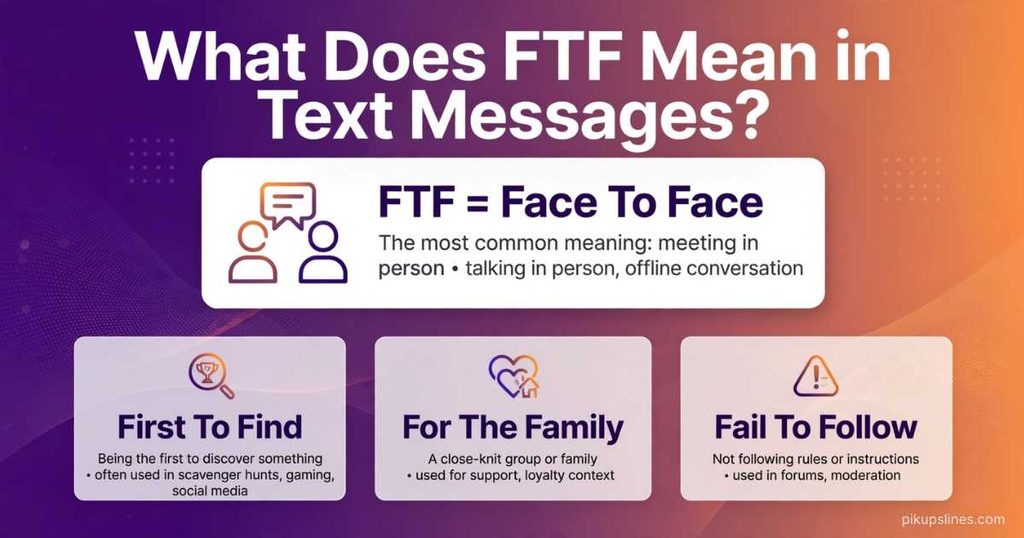
In texting, FTF stands for Face to Face. It describes communication between people who meet physically rather than interacting through digital messages. When someone suggests talking FTF, they’re usually proposing an in-person conversation.
For example, imagine your friend sends this message:
“We’ve been discussing this for hours. Let’s talk FTF tomorrow.”
Your friend wants to continue the discussion in person. They might believe a direct conversation will make everything clearer. Instead of exchanging another dozen messages, you can sit together and discuss the matter.
The FTF meaning in text generally stays consistent across everyday messaging platforms. However, some specialized communities might use the same letters differently. That’s why understanding the surrounding conversation matters.
FTF Meaning at a Glance
Here’s a quick breakdown of the FTF abbreviation:
| Detail | Meaning |
|---|---|
| Abbreviation | FTF |
| Full form | Face to Face |
| Main meaning | Meeting or communicating in person |
| Category | Texting abbreviation |
| Common usage | Personal messages and professional communication |
| Tone | Usually neutral |
| Communication style | Direct, in-person interaction |
| Similar expression | In Person |
Simply put: FTF means someone wants to communicate directly instead of relying on online messages or remote conversations.
Simple Examples of FTF in Sentences
The easiest way to understand FTF usage is through everyday examples. Notice how each sentence connects the abbreviation with an in-person interaction.
- “Can we discuss this FTF tomorrow?”
The person wants to discuss something in person. - “I’d rather explain everything FTF.”
The speaker prefers a direct conversation. - “Let’s meet FTF after school.”
They’re suggesting an in-person meeting. - “We finally met FTF last weekend.”
Two people previously connected online and eventually met physically. - “The manager requested an FTF meeting.”
The manager wants employees to attend a physical meeting.
Although these examples cover different situations, the central meaning remains unchanged.
What Does FTF Mean on Different Social Media Platforms?
FTF meaning on social media usually refers to Face to Face. People use the abbreviation when discussing personal meetings, friendships, and offline activities.
However, each platform creates slightly different communication habits. WhatsApp focuses heavily on messaging, while TikTok encourages public conversations through comments. Instagram and Snapchat also support private conversations between friends.
People also use shorter expressions in everyday chats, and learning the HY meaning in text can make social media conversations easier to understand.
FTF Meaning on WhatsApp
On WhatsApp, people commonly use FTF when arranging meetings or discussing something that deserves a personal conversation.
For example:
Person A: “Can we discuss the school project tonight?”
Person B: “Sure, but let’s do it FTF tomorrow.”
Person A: “Okay, that sounds easier.”
Here, Person B wants to discuss the project in person. A physical meeting might make sharing ideas and solving problems easier.
You might also see FTF in WhatsApp groups when members arrange social gatherings, workplace meetings, or group discussions.
FTF Meaning on Instagram
Instagram users often communicate through direct messages. Sometimes, online conversations eventually lead to plans for meeting offline.
For example:
Person A: “We’ve followed each other for ages!”
Person B: “True! We should finally meet FTF.”
Person A: “That would be fun.”
In this situation, FTF refers to meeting someone physically after communicating online.
It doesn’t automatically suggest romantic interest. The conversation could involve friends, classmates, creators, or other acquaintances.
FTF Meaning on Snapchat
Snapchat conversations often involve quick messages and casual plans. Consequently, FTF fits naturally into conversations about meeting friends.
For example:
Person A: “Are you coming to the weekend gathering?”
Person B: “Definitely! It’ll be nice seeing everyone FTF.”
Person A: “Can’t wait!”
The abbreviation highlights the difference between communicating through Snapchat and spending time together physically.
FTF Meaning on TikTok
TikTok users frequently discuss online friendships, creators, and social interactions. FTF can appear in comments when someone talks about meeting another person outside the platform.
For example:
Person A: “We’ve been friends through TikTok for two years.”
Person B: “You should meet FTF sometime!”
Person A: “Hopefully, that happens soon.”
Here, FTF describes an offline meeting between people who originally connected online.
Remember that TikTok comments can also contain unrelated acronyms. Always consider the surrounding discussion before interpreting unfamiliar letters.
How Is FTF Used in Everyday Conversations?
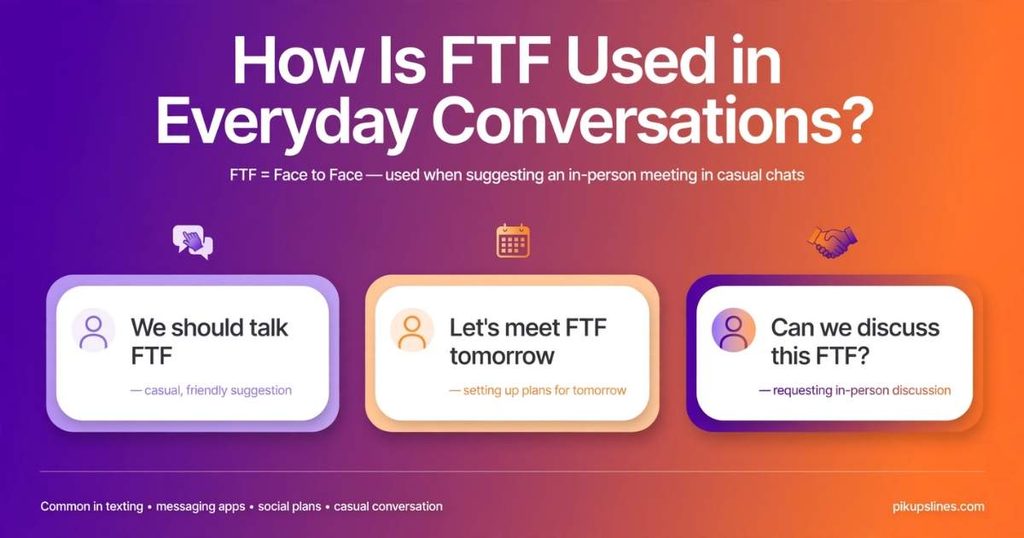
FTF isn’t limited to social media or casual texting. People use it in everyday situations whenever they want to emphasize direct communication.
Sometimes, the reason is simple. They want to make plans with friends. Other times, they need to discuss something complicated or important.
Using FTF to Make Plans
One common reason people use FTF is arranging an in-person meeting.
Instead of exchanging several messages, someone might suggest meeting at a convenient location. This makes planning activities easier when everyone needs to coordinate.
Examples include:
- “Let’s meet FTF this Saturday.”
- “Are you available for an FTF coffee?”
- “We should catch up FTF sometime.”
- “It’s been ages since we met FTF.”
These messages usually carry a friendly, casual tone.
Using FTF for Important Discussions
Some conversations need more attention than ordinary text messages can provide.
For example, imagine two classmates disagreeing about an important project. Messages become confusing because neither person fully understands the other’s explanation.
One might finally write:
“Let’s discuss everything FTF tomorrow.”
This suggests that a direct conversation could help both people explain their thoughts.
FTF discussions can also help with:
- Clearing up misunderstandings.
- Discussing important decisions.
- Resolving disagreements.
- Explaining complicated ideas.
- Having meaningful personal conversations.
However, meeting physically isn’t always necessary. Sometimes, a phone or video conversation provides enough clarity.
Using FTF in Friendships and Relationships
Friends sometimes use FTF when they want to spend time together without relying on online communication.
For example, someone might say, “We’ve talked online for months. Let’s finally meet FTF.”
In personal relationships, the abbreviation can also introduce more meaningful discussions. People may prefer meeting physically when discussing plans, expectations, or misunderstandings.
Still, FTF itself doesn’t reveal someone’s romantic intentions. The relationship and surrounding conversation provide that information.
Using FTF in Professional Communication
FTF also appears in workplace messages and business communication.
Employees might use it when distinguishing physical meetings from virtual meetings. Managers can also use the abbreviation when arranging interviews or professional discussions.
Examples include:
- “The client requested an FTF meeting.”
- “Our next project discussion will happen FTF.”
- “Can we arrange an FTF interview?”
- “The manager prefers FTF consultations.”
In professional settings, spelling out “face-to-face” often looks clearer. Nevertheless, colleagues who understand the abbreviation may use it casually in internal messages.
Why Do People Use FTF Instead of Writing Face to Face?
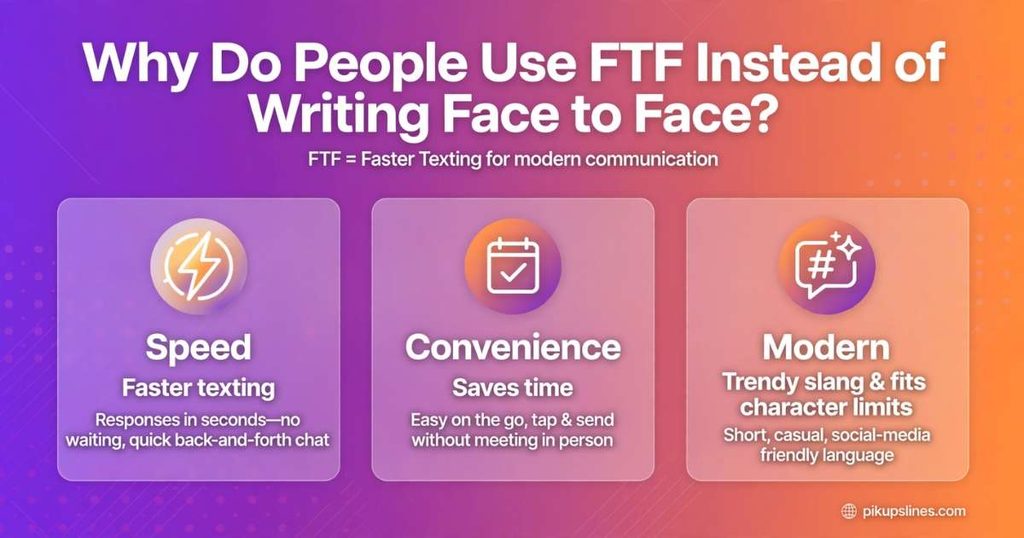
People use abbreviations because digital communication often rewards speed and simplicity. Typing three letters takes less effort than writing an entire expression.
However, convenience isn’t the only reason behind FTF’s popularity. The abbreviation also communicates a specific preference about how people want to interact.
Faster and Shorter Communication
Text messaging encourages brief, direct exchanges. People frequently shorten familiar expressions to make conversations quicker.
FTF works particularly well because its meaning is easy to understand in suitable contexts.
Compare these messages:
- “Let’s discuss everything face to face tomorrow.”
- “Let’s discuss everything FTF tomorrow.”
Both communicate the same basic idea. The second simply uses fewer characters.
Other texting abbreviations follow similar patterns. For example, people use BRB for “Be Right Back” and BTW for “By The Way.”
Avoiding Misunderstandings
Written messages don’t always communicate emotions clearly.
A short reply might sound rude even when the sender has no negative intentions. Similarly, complicated explanations can become confusing when people exchange messages without enough context.
An FTF conversation gives participants more opportunities to clarify their meaning.
They can ask questions immediately, explain their thoughts, and respond naturally.
Creating More Personal Communication
Face-to-face interaction provides information that ordinary text messages cannot fully convey.
During an in-person conversation, people can notice:
- Facial expressions.
- Eye contact.
- Tone of voice.
- Gestures and body language.
- Immediate emotional reactions.
These communication cues can make certain discussions feel more personal and understandable.
Of course, online communication remains useful. The best method depends on the situation and everyone’s preferences.
Is FTF Casual, Professional, or Romantic?
One common misunderstanding involves assuming FTF always carries a particular emotional meaning.
In reality, FTF is a neutral abbreviation. It describes a communication method rather than someone’s feelings or intentions.
The surrounding conversation determines whether the request sounds casual, professional, or personal.
Casual Meaning Among Friends
Friends frequently use FTF when arranging ordinary activities.
For example:
- “Let’s meet FTF after lunch.”
- “We need an FTF catch-up.”
- “It would be great to see everyone FTF.”
These messages suggest simple social interaction. There’s no hidden meaning behind the abbreviation.
FTF Meaning in Romantic Conversations
Romantic partners might use FTF when discussing personal matters or arranging time together.
For example:
“There’s something important I’d like to discuss FTF.”
This could involve relationship plans, expectations, or a misunderstanding.
However, the abbreviation doesn’t automatically mean someone wants a romantic date. It simply indicates a preference for an in-person conversation.
Always consider the actual message instead of making assumptions based on three letters.
FTF Meaning in Professional Conversations
Workplaces use FTF to distinguish in-person communication from remote collaboration.
Common examples include:
- FTF interviews.
- FTF appointments.
- FTF consultations.
- FTF training sessions.
- FTF networking events.
- FTF presentations.
- FTF business meetings.
For example, a recruiter might write, “We’d like to arrange an FTF interview next week.”
This means the candidate should attend an in-person interview rather than completing the entire process online.
FTF vs. IRL, DM, VC, and Other Texting Abbreviations
FTF belongs to a wider group of internet expressions that describe communication methods.
Although some abbreviations have similar meanings, they aren’t interchangeable. Understanding their differences helps you interpret messages correctly.
Another abbreviation you may encounter in digital conversations is DTM meaning in text, which is worth understanding alongside other common internet slang.
FTF vs. IRL
IRL stands for In Real Life.
Both expressions distinguish offline experiences from digital interactions. However, they emphasize slightly different things.
FTF specifically describes direct, in-person interaction. IRL refers more broadly to experiences outside online environments.
For example:
- “Let’s talk FTF tomorrow.”
The person wants an in-person conversation. - “I finally met my online friends IRL.”
The person is describing an offline experience.
Therefore, FTF focuses on meeting physically, while IRL covers a wider range of real-world activities.
FTF vs. DM
DM stands for Direct Message.
It refers to a private message exchanged through a social media platform or messaging service.
For example, Instagram users might say, “Send me a DM.”
A DM is digital communication. FTF refers to communicating in person.
FTF vs. VC
VC commonly stands for Voice Chat in online gaming and communication communities.
It describes speaking with someone through an audio connection.
For example, friends playing an online game might write, “Join our VC.”
Unlike FTF, voice chat doesn’t require participants to share the same physical location.
FTF vs. Video Call
A video call allows people to see and hear each other remotely.
It provides visual communication, including facial expressions and some body language. However, participants still interact through digital technology.
FTF requires physical presence in the same place.
FTF vs. In Person
“In Person” and “Face to Face” have almost identical meanings in everyday communication.
Both describe direct interaction between people who physically meet.
For example:
- “Let’s discuss the project in person.”
- “Let’s discuss the project FTF.”
Either expression communicates a preference for a physical meeting.
Quick Comparison of Related Terms
| Expression | Full Meaning | Communication Type |
|---|---|---|
| FTF | Face to Face | In-person interaction |
| IRL | In Real Life | Offline experience |
| DM | Direct Message | Private online messaging |
| VC | Voice Chat | Online audio conversation |
| Video Call | Video conversation | Remote visual communication |
| In Person | Physical interaction | Face-to-face meeting |
| Texting | Written messages | Digital communication |
| Online Only | Digital interaction | Internet-based activity |
Key takeaway: FTF specifically emphasizes personal presence. Other expressions describe different ways people communicate or experience the world.
How to Respond When Someone Says FTF
Knowing what FTF means is only half the picture. You should also understand how to respond naturally.
Your reply depends on the situation. Are you happy to meet? Do you need more information? Would you prefer another communication method?
Here are some practical responses.
Friendly and Casual Replies
If a friend suggests meeting FTF, keep your response simple.
Examples:
- “Sure, when are you free?”
- “Sounds good! Let’s meet.”
- “Absolutely, that works for me.”
- “I’d love to catch up.”
- “Let’s decide on a time.”
These replies show interest without making the conversation complicated.
Funny and Playful Replies
Sometimes, a little humor makes an ordinary conversation more enjoyable.
Try these lighthearted responses:
- “FTF? Time to leave the texting world!”
- “Wow, actual human interaction!”
- “Guess the phone needs a break.”
- “Finally, a conversation without typing!”
Use playful replies when the other person understands your humor.
Professional Replies
Workplace communication usually benefits from clear and polite responses.
Examples include:
- “An in-person meeting would work well.”
- “Please share your available meeting times.”
- “I’d be happy to discuss this face to face.”
- “Let’s schedule a convenient time.”
These responses communicate professionalism while confirming your willingness to meet.
When You Don’t Want to Meet in Person
You don’t have to accept every suggestion for an in-person meeting.
If you prefer digital communication, explain your preference respectfully.
For example:
- “Could we discuss this over a video call instead?”
- “I’m more comfortable talking through messages.”
- “A phone conversation would work better for me.”
- “Can we arrange an online meeting?”
Clear communication helps establish comfortable boundaries.
When Should You Avoid Using FTF?
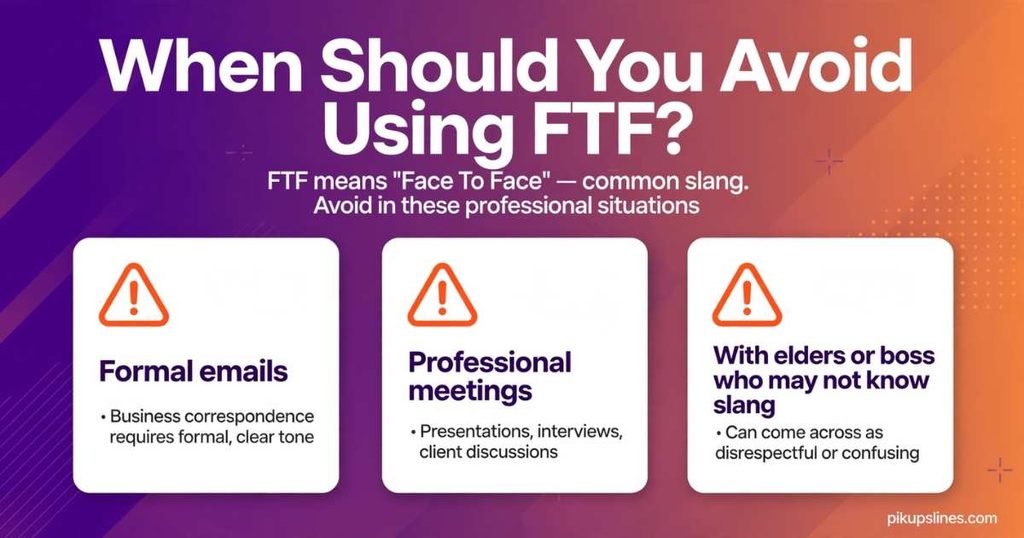
Although FTF works well in casual messages, it isn’t appropriate everywhere.
Some audiences may not recognize texting abbreviations. Others might expect complete words and formal language.
Knowing when to write the full expression makes communication clearer.
Formal Emails and Official Documents
Avoid unnecessary abbreviations in contracts, reports, legal documents, and official business correspondence.
For example, instead of writing:
“Please attend the FTF meeting on Monday.”
Consider:
“Please attend the face-to-face meeting on Monday.”
The complete expression looks more professional and reduces confusion.
Conversations With Unfamiliar People
Not everyone follows internet slang or texting trends.
If you’re messaging someone unfamiliar with common abbreviations, spell out the phrase first.
This small adjustment can prevent unnecessary misunderstandings.
International Communication
People communicate across different languages and cultures every day.
Although FTF appears in global internet conversations, you shouldn’t assume everyone recognizes it.
For international business communication, writing “in-person meeting” or “face-to-face discussion” often provides better clarity.
Sensitive or Important Discussions
When discussing emotional matters, clarity matters more than typing speed.
For example, someone might misunderstand a short message about an important relationship decision.
Instead of relying on abbreviations, explain your intentions directly. This helps both people understand the purpose of the conversation.
Common Misunderstandings About FTF
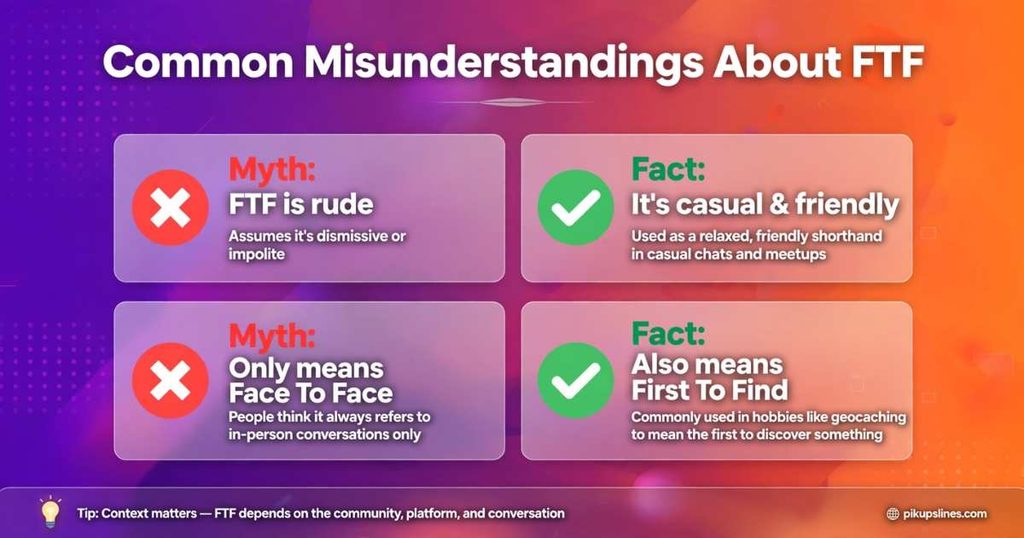
FTF looks simple, but people sometimes misunderstand its meaning. Most confusion comes from interpreting the abbreviation without considering its context.
Just like FTF, other texting abbreviations can have meanings that depend on context. Understanding the MBN meaning in text can help you interpret casual online conversations.
Let’s clear up some common mistakes.
Assuming FTF Always Means a Romantic Meeting
FTF doesn’t automatically indicate romantic interest.
Friends, relatives, classmates, colleagues, and business partners can all use it.
For example, “Let’s discuss the assignment FTF” clearly suggests an academic discussion.
The relationship between the speakers determines the personal context.
Thinking FTF Means a Video Call
A video call allows remote visual communication. FTF usually refers to meeting physically.
Although both methods allow people to see each other, they aren’t identical.
Assuming Every FTF Request Is Serious
An FTF suggestion doesn’t necessarily signal a difficult conversation.
Someone might simply want to meet for coffee or discuss weekend plans.
Always read the complete message before assuming something negative.
Ignoring Context and Alternative Meanings
FTF can have specialized meanings in certain professional, technical, or online communities.
For example, a gaming community might use an abbreviation differently from a workplace discussion.
Nevertheless, Face to Face remains the most common interpretation in ordinary texting contexts.
What Is the Difference Between FTF and Online Communication?
FTF and digital communication serve different purposes. Neither method works perfectly for every situation.
Understanding their strengths can help you choose the right communication style.
Benefits of Face-to-Face Communication
In-person conversations allow people to exchange information directly.
Participants can observe reactions, ask immediate questions, and respond naturally.
Some important advantages include:
- Clearer communication: People can explain their thoughts immediately.
- Body language: Gestures and facial expressions provide additional context.
- Personal connection: Physical presence can make certain conversations feel more meaningful.
- Immediate feedback: Participants can respond without waiting for another message.
- Relationship building: Personal interaction can help establish trust.
These benefits make FTF particularly useful for complicated discussions and certain professional situations.
Benefits of Digital Communication
Digital communication offers flexibility that physical meetings cannot always provide.
People can exchange information regardless of distance or location.
Its main advantages include:
- Convenience and accessibility.
- Faster communication across distances.
- Written records of important discussions.
- Flexible scheduling.
- Easy collaboration through messaging platforms.
For example, remote employees can coordinate projects through WhatsApp, email, and virtual meetings without traveling to an office.
When Is an FTF Conversation Better?
An in-person discussion can be helpful when participants need detailed explanations or direct interaction.
Common examples include:
| Situation | Suitable Communication Method |
|---|---|
| Quick update | Text message |
| Urgent clarification | Phone call |
| Routine project discussion | Online meeting or FTF |
| Personal disagreement | FTF or another mutually comfortable method |
| Job interview | FTF or video call |
| Casual social plans | Texting or FTF |
| Complex business negotiation | Often FTF |
The best choice depends on the topic, participants, accessibility, and personal preferences.
Is FTF Safe for Kids and Teenagers?
The abbreviation FTF itself is generally harmless. It simply means Face to Face in ordinary texting conversations.
However, context matters when someone discusses meeting a person they originally encountered online.
For children and teenagers, online-to-offline meetings require particular care. A friendly conversation through WhatsApp, Instagram, Snapchat, or TikTok doesn’t automatically establish someone’s identity or intentions.
Young people should understand a few important safety principles.
Understanding the Meaning Before Responding
If someone sends an unfamiliar message containing FTF, don’t feel pressured to respond immediately.
Instead:
- Read the surrounding conversation.
- Ask what the person means if necessary.
- Avoid making assumptions about their intentions.
- Discuss uncomfortable messages with someone trustworthy.
Staying Safe When Online Friends Suggest Meeting
Meeting someone from an online friendship requires careful planning and adult involvement.
Important precautions include:
- Never arrange secret meetings with online contacts.
- Involve a trusted parent or guardian.
- Don’t share your home address or private details.
- Never feel pressured to meet someone.
- Seek help if anyone makes you uncomfortable.
Remember: Understanding texting abbreviations is useful, but personal safety always comes first.
Frequently Asked Questions About FTF Meaning in Text
What does FTF mean in texting?
FTF most commonly means Face to Face. People use it when discussing an in-person meeting or direct conversation instead of communicating through messages or online platforms.
What does FTF stand for in a text message?
FTF stands for Face to Face. It’s a shortened expression that describes physical interaction between people who meet in the same location.
Does FTF mean meeting someone in person?
Yes. In everyday texting, FTF usually means meeting someone physically. For example, “Let’s discuss this FTF tomorrow” suggests having an in-person conversation.
What does FTF mean on Instagram?
On Instagram, FTF generally means Face to Face. Users might include it in direct messages when discussing meeting online friends or arranging personal conversations.
What does FTF mean on WhatsApp?
FTF means Face to Face on WhatsApp. People commonly use it when arranging physical meetings, discussing important matters, or suggesting direct conversations.
What does FTF mean on TikTok?
On TikTok, FTF usually refers to Face to Face. It can appear in comments or messages when users discuss meeting someone outside the platform.
Is FTF positive or negative?
FTF is generally neutral. It doesn’t automatically express positive or negative feelings. The surrounding message determines whether the suggestion sounds friendly, serious, or professional.
Is FTF a romantic abbreviation?
No. FTF doesn’t specifically mean dating or romantic interest. Friends, family members, classmates, and colleagues can all use it when suggesting an in-person conversation.
What is the difference between FTF and IRL?
FTF means Face to Face and specifically describes direct physical interaction. IRL means In Real Life and refers more broadly to experiences outside the digital world.
Can FTF be used professionally?
Yes. Employees sometimes use FTF when discussing interviews, appointments, consultations, and workplace meetings. However, writing “face-to-face” is generally better in formal business documents.
How do you respond when someone says FTF?
You can reply with “Sure, when are you free?” or “That sounds good.” If you prefer digital communication, politely suggest a phone call or video meeting instead.
Why do people prefer face-to-face conversations?
People may prefer FTF conversations because they allow direct communication, immediate feedback, and access to facial expressions and body language. These features can help clarify complicated discussions.
Does FTF have other meanings besides Face to Face?
Yes, specialized industries and communities may use FTF for other expressions. However, Face to Face remains its most common meaning in everyday texting and social media conversations.
Conclusion: Understanding What FTF Means in Text
Understanding what FTF means in text becomes easy once you recognize its most common definition. FTF stands for Face to Face and describes direct communication between people who meet physically.
You’ll commonly encounter this abbreviation on WhatsApp, Instagram, TikTok, Snapchat, and ordinary text messages. Friends might use it when arranging social gatherings. Colleagues may include it when discussing workplace meetings or professional appointments.
Although FTF sometimes appears in serious conversations, it doesn’t automatically suggest conflict or romantic interest. Context always matters.
The next time someone writes, “Let’s talk FTF,” you’ll know what they mean. They simply want to communicate face to face rather than continue through digital messages.